
Printable Memory Game Types for Seniors and Their Uses
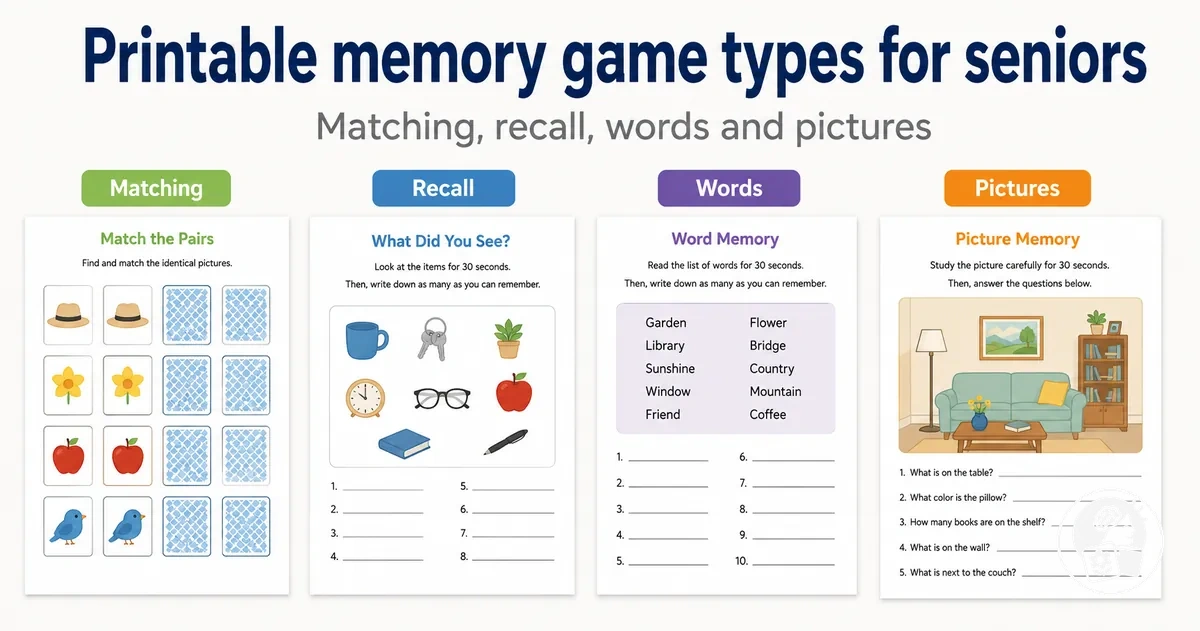
Printable memory games for seniors are best classified on two independent dimensions: retrieval demand—recognition or matching with more answer-related cues versus recall with fewer direct cues—and material type—verbal/word versus visual/picture material. Choose a starting format from the senior’s observed comfort and performance with cues and with words or pictures, then adjust difficulty separately through variables such as item count, similarity, cue strength, delay, and amount to remember.
Choose a starting memory-game format
Use two observations independently: how comfortable retrieval remains when cues are reduced, and whether familiar words or pictures are the more comfortable material. This selector identifies a starting format; it is not a diagnosis or a difficulty score.
Suggested starting format
Select both observations above.
The result will combine retrieval demand with material type and keep difficulty as a separate decision.
Keep comparisons like-for-like: when comparing recognition with recall, keep the material as similar as practical; when comparing words with pictures, keep retrieval demand and other challenge variables as similar as practical.
Matching, recall, word games, and picture games are overlapping classifications, not four mutually exclusive categories. Retrieval demand identifies how remembered information is accessed, while material type identifies whether the task uses verbal or visual material.
For example, a printable activity with 10 word pairs combines matching/recognition with verbal material, while an activity that shows 10 pictures and later asks the participant to name the remembered pictures combines recall with visual material. The quantities are illustrative; they classify the task structure rather than set a recommended level.
Identifying both dimensions makes the format explicit before selection: cue availability distinguishes recognition from recall, while stimulus type distinguishes verbal from visual material.
Table of Contents
Matching and Recall Formats Differ by Retrieval Demand
Matching formats present answer-related cues and ask for recognition among presented options, while recall formats require retrieval of remembered information with fewer cues.
Cue availability is therefore the main attribute that separates the two retrieval formats.
The difference describes how the answer is retrieved, not which subject matter the activity uses.
In matching tasks, presented options remain available so the response is recognition of a corresponding item or pair.
In recall tasks, direct answer cues are reduced or removed, so the response is retrieval of remembered information from a prompt or from memory.
Retrieval demand therefore changes with the amount of cue support, while the task format itself does not define a fixed difficulty level.
A matching activity can be made more demanding by changing the number or similarity of presented options, just as a recall activity can vary according to how many cues remain.
- Matching: visible cues and presented options remain available; the expected response is recognition. For example, an illustrative set of 8 cards can show 4 matching pairs at once, and the participant identifies which visible cards correspond.
- Recall: fewer cues remain; the expected response is retrieval of remembered information. For example, the same illustrative 4 pairs can be shown first and then removed before the participant is asked to name the 4 remembered items.

The 8-card and 4-item quantities are hypothetical and serve only to keep the subject matter constant while the retrieval format changes.
In matching, the participant selects from visible information; in recall, the participant produces remembered information with fewer cues.
Changing the number of items, cue strength, or item similarity can alter difficulty without changing the basic retrieval format, so retrieval format and difficulty remain separate variables.
Matching Games Use Recognition to Find Pairs
Printable matching games require the participant to use recognition to identify corresponding items among cards, pictures, words, symbols, or other printed items.
Matching pairs can be identical, such as two copies of the same picture, or meaningfully associated, such as a word and its corresponding picture.
The cues can remain visible during pairing or, when cards are concealed after being seen, require the participant to retain an item's identity or location.

For example, suppose a printable matching game contains an illustrative set of 8 cards forming 4 matching pairs: the participant sees the printed items, retains their identities or locations when required by the design, and uses the available or previously encountered cues to recognise each corresponding item.
With identical pairs, the recognised relationship is the same item on both cards; with meaningfully associated pairs, the relationship is an established connection between two different items, such as a printed word and its picture.
Matching therefore uses recognition to find pairs, but designs that conceal previously seen cards can also involve short-term retention and spatial memory because the participant must retain item identities or locations before recognising the corresponding items.
Recall Games Retrieve Information with Fewer Cues
Printable recall games require the participant to retrieve remembered information after direct answer cues have been reduced, while a prompt or partial cue can still remain.
The cue level can range from cued recall, where part of the previously presented information supports the response, to free recall, where item-specific retrieval cues are not supplied.
Cue level, delay, response form, and the amount of information to retrieve can therefore change retrieval demand without changing the activity from a recall format.

For example, suppose a printable recall game first presents an illustrative list of 6 words and then covers it: a partial-cue version could provide the first letter of each word as a prompt and ask the participant to write the 6 remembered words, whereas a free recall version could ask for the same 6 words without item-specific prompts.
In this example, the amount of information and response form remain fixed at 6 written responses while cue support changes, making cue level the variable that changes the retrieval task.
The quantities are illustrative rather than a recommended difficulty level, and printable recall games can contain different amounts of prompting between strongly cued retrieval and relatively free recall.
Word and Picture Formats Differ by the Material Remembered
Word formats and picture formats classify the stimulus type being remembered, whereas recognition and recall classify how that material is retrieved.
A word format presents verbal material, while a picture format presents visual material.
These dimensions intersect rather than compete: words or pictures can each be used in recognition-based matching or in recall tasks.

In a word format, the remembered stimulus is verbal material such as written words or prompts; in a picture format, the remembered stimulus is visual material such as pictures, images, or scenes.
Recognition asks the participant to identify previously presented material when relevant options or cues are presented, whereas recall requires remembered material to be produced with less direct access to the original stimulus.
Laboratory research has documented a picture-superiority effect under particular experimental conditions, but that finding does not establish a universal performance advantage for picture formats across printable memory games for seniors.
Familiarity, language, visual clarity, task design, and prior knowledge can differ between tasks and therefore prevent stimulus type alone from defining an easy-versus-hard ranking.
| Format | Material Remembered | Recognition Example | Recall Example |
|---|---|---|---|
| Word format | Verbal material: the written object name “apple” | Recognise “apple” among presented written options | Produce the remembered word “apple” after the written stimulus is removed |
| Picture format | Visual material: a picture of the same apple | Recognise the apple picture among presented images | Identify the remembered object after the previously presented apple picture is removed |
For example, suppose two otherwise parallel printable tasks use the same subject, an apple: one presents the written word “apple” and the other presents one image of an apple, so the changed attribute is stimulus type rather than subject matter.
Both tasks can then use the same retrieval category—recognition with presented alternatives or recall after the original stimulus is removed—showing that word/picture and recognition/recall are intersecting classification dimensions.
The comparison does not establish that either material type is inherently easier because familiarity, language, visual clarity, task design, and prior knowledge are not held constant across all real-world activities.
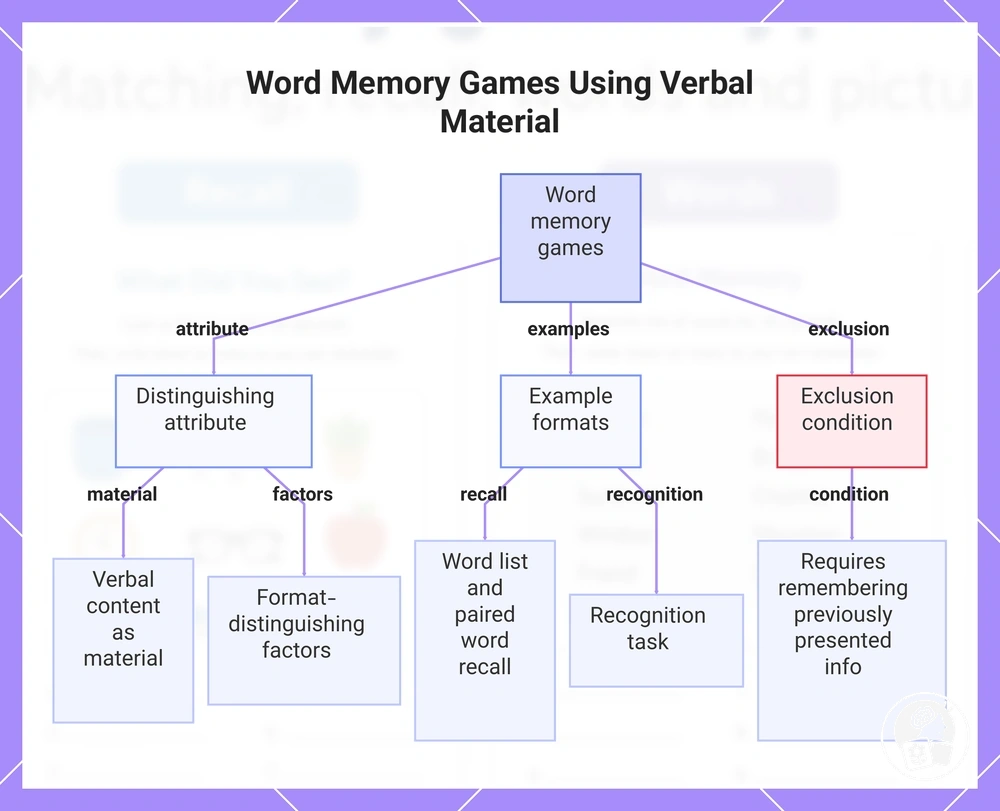
Word Games Use Verbal Material
Printable word memory games use written words or short printed prompts as verbal material that the participant must recognise, retain, or retrieve.
The distinguishing attribute is the verbal content itself, which can take the form of a word list, paired words, category words, or a brief written prompt.
Vocabulary familiarity, cue availability, list length, and response type distinguish individual word-memory formats while keeping written words as the material being remembered.
For example, an illustrative 6-word list can be studied and then covered so the participant uses recall to retrieve the words; an illustrative set of 4 paired words can present one partner as a prompt so the participant retrieves the corresponding word; and a word-based recognition task can present previously encountered words among alternatives for identification.
These quantities are illustrative task structures rather than recommended list lengths, and each example qualifies as a memory activity because recognition, retention, or retrieval of previously presented verbal material is required.
A crossword, word search, or similar word-based activity belongs in this category only when remembering previously presented information is part of the actual task, so the presence of written words alone does not make every word puzzle a memory game.
This chart defines word memory games that use verbal material, illustrates example formats, and clarifies when word puzzles qualify as memory games.
Picture Games Use Visual Material
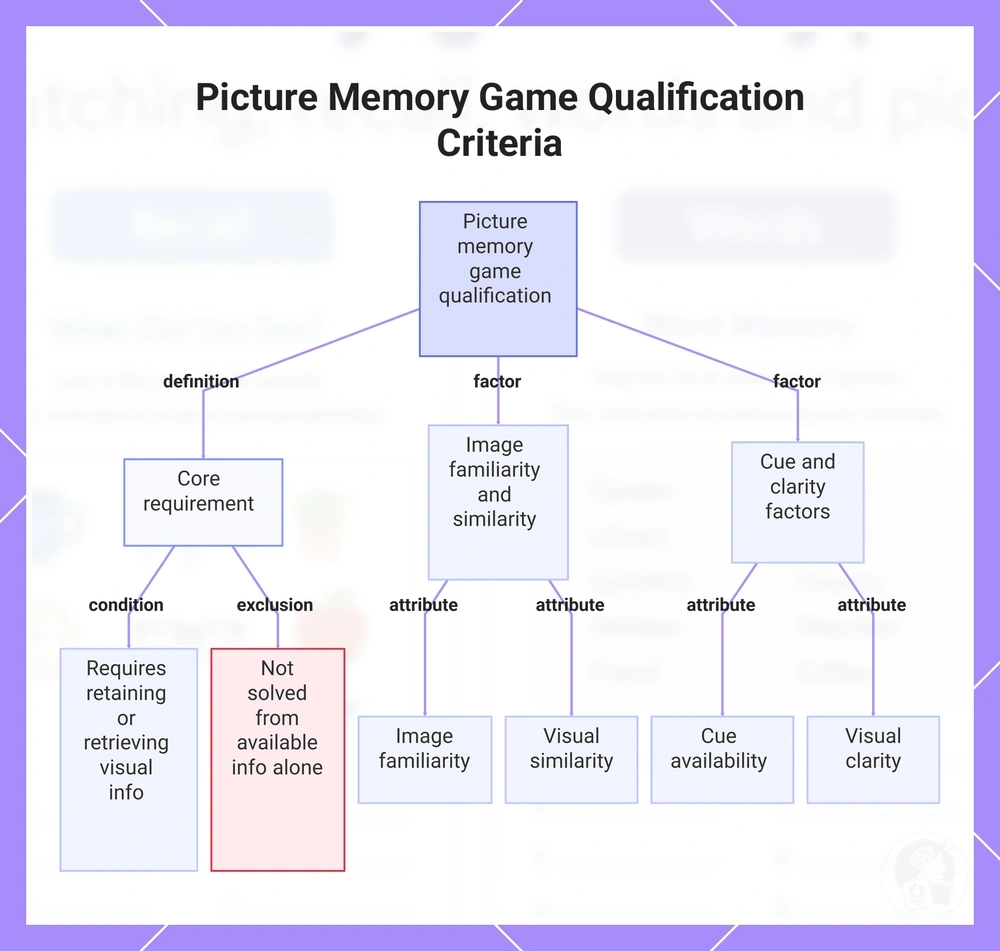
Printable picture memory games use printed images, illustrated objects, scenes, or picture cards as the visual material that a participant must remember through matching, recognition, or recall.
Image familiarity and visual similarity describe the relationship between the participant and the pictured content or between competing images, while cue availability determines whether the required memory response uses presented visual information or retrieval after that information is removed.
Visual clarity can affect whether the participant can perceive the material required for the intended memory task, but it does not make picture formats inherently easier.
For example, suppose an illustrative picture game presents 8 picture cards as 4 identical pairs: matching requires the participant to remember and recognise corresponding images; a second illustrative task can show 6 printed images and later require recognition of those 6 among other visible images; and a third can show one scene, cover it, and require recall of remembered details with the original visual cues unavailable.
These quantities are hypothetical task structures rather than recommended difficulty levels: changing image familiarity or visual similarity changes the visual content that must be distinguished, while changing cue availability changes whether the participant recognises presented material or recalls remembered material.
An image-based activity is a visual memory task only when completing it requires retaining or retrieving visual information; a visual puzzle that can be solved entirely from information that remains available does not qualify on its visual format alone.
This chart shows the core requirement and key factors that determine whether an image-based activity qualifies as a visual memory task.
Choosing a Game Type Around a Senior’s Recognition, Recall, Verbal, and Visual Abilities
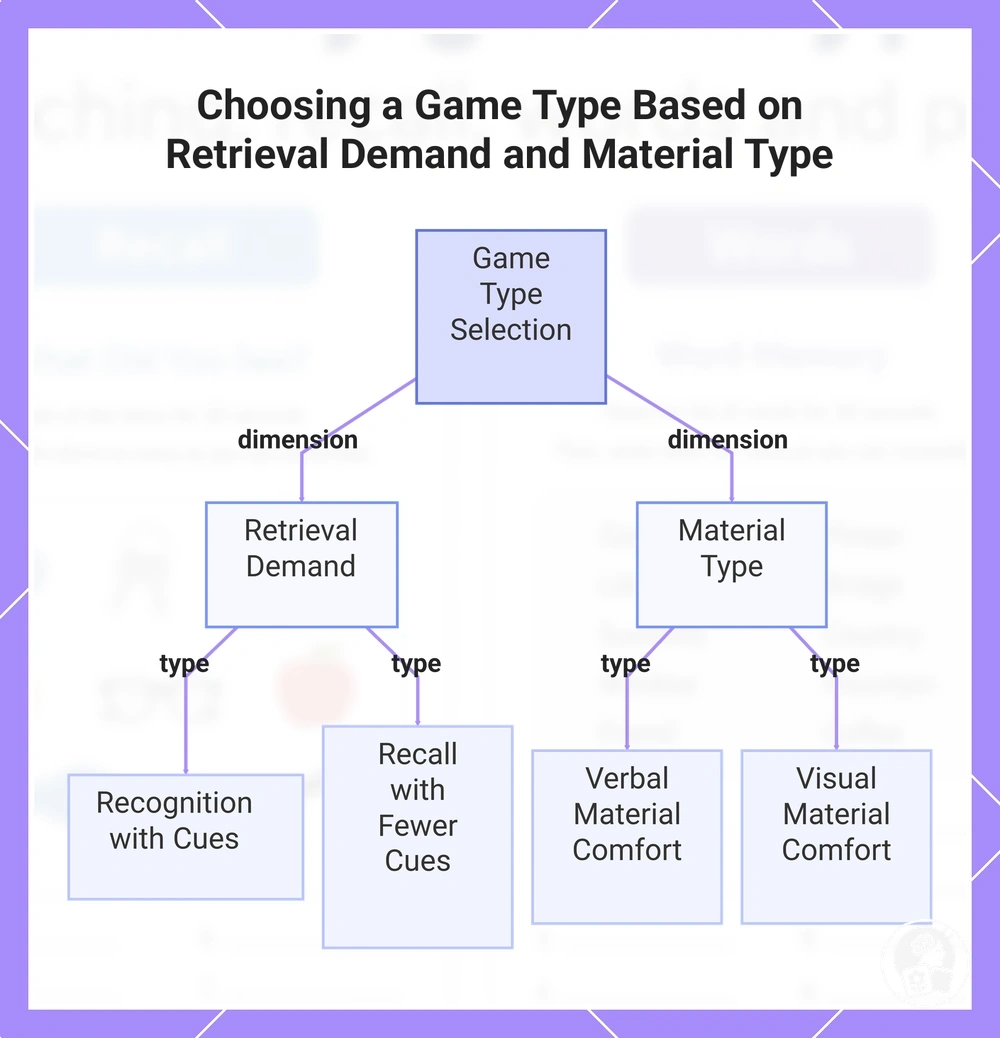
Game-type selection for a senior should match two separate dimensions—retrieval demand and material type—to observed performance, comfort, and preference rather than age alone.
Retrieval demand has two relevant starting categories here: recognition with presented cues and recall with fewer cues; material type has two: verbal material and visual material.
The starting format should therefore reflect the combination of task demand and material with which the senior currently responds comfortably, rather than treating one observation as a fixed judgment about ability.
Recognition is a reasonable starting format when the senior comfortably identifies previously presented information while relevant options or answer-related cues remain available.
Recall is a reasonable starting format when the senior comfortably retrieves previously presented information with fewer direct cues; when observed performance declines after those cues are reduced, retaining more cue-supported recognition is the more conservative starting choice for that activity.
These criteria describe the observed response to the retrieval demand, not a diagnostic threshold or an age-based classification.
- Recognition comfort: if presented cues support a comfortable and consistent recognition response, begin with a recognition or matching format.
- Recall with fewer cues: if retrieval remains comfortable after direct answer cues are reduced, begin with a recall format; if the observed response becomes less successful or uncomfortable, retain more cue support as the starting format.
- Verbal-material comfort or familiarity: if familiar words and written prompts produce the more comfortable response and align with the senior’s preference, begin with verbal material.
- Visual-material comfort or familiarity: if familiar pictures or picture cards produce the more comfortable response and align with the senior’s preference, begin with visual material; if both material types are comfortable, a mixed verbal-and-visual format is also reasonable.
Verbal material and visual material should be considered separately from retrieval demand because preference or familiarity with words versus pictures does not determine whether recognition or recall will be comfortable.
Image familiarity and word familiarity can support the corresponding material choice, while greater visual similarity between picture alternatives can make those alternatives harder to distinguish.
Mixed formats remain a reasonable starting format when observed performance, comfort, and preference support both words and pictures. When choosing between word and picture material, compare them under the same retrieval demand and similar challenge conditions where practical so material type is the main variable being tested.
For example, suppose a senior recognises 6 of 6 previously presented items when answer-related options remain visible but recalls 2 of the same 6 after those options are removed; these hypothetical values illustrate choosing recognition as the starting format without establishing a diagnostic or recommended numerical threshold.
In a second hypothetical scenario, the same senior recognises 5 of 6 familiar pictures but 3 of 6 corresponding written words under otherwise similar recognition conditions; that observed response illustrates starting with visual material while keeping the retrieval demand constant.
After these two dimensions establish the starting format, the next decision is introducing a selected memory game in practice.
This chart shows how to select a starting game format for a senior by evaluating two dimensions—retrieval demand (recognition vs recall) and material type (verbal vs visual)—based on observed comfort and performance, not age or diagnostic thresholds.
Game Type and Difficulty Are Separate Attributes
Game type and difficulty describe different attributes of a printable memory game.
Game type identifies the retrieval task or material type—recognition, recall, verbal material, or visual material—whereas difficulty describes the task demand within a particular format.
Changing a challenge variable therefore changes difficulty without, by itself, creating a different game type.
Game-type variables classify what the participant retrieves or what material the participant remembers, while difficulty variables include number of items, similarity between items, cue strength, delay, and amount to remember.
Recognition and recall are retrieval-task values, and verbal material and visual material are material-type values; by contrast, increasing the number of items or similarity, reducing cue strength, extending the delay, or increasing the amount to remember changes a condition of the challenge.
No universal item-count, delay, similarity, or cue-strength threshold separates “easy” from “hard” printable memory games for every senior. Set difficulty from repeated performance, comfort, prompting needs, and ability to complete the activity, and change one challenge variable at a time where practical so its effect is easier to interpret.
| Attribute | What Changes |
|---|---|
| Game type | The retrieval task changes between recognition and recall, or the material type changes between verbal material and visual material. |
| Difficulty | The challenge condition changes through number of items, similarity between items, cue strength, delay, or amount to remember while the game type remains the same. |
For example, suppose the same matching game contains 8 cards forming 4 pairs in an illustrative easier version and 16 cards forming 8 pairs in an illustrative harder version: the number of items doubles from 8 to 16 and the amount to remember increases, but the retrieval task remains matching; alternatively, the pictures can be made more similar while the matching format remains unchanged.
These values are hypothetical examples of attribute separation, not measured or recommended difficulty thresholds.
After the game type is identified, difficulty selection remains a separate next decision used to match the game to the right difficulty.