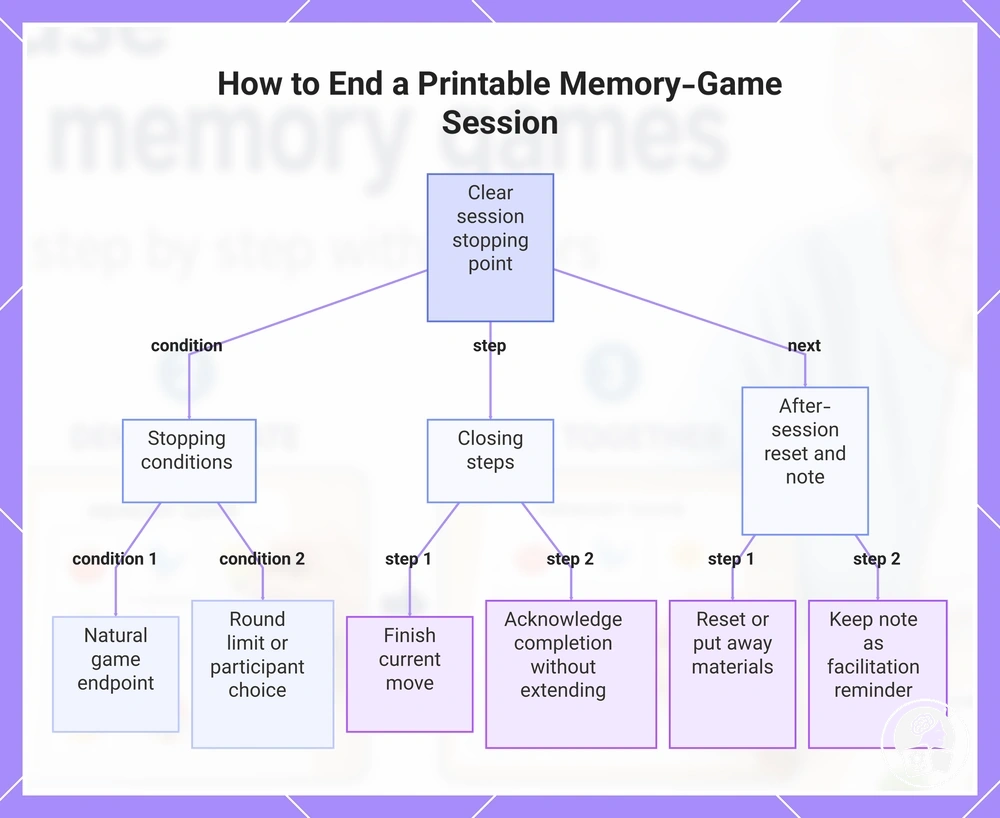
Using Printable Memory Games With Seniors
To use a printable memory game with a senior, prepare the materials and readable play area, explain the immediate goal and first rule, demonstrate one practice turn, then allow time for an independent response before offering the smallest useful prompt. Leave control of the task with the senior: wait while they are actively trying, clarify when they ask for help, cue only when a move is stalled, and end at a clear natural, agreed, or participant-chosen stopping point.
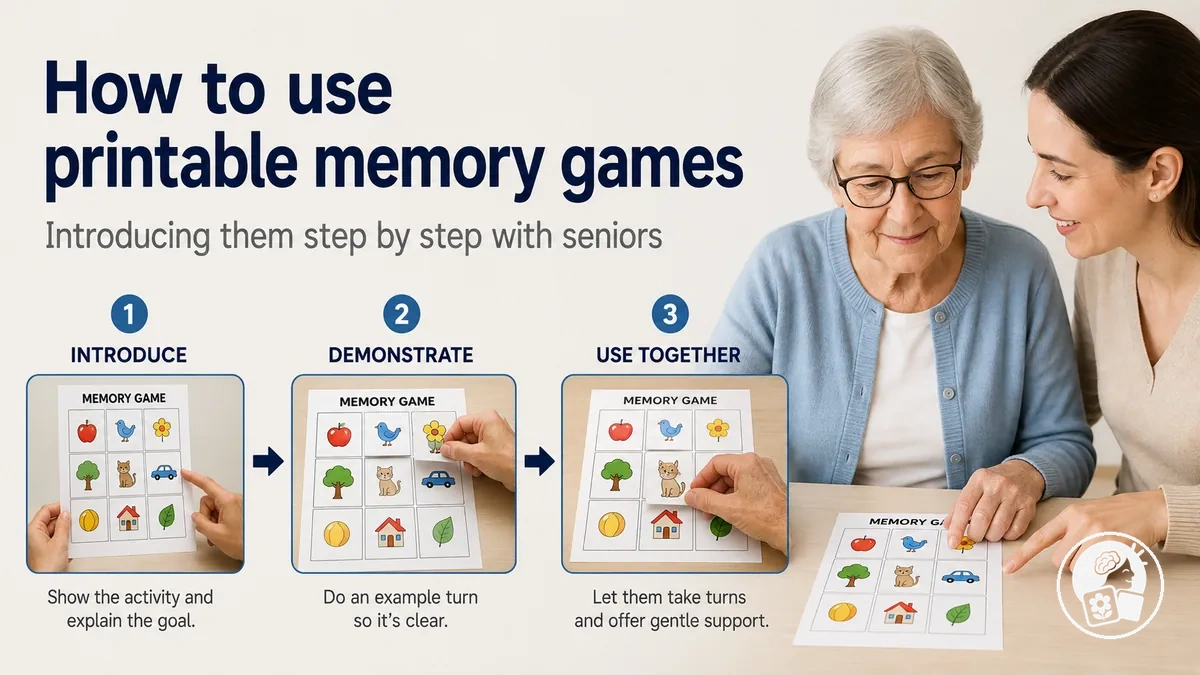
Printable memory game facilitation sequence
Use the same four-stage sequence from setup to stopping. The aim is to make the next action clear while preserving the senior's opportunity to complete the task independently.
- PrepareSet out the complete game, required materials, a usable surface, the starting position, readable print, and an agreed way to finish the session.
- Explain and demonstrateState the goal, essential rule, first action, and what happens next; then show one representative practice turn.
- Observe and supportLet an active attempt continue. Clarify a rule when help is requested and use a minimal cue only when the move is stalled.
- End clearlyStop at the game's natural endpoint, a pre-agreed number of rounds, or the participant's choice to stop; then acknowledge completion and reset the materials.
During play: continuing attempt → wait; request for help → clarify; stalled move → give one minimal cue; persistent confusion, repeated inability to continue, or distress → stop escalating prompts and reassess the difficulty or move to troubleshooting.
Adjust explanation, response time, and support to the selected game and the senior's observable behaviour. If readability, challenge level, or the group setting becomes the limiting factor, adjust that condition rather than taking over the move.
Table of Contents
Prepare the Printable Memory Game Before the Session
A printable memory game is ready for the session when the printed activity, required materials, usable play surface, starting position, rules, and time are prepared before the senior begins.
The facilitator should have each game-specific item ready and understand the basic rules well enough to present the first action without interrupting the start to find materials or resolve the procedure.
The printed activity and any required pen, cards, counters, or answer sheet should be complete and within reach, while the play surface should provide clear space for the materials in their starting position.
The facilitator should confirm the rules in advance and reserve enough uninterrupted time for the selected activity. Match the session length to the game, the senior's pace, and the chosen stopping condition rather than applying the same fixed number of minutes to every session.
Readability is ready when the senior can comfortably see and handle the printed page in the current setting.
If the page is difficult to see or handle, the setup requires a separate adjustment to improve print readability and usability before play rather than treating the limitation as proof that the activity itself is unsuitable.

- Printed activity: Check that every page, card, or answer sheet required by the selected printable memory game is printed, complete, and ready to use.
- Required materials: Have the pen, cards, counters, answer sheet, or other materials specified by the selected activity within reach; an accessory is not required when the selected game does not use it.
- Play surface: Confirm that the surface has clear usable space for the printed activity and its required materials without unrelated objects obstructing their use.
- Starting position: Place the pages, cards, counters, and writing materials in the positions required for the first action before the senior begins.
- Rules and facilitator readiness: Confirm that the facilitator understands the basic rules and knows what first action to present without needing to resolve the procedure during play.
- Time: Reserve enough uninterrupted time to reach the selected game's natural endpoint, the pre-agreed number of rounds, or a participant-chosen stop rather than applying one fixed duration to every session.
- Readability and handling: Confirm that the senior can comfortably see the printed content and handle the page or pieces in the current setting; if not, classify the setup as requiring a separate usability adjustment before play.
Preparation is complete when the facilitator can present the first action with the required materials already in place, without searching for supplies or working out basic rules mid-session.
Introduce the Game With Clear Rules and a Demonstration
Introduce the printable memory game by stating the immediate goal, giving only the essential rule needed to begin, and showing the first action before the senior starts independent play.
Use the order goal → rule → first action → demonstration so the spoken instruction is connected to an observable action and its immediate meaning.
The initial explanation should identify what the senior is trying to do, what starts the game, what counts as a completed move, what happens after that move, and any turn or stopping rule required for initial participation.
Essential rules come before exceptions: defer optional variations and rules that are not needed to make the first move.
This keeps the introduction focused on actions the senior can follow immediately rather than information that is only relevant later.

- State the goal: Explain in plain language what the senior is trying to accomplish in the printable memory game.
- Identify the first action: Point to the relevant part of the printable game and state exactly what action begins play.
- Explain the essential rule: State what the senior must do for that action to count as a correct or completed move.
- Show what happens next: Identify the immediate result of the completed move and the next action, turn, or stopping rule when one is required.
- Demonstrate one turn: Perform the first action once with the printable game so the senior can connect the spoken rule to the observable action.
Keep each essential rule tied to the action it controls: state the rule, show the corresponding move, and identify what happens immediately afterward.
Leave detailed practice and confirmation of understanding for the later steps rather than turning the introduction into an assessment.
Explain What to Do in Clear Steps
Each instruction for the printable memory game should name one game object and give that object one observable action in the order required by the selected rule.
The sequence should make the object, action, order, and any condition that changes the next action explicit.
If a condition changes the next step, place that condition beside the action it controls.
In a matching-card game, for example, the rule may require matched cards to remain together and unmatched cards to return face down; the selected game's actual rule determines which next action applies.
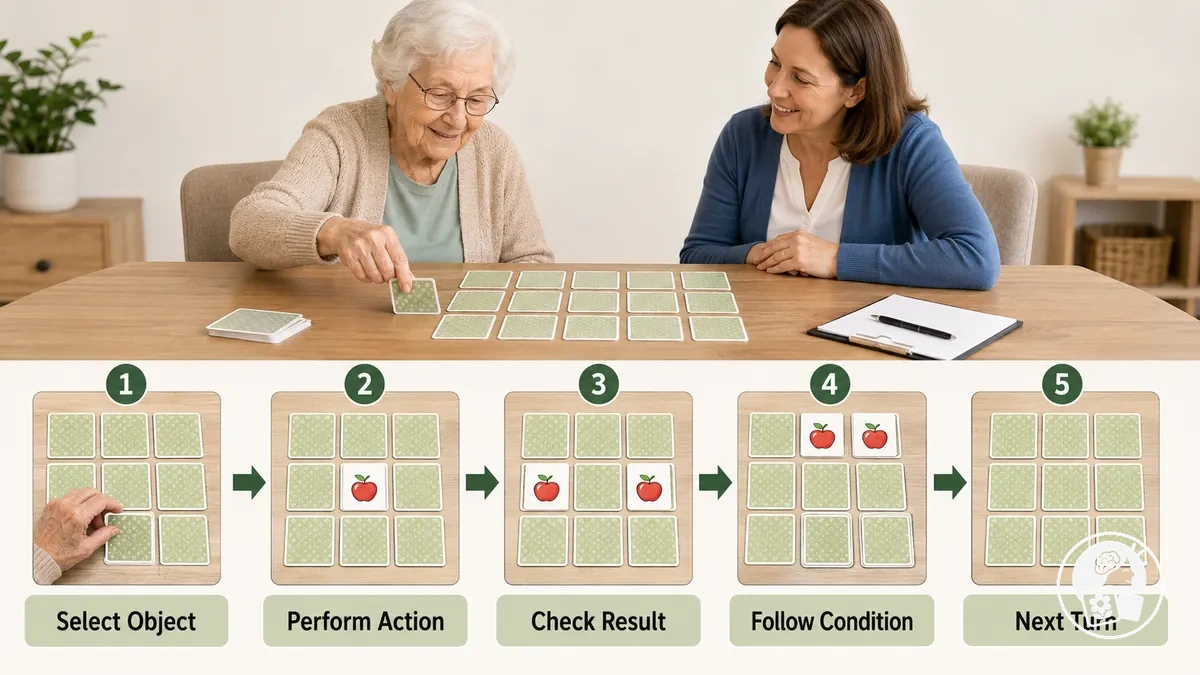
- Select the first object: Choose the card, worksheet element, or other game object identified by the selected game's first rule.
- Perform the required action: Turn the named card, mark the named worksheet element, or make the specific move required by that rule.
- Check the result: Compare the completed move with the condition that determines the next action.
- Follow the condition: Perform the next action specified for that result, such as keeping a matched pair together or returning an unmatched pair face down when those actions are part of the selected game's rules.
- Continue the sequence: Start the next move using the same ordered instructions until the selected game's stopping rule is reached.
Wording example: Instead of “Do it again if that doesn't work,” write “If the two cards do not match, turn both cards face down, then start the next turn.” The revised instruction names the cards, condition, action, and order without adding another rule.
The sequence is complete when the actionable game instructions identify enough ordered actions and applicable conditions to start and continue the selected printable memory game; the sequence does not need to explain optional variations before the core actions are understood.
Show How to Play With a Practice Turn
Use one practice turn to show the senior the printable game's starting state, the facilitator's action, the immediate result, and the next action before the senior begins an independent turn.
The exact move depends on the selected printable format, so this demonstration covers one representative matching-card example and only the mechanics needed for the senior's first move.
The senior should observe the complete sequence from the starting arrangement through the demonstrated result and handoff.
- Starting state: The matching cards are face down in the starting arrangement for this printable game.
- Action: The facilitator reveals two cards to demonstrate one move.
- Result: In this practice turn, the two revealed cards do not match, so the facilitator turns both cards face down again according to the example's stated rule.
- Next action: The facilitator hands control to the senior, who selects the cards for the first independent turn.

Check Understanding Before Starting
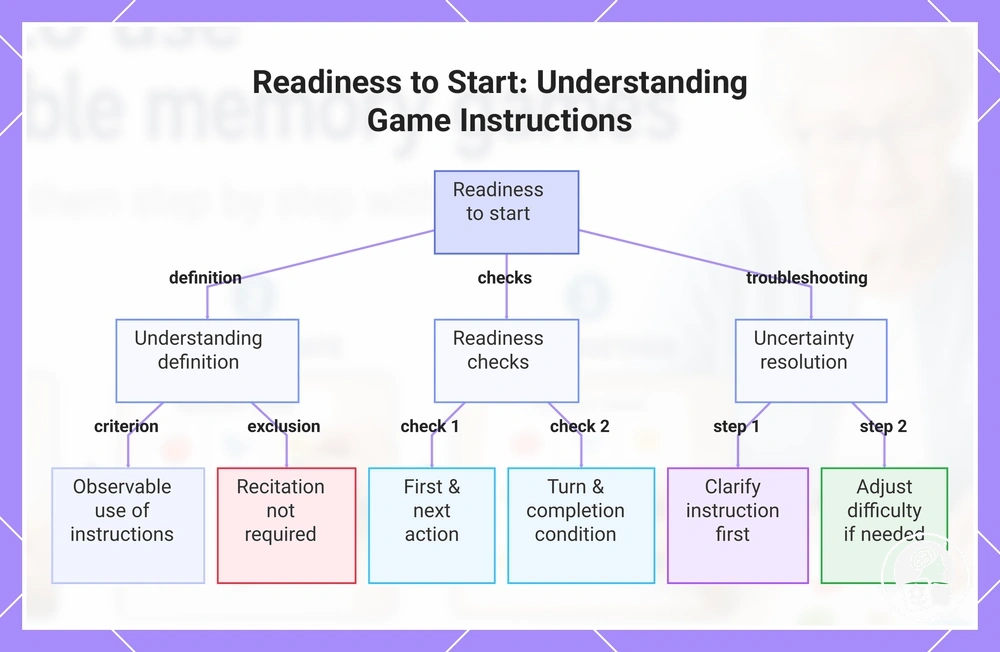
Understanding of the game instructions is enough to begin when the senior can act on the core rule, including identifying the first action and what follows it; reciting every instruction is not required.
Readiness is therefore shown through observable use of the instructions rather than a score or a set number of correct responses.
If the senior is uncertain about the first action, next action, turn condition, or completion condition, treat the uncertainty first as an instruction clarity issue: clarify the relevant rule or re-demonstrate the move, then check understanding again.
One uncertain or incorrect response does not establish the reason for the difficulty.
If instruction clarity has been rechecked and difficulty remains, treat challenge level as a separate factor: adjust the difficulty when needed, preferably by changing one demand at a time so you can see whether the senior can continue more independently.
- First action: The senior can identify or begin the first action required by the rule.
- Next action: The senior can show or describe what follows the move under the core rule.
- Turn condition: The senior can recognise when the current turn ends or the next turn begins when the game uses turns.
- Completion condition: The senior can recognise the basic condition that completes the relevant move or activity.
This chart shows how to assess a senior's understanding of game instructions by focusing on observable use, key readiness checks, and a troubleshooting process for uncertainty.
Guide Play With Manageable Pacing and Prompts
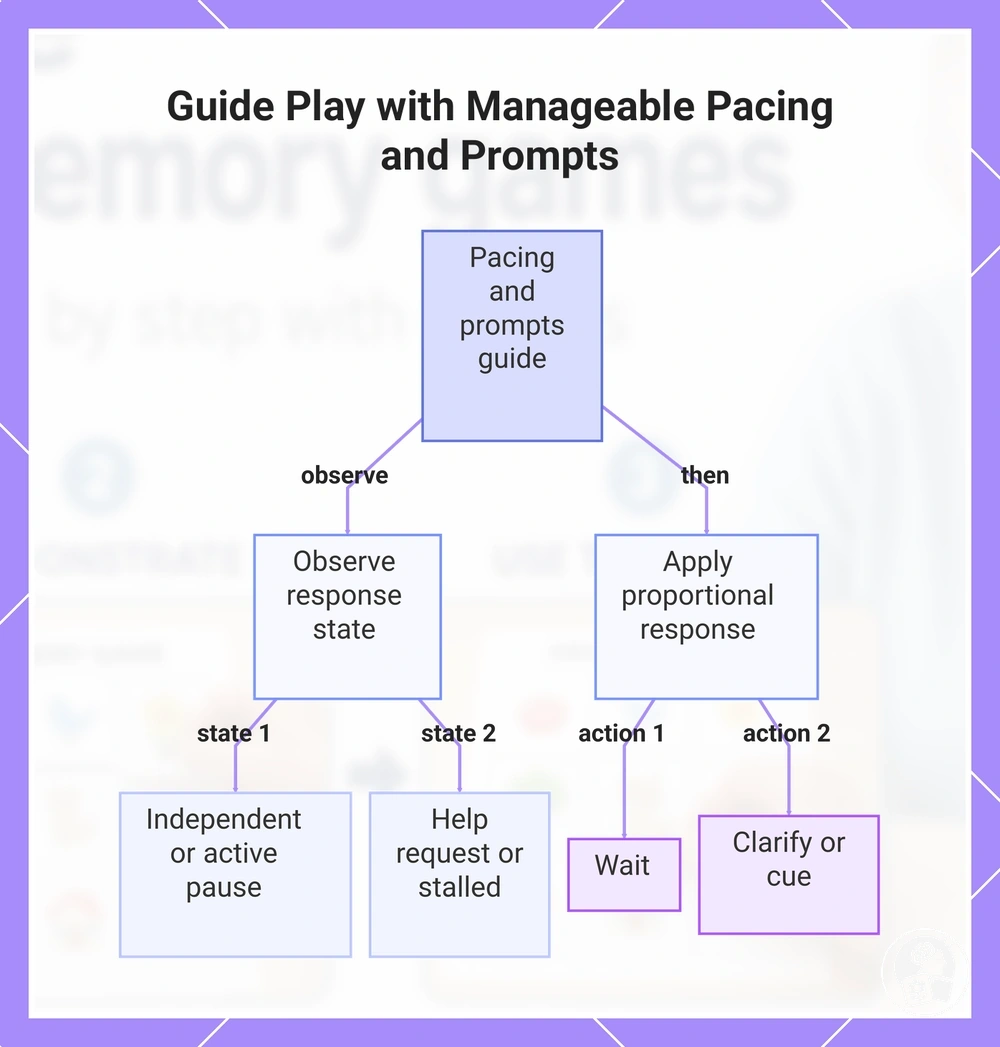
Live facilitation of a printable memory game should use observable behaviour to guide pacing, response time, and support rather than an automatic prompt schedule.
If the senior is continuing an independent response, allow the attempt to continue; when the observable state changes, provide only the level of support that matches the immediate need.
During play, distinguish an independent response, an active pause, a request for help, and a stalled move before choosing an action.
An independent response shows that the senior is progressing without support, while an active pause shows that the senior is still considering the move.
A request for help calls for clarification of the relevant rule, whereas a stalled move may justify a minimal cue.
Use observable behaviour rather than a fixed countdown to guide pacing: continue waiting while the senior is attending to or working through the move, and change the level of support when the observable state changes.
- Continuing attempt → wait: If the senior is still working through the move, allow more response time without inserting a prompt.
- Clarification request → restate the rule: If the senior asks what to do, clarify the rule or immediate action that applies to the current move.
- Stalled move → minimal cue: If observable progress has stopped, provide one cue aimed at the immediate action, then return control to the senior.
- Persistent confusion or frustration → adjacent context: If ordinary pacing, clarification, and a minimal cue do not resolve the difficulty, move beyond routine live facilitation rather than increasing prompts repeatedly.
The proportional response is therefore to wait, clarify, cue, or move to an adjacent context as the observable need changes.
When several seniors are participating together, pacing must also account for shared turns and participation, which belongs under adapt the activity for a group.
This keeps the present section focused on ordinary one-to-one live facilitation rather than group-specific management.
Supportive pacing allows a senior who is visibly considering the next move to continue, while rushing interrupts that pause and over-helping completes too much of the move instead of offering a minimal cue.
If confusion or frustration persists after ordinary pacing, clarification, and prompting adjustments, use the separate guidance to troubleshoot frustration and confusion rather than assigning a single cause.
This chart shows how to observe a senior's response state during a memory game and choose the proportional facilitation action.
Allow Time for a Response
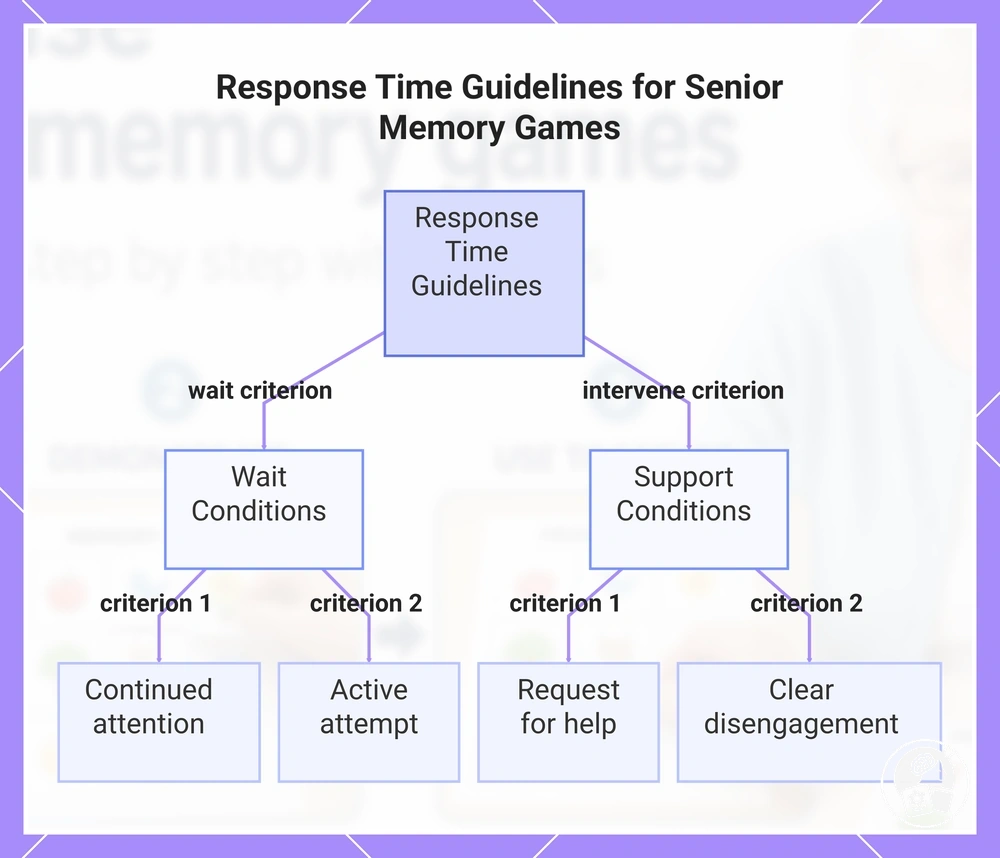
Response time during a printable memory game should depend on what the senior is doing rather than on a universal number of seconds.
Continued attention to the task or an evident attempt to work through the move shows continued effort, so the facilitator should continue to wait while those observable conditions remain present.
An active pause differs from a point where support may be useful because the senior is still attending to the task or attempting the next action.
A direct request for help or a clear shift away from the activity changes that condition and suggests support may be useful; elapsed time alone should not determine when to intervene.
- Continued attention → continue waiting: If the senior remains focused on the relevant cards, page, or game pieces, continue waiting while that attention is maintained.
- Active attempt → continue waiting: If the senior is examining choices, handling the relevant game pieces, or otherwise working through the move, allow the attempt to continue without taking over the next action.
- Request for help → consider support: If the senior directly asks what to do or requests assistance, consider intervening because the observable condition has changed from independent processing to a request for help.
- Clear disengagement → consider support: If the senior shifts away from the activity and is no longer attending to or attempting the move, consider support rather than using response time alone as the deciding criterion.
A slower response alone does not determine failure or disengagement; continue waiting while observable effort is present, and consider support when the senior's behaviour indicates that help may be useful.
This chart shows the observable behaviors that determine whether to continue waiting or to offer support during a printable memory game for seniors.
Give a Prompt Only When Needed
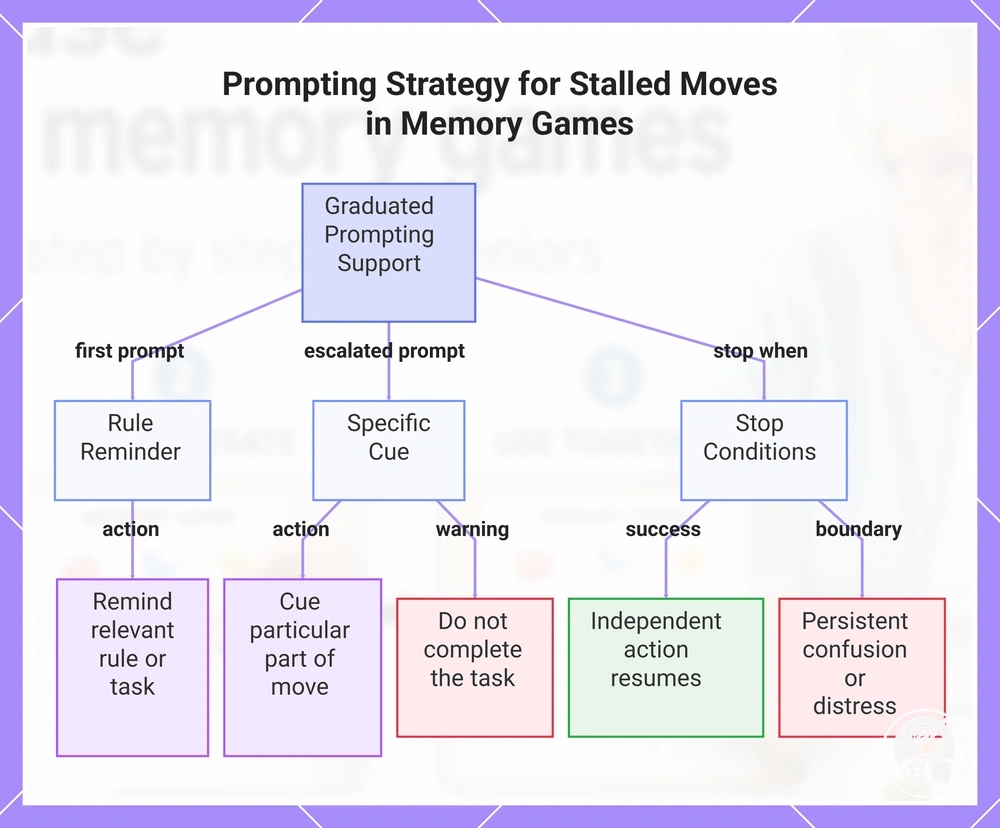
For a stalled move in a printable memory game, give the senior the smallest useful prompt first: begin with a neutral rule reminder, then use a more specific cue only if the senior still cannot continue the current move.
This graduated support moves from minimal help toward more explicit guidance only when the stalled move continues.
Stop escalating support as soon as the senior resumes independent action.
Once the senior can continue the move independently, further prompting is unnecessary; persistent confusion, repeated inability to continue, or distress marks the troubleshooting boundary rather than a reason to keep increasing support.
- Rule reminder: Remind the senior of the relevant rule or task; if independent action resumes, stop prompting.
- Specific cue: If the move remains stalled, cue the particular part of the current move that needs attention without completing the task; if the senior resumes independently, stop escalating support.
This chart outlines the graduated prompting approach: start with a rule reminder, escalate to a specific cue if needed, and stop when independent action resumes or when persistent confusion or distress appears.
End the Session With a Clear Stopping Point
End the printable memory-game session at a clear stopping point rather than prolonging play solely to obtain a better result or waiting for an error or loss of attention.
Use one of three stopping conditions: the selected game's natural endpoint, a pre-agreed session limit measured in rounds, or the participant's willingness to continue.
If the game has a natural endpoint, end when that game-defined completion condition is reached.
If a number of rounds was agreed before play, end at that round; if participation is based on willingness to continue, the participant's choice to stop becomes the stopping point.
Each criterion gives the final move a defined place and supports a calm, predictable ending without turning completion into a judgment of performance.
- Finish the final move: Complete the current action where appropriate, then end play at the selected natural endpoint, pre-agreed round, or participant-chosen stopping point.
- Acknowledge completion: Acknowledge neutrally that the activity or agreed portion is complete, without extending play solely to obtain a different result.
- Reset the materials: Return the cards, worksheets, counters, and other materials to their starting arrangement or put them away so the activity has a clear finish.
For the next session, note only an instruction or prompt that needed clarification so the next introduction can be clearer.
Keep this note as a facilitation reminder rather than a formal assessment of the participant.
This chart maps the supported stopping conditions and closing steps for ending a printable memory-game session.