Printable Memory Games for Seniors: Evidence and Realistic Expectations
Printable memory games can help older adults practise memory skills and improve performance on the game itself, with gains potentially reflecting familiarity, repeated exposure, or strategy use. Transfer to different memory tasks, everyday function, or long-term cognitive benefit requires separate evidence, and printable games have not been shown to prevent, diagnose, treat, or cure dementia. Judge benefit against a defined outcome such as recall accuracy, errors, or completion performance rather than assuming broad cognitive change.
Evidence interpretation at a glance
Match each claim to the outcome that was actually measured. A broader claim needs a broader, independently measured outcome.
Key boundary: results from structured or computerized cognitive-training studies can inform expectations only when intervention features and outcome measures are sufficiently comparable; their effect sizes should not be assigned directly to a printable game.
Evidence from formal cognitive training in older adults varies by study population, intervention type, outcome measured, and follow-up duration, so results from those interventions cannot be assigned directly to printable memory games.
A 2014 PLOS Medicine systematic review of computerized cognitive training found an overall Hedges' g of 0.22 (95% CI 0.15 to 0.29) across 52 randomized-trial datasets with 4,885 cognitively healthy older adults, indicating a small average effect on the cognitive outcomes studied.
Memory training is structured practice directed at memory performance, whereas transfer describes whether improvement extends beyond the trained task to another task or everyday function.
The same PLOS Medicine review illustrates why the measured outcome matters: computerized cognitive training produced Hedges' g values of 0.08 (95% CI 0.01 to 0.15) for verbal memory, 0.24 (95% CI 0.09 to 0.38) for nonverbal memory, and 0.22 (95% CI 0.09 to 0.35) for working memory in cognitively healthy older adults.
These results concern computerized cognitive training rather than printable memory games, so they support the principle of matching a benefit claim to the outcome actually measured rather than assuming that better performance on one memory task represents broader improvement.
Printable memory games differ from the formal cognitive training used in major trials in format, intensity, and evaluation, which limits direct conclusions about long-term or everyday effects.
In the ACTIVE randomized trial, 2,832 independently living adults aged 65 years or older received 10 sessions of memory, reasoning, or speed-of-processing training; at the 10-year follow-up, reasoning and speed-of-processing effects on their targeted abilities remained, whereas the memory-training effect on memory performance was no longer maintained, according to the Journal of the American Geriatrics Society report.
For printable memory games, “help” should therefore mean a measurable change in a specified outcome—such as correct recalls, accuracy, errors, or completion performance—under a defined practice and follow-up period; evidence for transfer to everyday memory or daily function requires a study that measures those outcomes separately.
Table of Contents
What It Means for a Memory Game to Help an Older Adult
For an older adult, a memory game “helps” when an observable change occurs in a specified outcome: performance on the practised task, transfer to a similar memory task, or transfer to everyday memory or daily function.
These are three progressively broader outcome categories, so evidence of improvement at one level supports a claim at that measured level rather than automatically establishing improvement at the broader levels.
A better score on the practised memory game therefore supports direct task improvement; a claim about a similar task or daily function requires a separate measure of that outcome.
Transfer refers to improvement extending beyond the trained task, with near transfer concerning closely related tasks and far transfer concerning more distantly related outcomes.
A review in Perspectives on Psychological Science distinguishes near from far transfer by the similarity between the trained and untrained domains, making the distance between training and the measured outcome part of the evidence boundary.
For printable memory games for seniors, this means that evidence becomes broader in scope as the claimed benefit moves from the practised task to a similar memory task and then to everyday memory or daily function.

“Memory” can also identify different measured outcomes rather than one interchangeable ability.
For example, a 2014 PLOS Medicine systematic review of computerized cognitive training in cognitively healthy older adults reported separate effect estimates of Hedges' g = 0.08 for verbal memory, 0.24 for nonverbal memory, and 0.22 for working memory, showing that the measured memory domain changes the result being described.
For a memory game, the benefit claim should therefore name the measured outcome and reserve claims about everyday memory or daily function for evidence that measures those real-world outcomes directly.
Improvement on the Practised Game
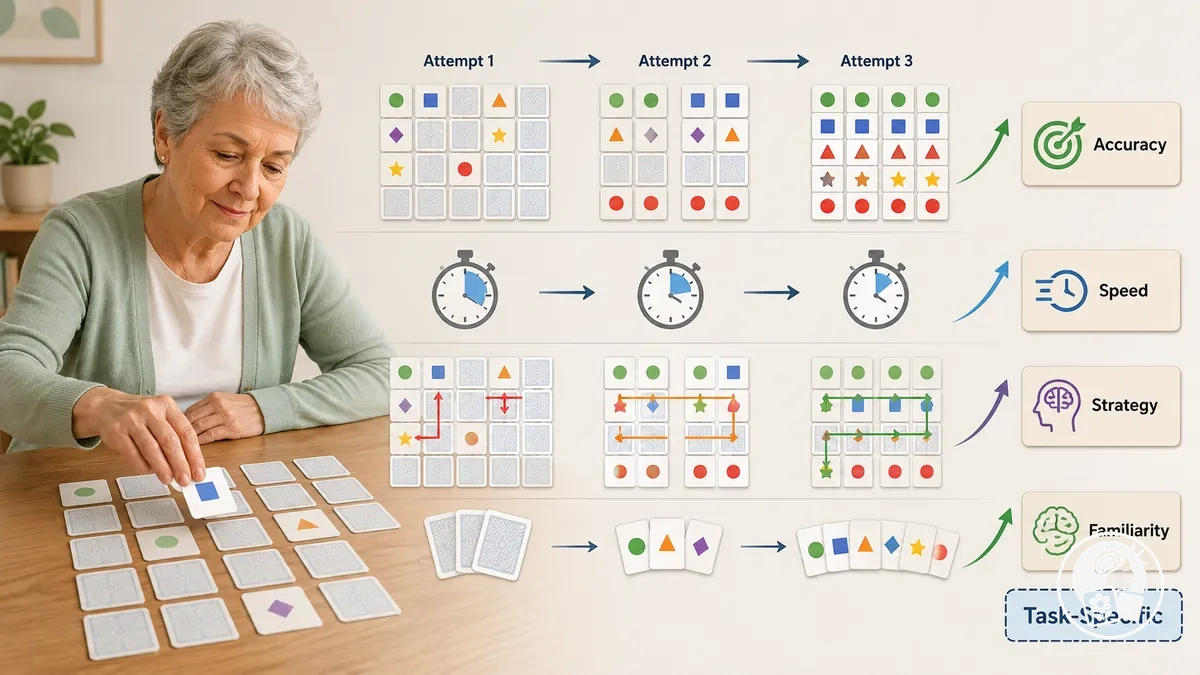
Performance on the practised game can improve within the activity itself: task performance can show greater accuracy, faster completion or response speed, and more consistent strategy use, while familiarity can increase through repeated exposure.
A 2012 meta-analysis of memory-training interventions in older adults reported retest effects of 0.37 standard deviations in placebo or active-control groups and 0.36 standard deviations in no-contact control groups, indicating that repeated assessment alone can contribute to measurable gains on memory-test performance.
These task-level changes may therefore reflect learned strategy, familiarity, repeated exposure, or overlapping effects rather than one identifiable mechanism.
For a concrete example, the ACTIVE trial trained older adults in mnemonic strategies including organisation, association, visualisation, and the method of loci; its memory assessments included three recall trials of a 12-word list and five recall trials of a 15-word list.
Under repeated recall, remembering more words can reflect strategy learning while repeated encounters with the procedure can also increase familiarity, so the observed measurement remains task-specific.
A better score on the practised activity is evidence about that task first, not automatically about broader memory.
Transfer to Similar Memory Tasks
Transfer to similar memory tasks, or near transfer, is improvement in older adults on a different task that shares relevant cognitive demand with the trained task rather than repeating that task exactly.
A 2019 second-order meta-analysis in Collabra: Psychology classified near transfer as transfer between similar domains and reported an uncorrected working-memory near-transfer effect for older adults of Hedges' g = 0.29 (95% CI 0.21 to 0.38; 35 effect sizes); when comparisons were restricted to active-control groups, the estimate was g = 0.23 across 19 effect sizes.
These values concern working-memory training rather than printable memory games specifically, so they show that near transfer can be measured on separate related tasks without establishing that a particular printable game will produce the same effect.
Exact repetition measures performance on the trained task, whereas a near-transfer test uses a similar task with a changed stimulus format or task format while preserving relevant cognitive demand and an outcome measure capable of detecting performance on that new task.
For example, a trained serial-recall task and a different serial-recall task can support a near-transfer comparison when both require maintaining and recalling ordered information; superficial visual resemblance without shared memory demands does not satisfy that criterion.
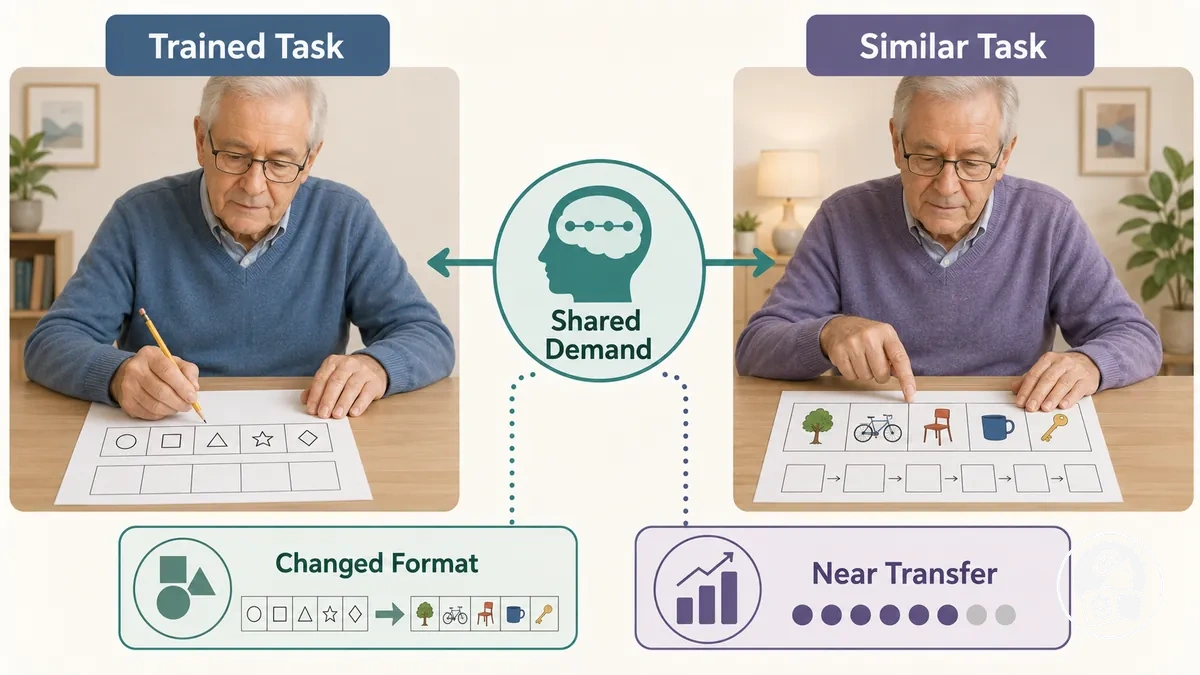
Better performance on the separate similar task supports a near-transfer claim at that outcome-measure level; it does not by itself establish a change in everyday function.
The evidentiary boundary therefore remains task similarity → measured performance on a different related task → possible near transfer, with broader functional change requiring a different outcome measure.
Transfer to Everyday Memory and Daily Function
Transfer to everyday memory and daily function, or far transfer, means that improvement is detected in a broader real-world outcome outside the practised activity rather than only in game or laboratory performance.
Everyday memory can include remembering an appointment or an item's location, while daily function concerns performance in everyday activities.
A 2014 systematic review and meta-analysis of cognitive training in healthy older adults found that effects on everyday functioning were under-investigated, so improvement on a cognitive measure does not by itself establish far transfer to a functional outcome.
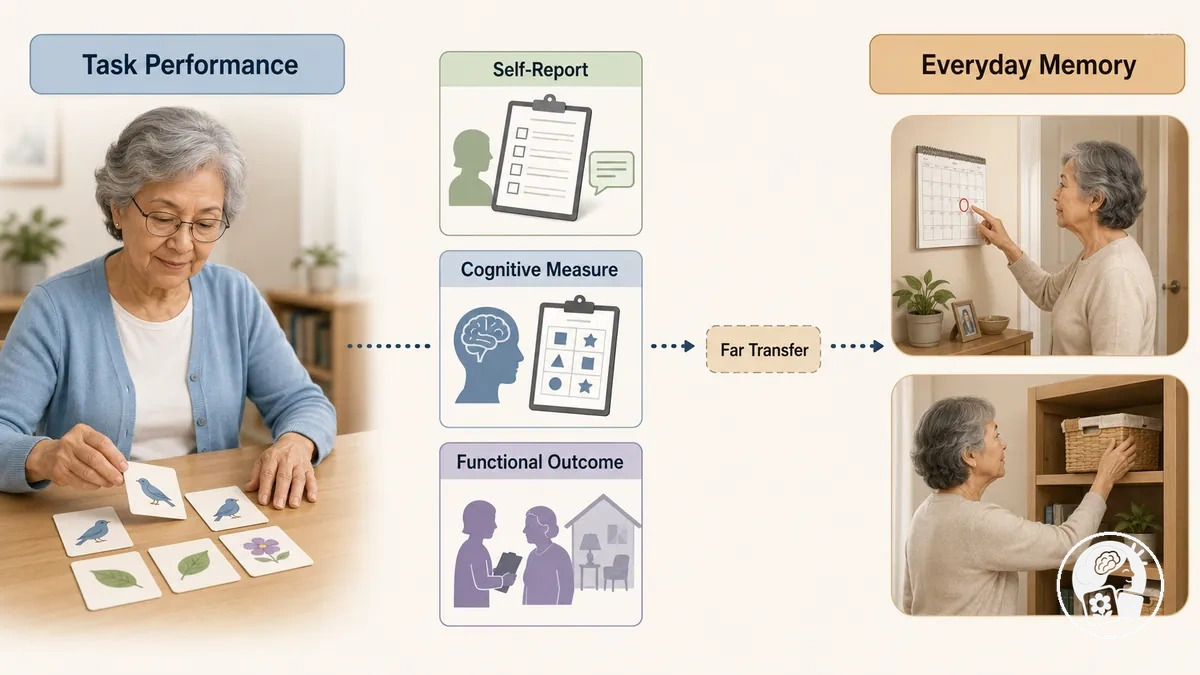
Self-reported change, standardized cognitive performance, and observable everyday function support different levels of inference.
In the 10-year ACTIVE randomized trial report involving 2,832 initially enrolled older adults, memory-trained participants reported less difficulty with instrumental activities of daily living than controls, with an effect size of 0.48 and a 99% confidence interval of 0.12 to 0.84; however, the investigators reported no training effect on performance-based measures of everyday function, and the memory-training effect on the targeted cognitive measure was no longer maintained.
For printable memory games, this distinction means that self-report may indicate perceived change, a standardized cognitive measure reflects performance on the ability it assesses, and an observed functional outcome provides evidence about the measured daily activity; broader claims about everyday memory or daily function therefore require evidence from those real-world outcomes rather than a higher game score alone.
What the Evidence Shows About Memory Training in Older Adults
Evidence on memory training and cognitive training in older adults is outcome-dependent rather than uniformly positive or negative.
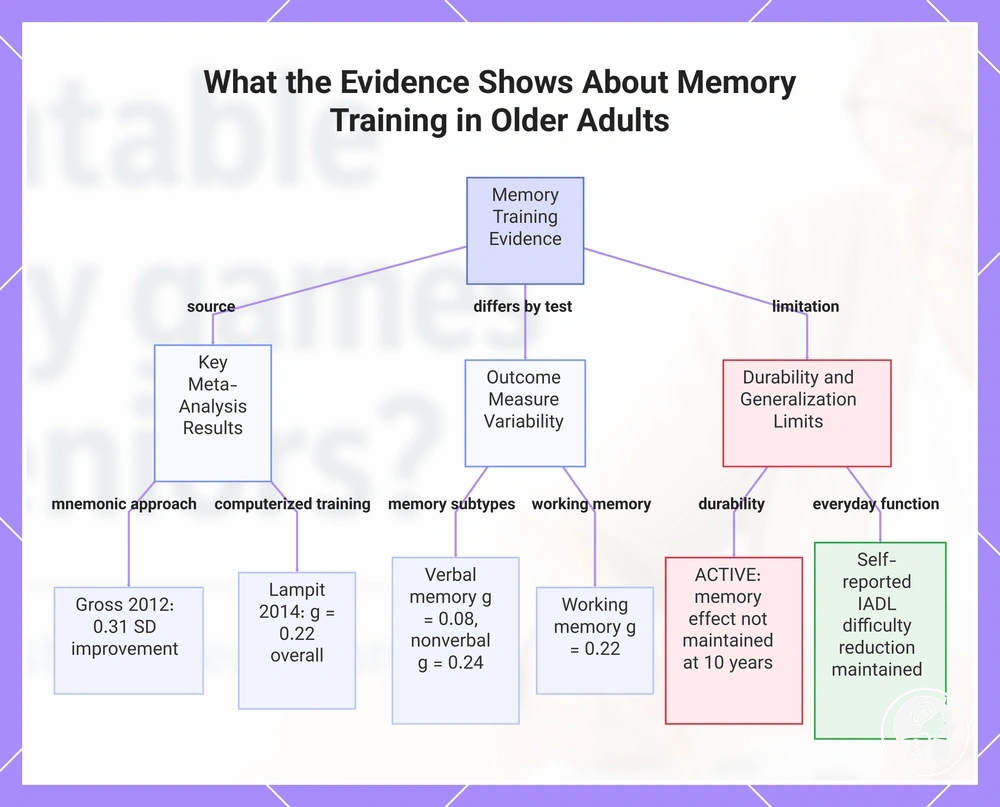
Gross and colleagues' 2012 meta-analysis of 35 studies in cognitively intact, community-dwelling older adults found that memory-trained groups improved by 0.31 standard deviations more than control groups on memory performance from pre- to post-training (95% CI 0.22 to 0.39).
Lampit, Hallock, and Valenzuela's 2014 PLOS Medicine systematic review of 52 randomized-trial datasets involving 4,885 cognitively healthy older adults found an overall effect of computerized cognitive training on untrained cognitive-test performance of Hedges' g = 0.22 (95% CI 0.15 to 0.29) after exclusion of one outlying study.
These findings support measurable improvement under specific study conditions, not a single expected effect for every intervention or for printable memory games.
Intervention type, population, study design, and memory outcome materially change the interpretation.
The Gross meta-analysis examined memory training using mnemonic approaches and found a pre-post effect of 0.43 standard deviations in memory-trained groups (95% CI 0.29 to 0.57) versus a practice effect of 0.06 standard deviations in control groups (95% CI -0.05 to 0.16).
The 2014 PLOS Medicine review instead examined at least 4 hours of computerized cognitive training and reported Hedges' g = 0.08 (95% CI 0.01 to 0.15) for verbal memory, 0.24 (95% CI 0.09 to 0.38) for nonverbal memory, and 0.22 (95% CI 0.09 to 0.35) for working memory.
Because these syntheses used different intervention types and outcome measures, their effect estimates should remain separate rather than being combined into one memory-training value.
The evidence also changes as measurement moves from trained performance and a memory outcome toward broader cognition, everyday function, and durability at follow-up.
In the ACTIVE randomized trial of 2,832 independently living older adults, participants received 10 sessions of memory, reasoning, or speed-of-processing training; Rebok and colleagues' 10-year report found maintained effects on the targeted abilities for reasoning, effect size 0.23 (99% CI 0.09 to 0.38), and speed of processing, effect size 0.66 (99% CI 0.43 to 0.88), while the memory-training effect on memory performance was no longer maintained.
The same report found less self-reported difficulty with instrumental activities of daily living for the memory-training group than controls, effect size 0.48 (99% CI 0.12 to 0.84), showing that a cognitive measure, an everyday-function measure, and durability can yield different findings within one study.
The main limitation is generalization: evidence from one population, cognitive training format, measured outcome, control condition, or follow-up period does not establish the same result under another set of conditions.
Higher-level evidence supports improvement in particular trained or cognitive outcomes, while evidence for broader everyday function and long-term durability depends more strongly on the outcome and study design.
Claims about memory training in older adults should therefore match the intervention studied, the outcome actually measured, and the follow-up period over which that outcome was assessed.
This chart summarizes key findings from major meta-analyses and the ACTIVE trial, showing that memory training effects depend on intervention type, outcome measure, and follow-up durability.
How Brain-Training Evidence Applies to Printable Memory Games
Evidence from computerized brain training, serious games, and structured cognitive training is relevant to printable memory games by analogy only when the intervention design and outcome measurement are sufficiently comparable; the formats should not be treated as equivalent.
The comparison basis is whether the interventions share the cognitive demand being trained and sufficiently similar adaptivity, feedback, task variety, supervision, training dose, and outcome measurement.
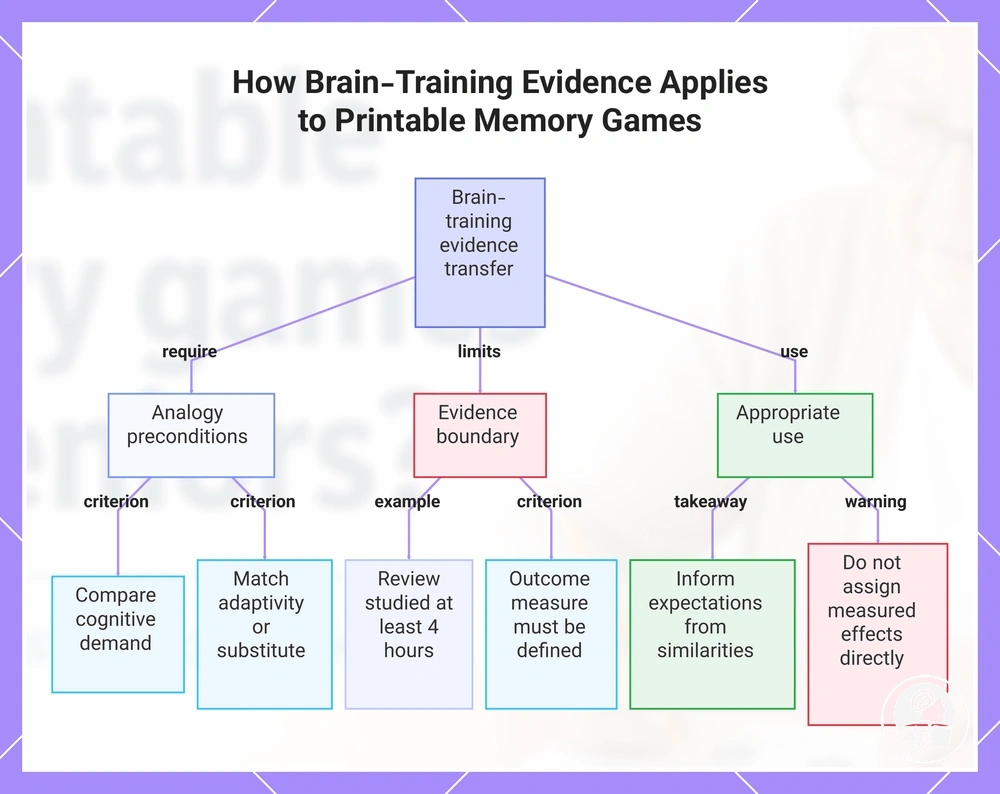
Lampit, Hallock, and Valenzuela's 2014 PLOS Medicine systematic review illustrates this evidence boundary: its 52 randomized-trial datasets included 4,885 cognitively healthy older adults receiving computerized cognitive training for at least 4 hours, so its findings describe interventions meeting those study conditions rather than printable memory games.
Greater similarity on the intervention features and measured outcome supports a more cautious analogy; a material difference limits the inference that can be transferred to a printable format.
Computerized or structured cognitive training differs from a printable memory game when software adjusts difficulty in response to performance, provides immediate feedback, or delivers a defined sequence of tasks, whereas a fixed printable activity has no automated adaptivity or feedback unless those functions are supplied by a facilitator or an explicit procedure.
Task variety is comparable only when the paper-based intervention and studied intervention exercise sufficiently similar cognitive demands, and supervision is comparable only when their delivery conditions align.
Training dose also requires a matched duration and frequency rather than the label “brain training”: for example, the 2014 PLOS Medicine review required at least 4 hours of computerized cognitive training and analysed session length, session frequency, and total training hours as intervention characteristics.
Outcome measurement is comparable only when both interventions are evaluated against a defined cognitive or functional outcome rather than assuming that completing a printable memory game represents the same endpoint measured in a computerized cognitive training study.
Brain-training evidence is therefore most relevant to printable memory games when the trained cognitive demand, adaptivity or its procedural substitute, feedback, task variety, supervision, training dose, population, and outcome measurement are closely aligned with the studied intervention.
Fixed difficulty, absent feedback, an unspecified training dose, different supervision, or a different outcome measure reduces comparability and limits the inference; the appropriate use of computerized brain-training evidence is to inform expectations according to documented similarities and differences, not to assign its measured effects directly to printable memory games.
This chart shows the preconditions for transferring brain-training evidence to printable memory games, the evidence boundary, and the correct way to use that evidence.
Why Memory-Training Results Vary Across Older Adults and Studies
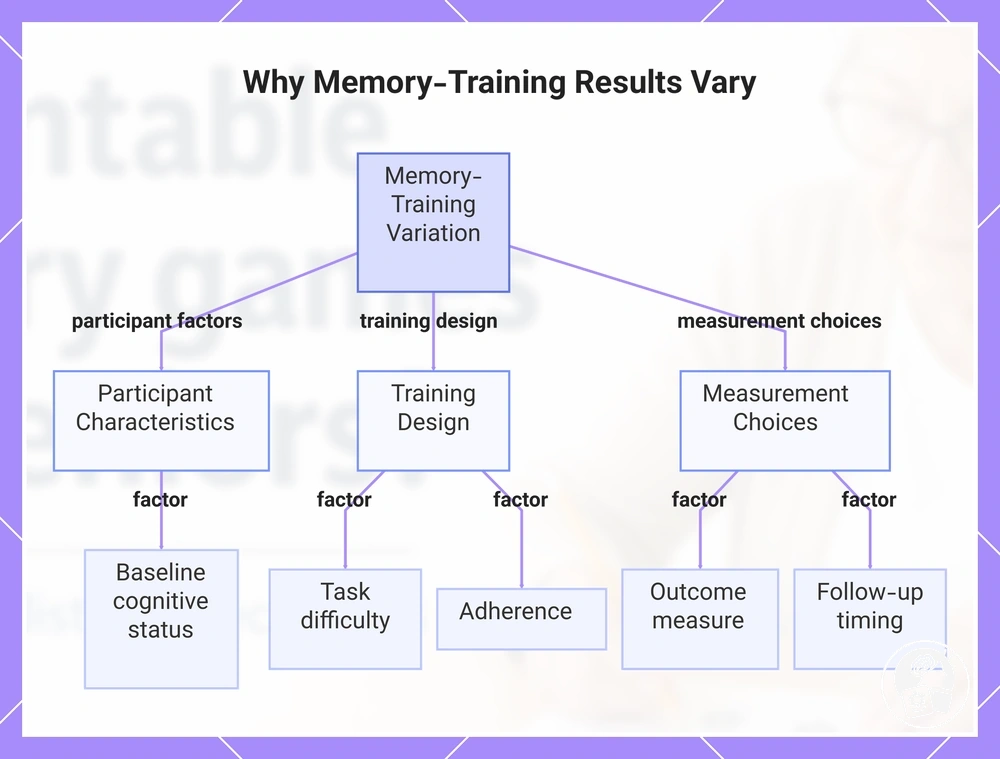
Variation in memory-training results across older adults and studies can arise from three condition classes: participant characteristics, training design, and measurement choices.
Baseline cognitive status is a participant-related moderator; task difficulty, training type, duration, frequency, and adherence are intervention-related conditions; outcome measure and follow-up are study-design conditions.
No single participant, training, or measurement factor should be treated as the universal cause of memory-training outcomes; observed results can change with the combination of baseline cognitive status, task difficulty, training design, adherence, outcome measure, and follow-up.
Baseline cognitive status may influence the starting level and the amount or type of change that an outcome measure can detect, while task difficulty can contribute to different performance when the cognitive demands placed on participants differ.
Training type and dose also require condition-specific interpretation: Lampit, Hallock, and Valenzuela's 2014 PLOS Medicine meta-analysis included 52 randomized-trial datasets with 4,885 cognitively healthy older adults receiving at least 4 hours of computerized cognitive training, and its analyses examined training frequency, session duration, total training hours, delivery format, and cognitive content as potential moderators.
No single training frequency or duration from these computerized interventions can be treated as the optimal schedule for every older adult or transferred directly to printable memory games.
Adherence changes the amount of prescribed practice actually completed. For printable games, track completed sessions or practice time against the planned schedule rather than treating one adherence percentage as a universal threshold for benefit.
Outcome measure and follow-up can produce apparently conflicting findings because studies may measure different abilities at different times: an immediate post-training result and a long-term result are not the same outcome condition.
In the ACTIVE randomized trial, 2,832 independently living older adults entered memory, reasoning, speed-of-processing, or control conditions; Rebok and colleagues' 10-year report found that the memory-training effect on the targeted memory measure was no longer maintained at the 10-year follow-up, while other trained abilities and self-reported functional outcomes followed different patterns.
Task difficulty remains one possible contributor rather than a universal explanation, so the practical need to choose an appropriate challenge level should remain distinct from a claim that difficulty alone determines memory-training results.
Differences in participant conditions, intervention design, outcome measure, and follow-up can therefore yield different observed results without requiring a single universal cause.
This chart shows the three condition classes—participant characteristics, training design, and measurement choices—that can contribute to variation in memory-training outcomes.
Limits of Memory Games for Seniors
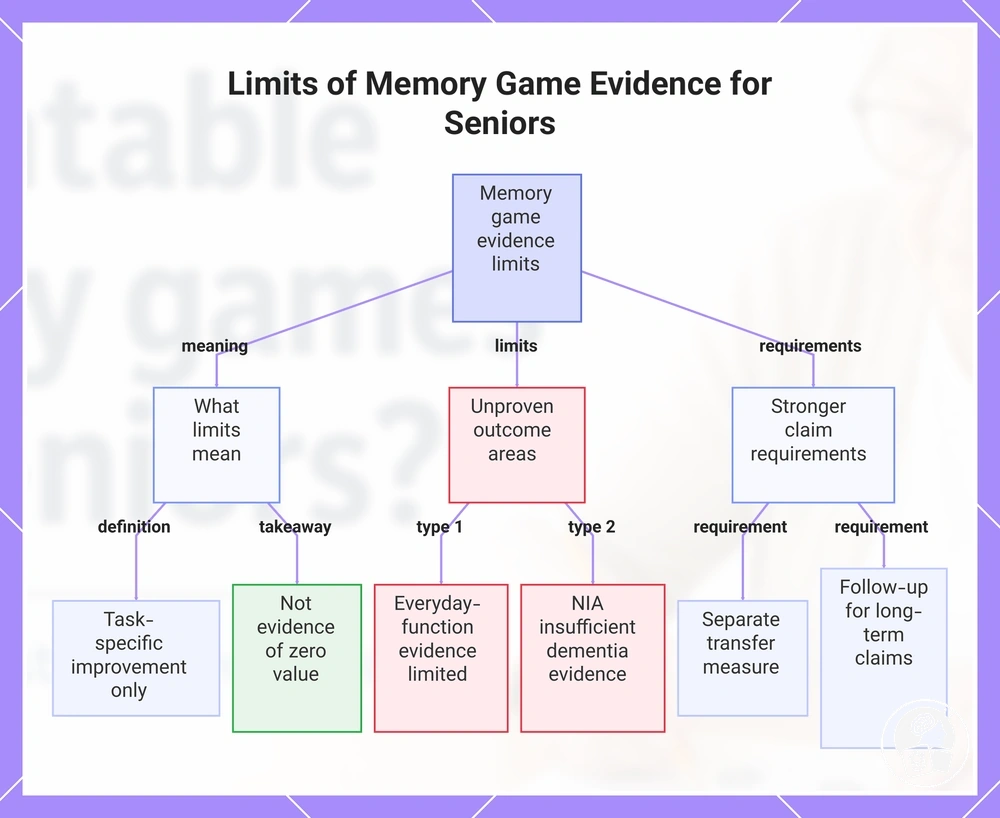
The limits of memory games for seniors are an evidence boundary on the strength and breadth of a claim, not evidence that the activity has zero value.
Task-specific improvement supports an inference about the measured task, but it does not by itself establish transfer to broader cognition, everyday function, long-term benefit, or a clinical outcome.
A 2014 systematic review and meta-analysis by Kelly and colleagues found evidence of improvement in selected cognitive outcomes after cognitive training in healthy older adults while identifying everyday functioning as an outcome for which the evidence base was limited.
The appropriate claim scope therefore remains the outcome that was actually measured.
The principal evidence boundaries concern four distinct questions: whether improvement extends beyond the trained task, whether it persists at follow-up, whether it transfers to everyday function, and whether it changes a clinical outcome such as dementia incidence.
These boundaries matter because evidence for one outcome is insufficient to infer another outcome without directly matched measurement.
For dementia prevention specifically, the U.S. National Institute on Aging states that there is not enough evidence to conclude that any particular activity, including cognitive training, prevents or delays Alzheimer's disease or related dementias.
Stronger memory-game claims therefore require stronger and more directly matched evidence: broader scope requires a separate transfer measure, long-term benefit requires follow-up measurement, everyday benefit requires an everyday-function outcome, and a clinical claim requires a measured clinical outcome.
These are distinct evidentiary tests, so uncertainty at a broader level limits the permissible inference rather than establishing that task-specific improvement has no value.
This chart maps the evidence boundaries around memory game claims for seniors, including what current research supports and what stronger claims require.
Practice Effects Are Not the Same as Broad Cognitive Improvement
A practice effect is improved trained performance after repeated exposure, and a gain on a repeated memory game or test does not by itself demonstrate broad cognitive improvement.
Almkvist and colleagues' 2022 study in Frontiers in Aging Neuroscience describes practice effects as improved cognitive-test performance associated with repeated assessment.
The observed gain may reflect task familiarity, a learned strategy, or other learning specific to the trained task, so moving from “better on the repeated task” to “better on an independent broader measure” would require independent transfer evidence.
For example, Duff and colleagues assessed older adults with amnestic mild cognitive impairment twice with the same cognitive battery at a 1-week interval to quantify practice effects from repeated testing.
A score increase under that repeated-exposure condition can support evidence of a practice-related gain in trained performance, but a claim about broader cognition or a functional outcome would require independent evidence from a separate measure of that broader outcome.
Short-Term Gains Do Not Establish Long-Term Benefits
A short-term gain in memory-training performance does not establish long-term benefit because persistence must be measured at an appropriately timed follow-up.
In the ACTIVE randomized trial, Ball and colleagues reported that immediately after training, 26% of memory-trained participants showed reliable improvement in the targeted memory ability, compared with 14% of the no-contact control group.
That post-training measure supports an immediate improvement claim, while a retained benefit requires evidence from reassessment over the period covered by the durability claim.
Measurement timing changes the strength of that inference: Willis and colleagues reported a memory-training effect on the targeted cognitive ability at the 5-year follow-up of 0.23 standard deviations (99% CI 0.11 to 0.35), whereas Rebok and colleagues reported that the memory-training effect on memory performance was no longer maintained at the 10-year follow-up.
These study-specific findings do not define a universal cutoff for durability, and absence of long-term evidence for another memory-training intervention is not evidence that its gain disappears; a longer-term claim must be supported by an appropriately timed follow-up measure covering the period claimed.
Memory Games Have Not Been Shown to Prevent or Cure Dementia
Current evidence does not establish memory games as a method of dementia prevention, cure, treatment, or diagnosis.
Alzheimer's Society reports that evidence is insufficient to show that commercial brain-training games prevent dementia, even though cognitive activity or cognitive training can improve performance on particular cognitive tasks.
This evidence boundary separates recreational or cognitive-training outcomes from a clinical outcome: better memory-game performance does not establish prevention, cure, or treatment of dementia.
Memory games are not a diagnostic test; the NHS states that dementia diagnosis cannot be made with a single test and instead involves assessment of symptoms and abilities alongside appropriate examinations and tests.
Claims of dementia prevention, treatment, cure, or diagnosis therefore require clinical evidence that directly measures the claimed outcome, rather than evidence limited to cognitive activity or game performance.
The U.S. National Institute on Aging states that no intervention has been proved to prevent Alzheimer's disease or other dementias and that researchers use clinical trials to determine whether interventions can prevent or treat disease; accordingly, memory-game evidence should support only the outcome actually measured, not an unmeasured clinical risk-reduction or treatment effect.
For expectations from memory games, the permissible conclusion is that task or cognitive improvement and a dementia clinical outcome are separate evidence claims.
Setting Realistic Expectations for Printable Memory Games
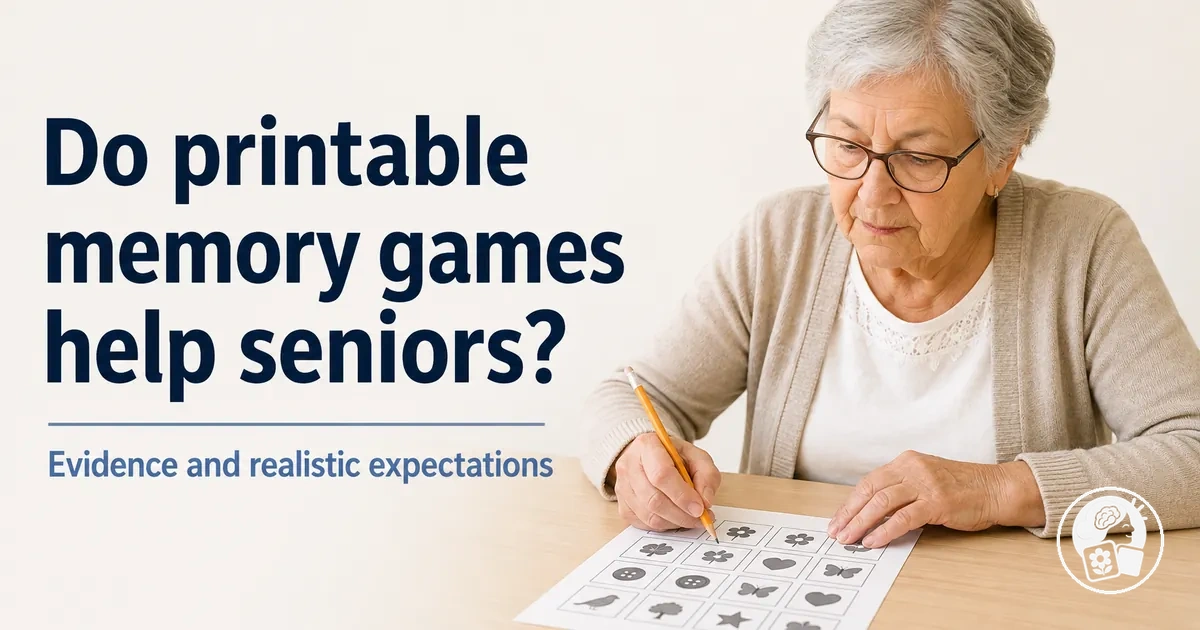
Realistic expectations for printable memory games should match the targeted outcome and the evidence strength supporting that outcome.
Improvement on the trained task is reasonable to expect when repeated performance on that task is the measured outcome; evidence at that level does not establish improvement in an unmeasured broader ability.
Similar-task transfer, everyday function, and durability each require evidence measured at their corresponding outcome level.
The practical decision rule is outcome-specific: interpret a result only as broadly and for as long as the supporting measurement permits.
For task-level improvement, better performance on the trained task supports a task-specific interpretation rather than broad cognitive improvement.
Similar-task transfer may support a broader expectation when a separate, related task also shows improvement; without that measurement, transfer remains unestablished.
Everyday function is uncertain unless an everyday functional outcome is measured directly, so improvement on a printable memory game or cognitive test alone is insufficient evidence of functional change.
Durability is likewise time-specific: an immediate post-training result establishes an effect at that assessment point, while persistence at a later interval requires follow-up evidence covering that interval.
The clinical evidence boundary is narrower still: printable memory games are not established as a dementia-prevention or dementia-curing intervention.
Alzheimer's Society reports that evidence is insufficient to show that brain-training games reduce the risk of developing dementia, while the U.S. National Institute on Aging states that evidence is insufficient to conclude that any particular activity prevents or delays Alzheimer's disease or related dementias.
A task-level or cognitive outcome should therefore remain a task-level or cognitive interpretation rather than being converted into an unsupported clinical claim.
For practical use, treat printable memory games as an activity with a specific, modest purpose and evaluate results against the targeted outcome rather than an unmeasured broader benefit.
With that evidence boundary established, the next context is how to use memory games in practice without treating the method of application as evidence of a broader effect.
This chart shows how to interpret outcomes from printable memory games based on evidence levels and clinical boundaries.