Troubleshooting Frustration and Confusion During Printable Memory Games for Seniors
When frustration or confusion appears during a printable memory game for a senior, treat it as a signal to reassess the activity—not as proof of permanent memory difficulty. Check one condition at a time: instruction clarity, task demand, fatigue, distraction, pressure, and willingness to continue; pause or stop when the senior asks to stop, distress persists, or confusion remains after a simple low-pressure adjustment.
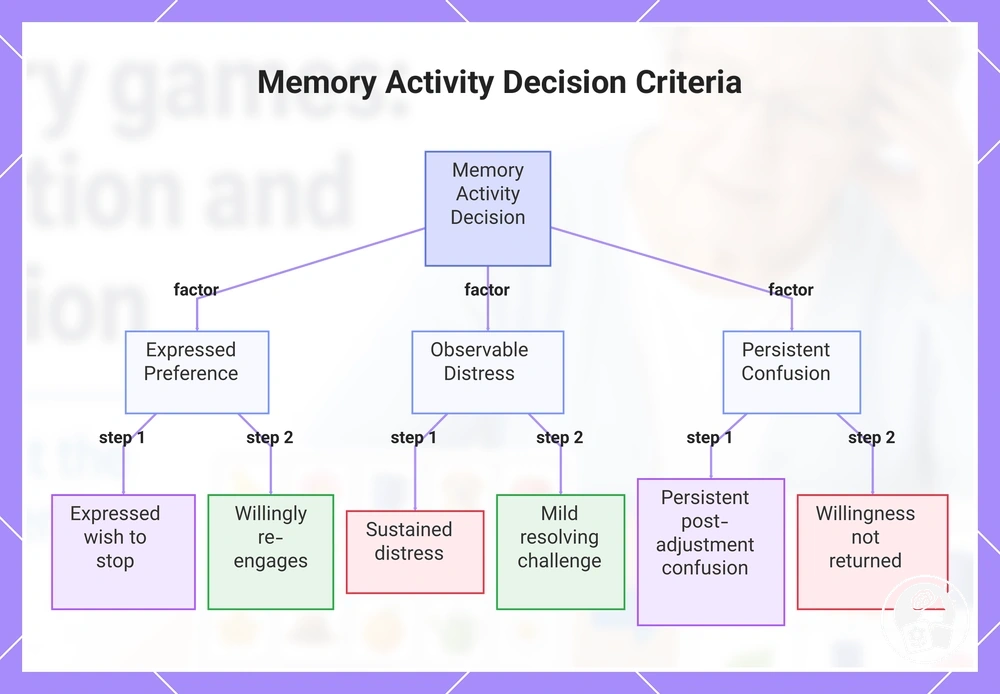
Memory game troubleshooting decision path
Match the observable pattern to one first check. Keep the other conditions as stable as practical, then compare the next response. Improvement can support a likely contributor, but it does not prove a diagnosis or permanent ability.
Rule questions or wrong-action starts
First check Instruction clarity.
Adjust State one immediate action or choice while keeping the memory task itself unchanged.
Interpret More purposeful responding after clarification supports an instruction-related contributor.
Rules are understood, but difficulty rises with more items, choices, actions or rules
First check Task demand.
Adjust Reduce one demand variable while keeping the activity recognisably the same.
Interpret Better participation at the lower demand means that level is more manageable for that moment.
Participation changes with tiredness, noise, rushed pace, scoring or social pressure
First check Temporary situational load.
Adjust Pause, slow the pace, or remove one distraction or pressure source.
Interpret Re-engagement after that single change supports a temporary contributor without proving it was the only cause.
The senior wants to stop, distress persists, or confusion remains after a simple adjustment
Decision Pause or end the current session instead of increasing pressure.
Retry condition Consider the activity again only when comfort and willingness return.
Boundary One difficult session does not establish a memory disorder or permanent inability.
The observable response can reflect task demand, unclear instructions, fatigue, distraction, pressure, or loss of interest, so the immediate response is calm reassessment rather than assuming one cause.
BrightStar Care's activity guidance, credited to the Alzheimer's Association, advises modifying or ending an activity when attention wanes or frustration increases and recommends adapting an activity when it is too complicated or not working at that time.
Keep the senior's observable response separate from the cause you infer, and preserve the person's choice to pause, continue, or try an adjustment.
Table of Contents
Signs of Frustration, Confusion or Disengagement During a Memory Game
Frustration, confusion or disengagement during a printable memory game is identified through observable changes in the senior's speech, behaviour, participation or task response, rather than one definitive sign.
Repeated questions, guessing, withdrawal, irritability or stopping participation are cues to check what is happening during the activity, not evidence by themselves of a specific underlying condition.
Read response patterns across more than one cue and compare them with the senior's participation earlier in the same memory game.
The signs of frustration, confusion or disengagement during a memory game illustrated below are observable responses rather than diagnoses; the useful distinction is whether an isolated difficulty passes or a pattern continues.

- Repeated questions or rule confusion: asking for the same instruction again is an observable verbal cue. If the senior resumes the task after a clear reminder, check whether the original instruction was difficult to follow before assigning another interpretation.
- Guessing instead of following the task: repeated random responses suggest that the expected task response is no longer being followed. Check whether a brief clarification restores purposeful responses.
- Withdrawal: turning away, setting down the pencil or becoming noticeably less involved marks a change in participation. Check whether engagement returns after a simple pause or adjustment.
- Irritability: a sharper tone, expressions of annoyance, or abandoning an attempted response are consistent with frustration during the activity. Check whether the behaviour settles when immediate task pressure is reduced.
- Stopping participation: no longer attempting the memory game is a direct behavioural change. Check whether the senior chooses to resume after a pause rather than assuming why participation stopped.
Ordinary challenge may involve brief hesitation or an error followed by continued participation, whereas confusion or distress that persists after a simple adjustment warrants pausing the activity or further troubleshooting.
The next check should focus on what was happening immediately before the repeated response pattern appeared, while keeping the observation separate from its possible interpretation.
Why Frustration and Confusion Happen During Memory Games
Frustration and confusion during a printable memory game can arise from three immediate classes of contributing factors: task demand, instruction clarity, and temporary situational load.
Each class can affect participation under different activity conditions, so frustration or confusion during the game does not establish one universal cause.
Task demand can contribute when the number of items or complexity increases the challenge, with errors or hesitation as plausible observable effects; unclear instructions or rules can contribute to procedural confusion about the expected response; and temporary situational load, including fatigue, distraction, pace, or social pressure, may interfere with attention and participation.
These are activity-level contributors rather than diagnoses. Instead of assigning a universal numerical score to their relative contribution, change one condition at a time and compare the senior's response while keeping the interpretation limited to the current activity.

The same outward behaviour can arise from different combinations of task, instruction, or situational factors: hesitation, for example, could appear when game demands increase, when a rule is unclear, or when distraction interrupts attention.
The relevant condition should therefore be checked rather than assumed, with task demand, instruction clarity, fatigue, distraction, pressure, and participation considered separately in the more specific cause checks.
The Challenge Does Not Match the Senior's Current Ability
The challenge level of the current memory game can contribute to repeated difficulty when its task demand exceeds what is manageable for the senior at that moment.
The relevant condition is the senior's observed performance during the current activity: repeated errors, hesitation, or disengagement despite understanding the instructions can indicate that the immediate demand is not matching current ability.
The criteria below organise observable signs of a possible demand mismatch rather than test the senior's general ability.
No universal number of items, rules, or errors establishes that mismatch, so the pattern should be judged against the same person's response as task load changes.
- More items or greater complexity: errors or hesitation emerge as the number of items, choices, or task elements increases, while the less complex version remains manageable.
- More information to manage at once: individual parts of the memory game are manageable, but combining multiple items or rules produces repeated difficulty.
- Instructions are understood: the senior follows what the task requires but continues to show repeated errors, hesitation, or disengagement; if the instructions are not understood, the observed difficulty does not by itself identify excessive task demand.
- Difficulty forms a pattern: the response recurs under the same or increased task demand rather than appearing as one isolated error followed by continued participation.
The image compares task load, not the senior's worth or permanent ability.
For example, an illustrative version of the same printable memory activity might use 4 items and 1 rule for the manageable-demand state and 8 items and 2 rules for the higher-demand state; these numbers illustrate the contrast and are not evidence-based difficulty thresholds.

A recurring pattern in which the senior understands the instructions but errors, hesitation, or disengagement appear as task demand increases supports checking for a current challenge-level mismatch; one difficult attempt does not establish the person's general ability.
When that pattern is present, check whether the difficulty is appropriate and reduce the immediate task load to a manageable demand, then observe the response rather than treating the earlier difficulty as evidence of permanent capacity.
The Instructions or Expected Response Are Unclear
Unclear, multi-step, or changing instructions can create procedural confusion during a memory game even when the underlying memory task is manageable.
The relevant condition is uncertainty about the rules, turn, prompt, or expected response; these observable cues suggest checking instruction clarity rather than treating the response by itself as evidence of difficulty remembering.
Instruction-related procedural confusion can be checked through observable responses during the current game:
- Repeated questions: the senior asks again what the rules require or what action comes next.
- Wrong-action starts: the senior begins an action that differs from the stated expected response after an ambiguous or multi-step instruction.
- Turn uncertainty: the senior is unsure whose turn it is or whether an action should happen now.
- Expected-response uncertainty: the senior hesitates because the prompt does not make clear what response the rules require.
When these cues occur, clearer immediate guidance can test whether the instructions are contributing to the difficulty: keep the memory task unchanged while making the next expected action explicit.
For example, an illustrative three-part instruction such as “turn over two cards, remember where they are, then say whether they match” can be reduced initially to the one-action prompt “turn over two cards”; if the senior then performs that stated action, the observable change supports an instruction issue, although it does not establish how the senior will perform the later remembering task.
The image below demonstrates instruction clarity rather than a different game type: the printable memory activity remains unchanged while a multi-part instruction is contrasted with one clear action and an explicit expected response.

Confusion about what action to take is procedural confusion; difficulty recalling information after the rules and expected response are understood is a separate observation.
If clearer wording indicates that the instructions are the likely issue, review how the game is introduced for the broader game-introduction context.
Fatigue, Distraction or Pressure Changes Participation
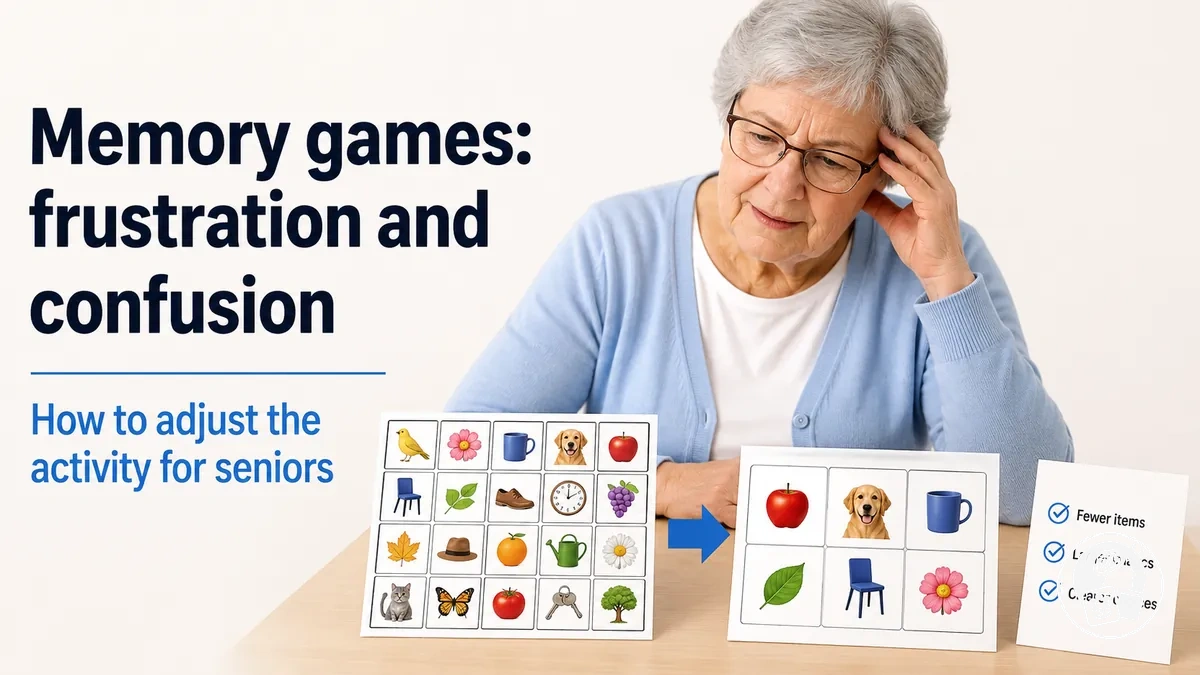
Temporary conditions can change a senior's participation in the same printable memory game: fatigue can reduce attention or contribute to slower responses, distraction in the environment can interrupt focus, and a rushed pace or social pressure may reduce willingness to continue.
These are conditional participation changes rather than evidence that one session measures the senior's fixed ability.
Personal state, environmental load, and interpersonal pressure should therefore be checked separately when attention or participation changes while the memory activity itself remains the same.
The conditions below organise observable change and a proportionate immediate adjustment; their order does not indicate severity.
- Fatigue or tiredness: if attention decreases, responses become slower, or willingness falls as tiredness becomes apparent, pause the activity and observe whether participation changes after rest.
- Distraction or interruption: if noise, conversation, or another interruption coincides with lost focus, reduce that distraction in the environment and observe whether attention returns to the same activity.
- Rushed pace: if shorter response time coincides with hesitation or reduced participation, allow the senior more time to respond and observe whether willingness changes.
- Social or scoring pressure: if being watched, corrected, compared, or expected to answer quickly coincides with hesitation or withdrawal, reduce the immediate pressure and observe whether participation changes.
A participation change that follows a situational change supports checking that temporary condition, but it does not establish that the condition was the only explanation or that the observed response reflects permanent ability.
For example, if nearby conversation coincides with repeated loss of attention and the senior resumes the same game after the environment becomes quieter, the relevant observed change is participation across two environmental conditions; if difficulty persists after fatigue, distraction, pace, and pressure are no longer apparent, a task or instruction problem remains a separate possibility.
This chart organizes temporary conditions that can change a senior's participation in a memory game, along with observable changes and immediate adjustments, to help distinguish conditional changes from fixed ability.
How to Identify What Is Causing the Problem
Narrow the likely source of frustration or confusion during a printable memory game by checking one observable variable at a time and interpreting the observed response before changing another.
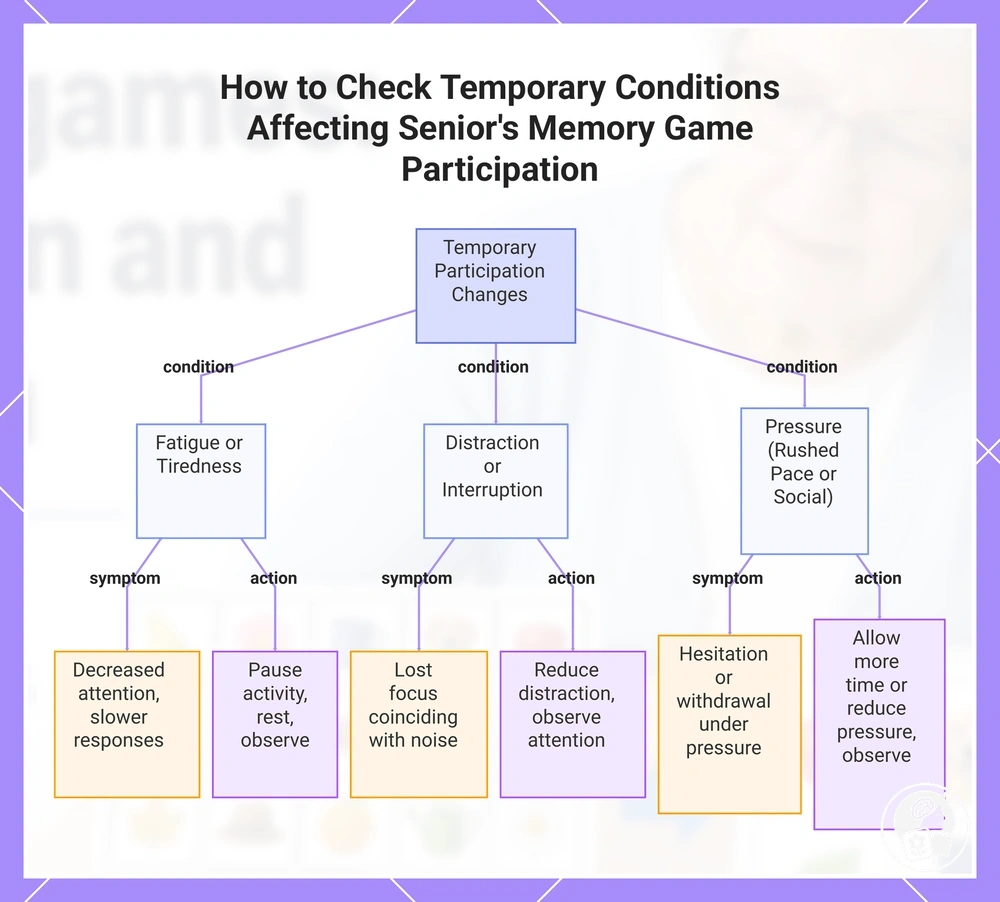
Use the sequence signal → recent trigger → one check → observed response → next decision, because a change in response can support a possible cause without proving that it is the only cause.
Start with the specific signal and what changed immediately before it appeared, then choose one variable to inspect, such as whether the instructions were understood, whether task demand changed, whether a pause alters engagement, or whether a simpler prompt changes the response.
Keeping one variable under review makes the comparison interpretable; changing several conditions together makes it unclear which change influenced participation.
- Observe the signal: identify the specific behaviour, such as repeated rule questions, hesitation, errors, or reduced engagement, without assigning a cause.
- Identify the recent trigger: check what changed immediately before the signal appeared, such as different instructions, increased task demand, or a change in the activity conditions.
- Check one variable: clarify one instruction, alter one element of task demand, introduce a pause, or give one simpler prompt while leaving the other conditions unchanged.
- Observe the response: compare engagement after that single check with the earlier signal and note whether the response decreases, persists, or changes in another way before testing anything else.
- Choose the next check: if the observed response clearly improves, treat that result as supporting evidence for a likely contributor; if it does not, keep the interpretation uncertain and test a different in-scope variable next.
For example, if repeated rule questions begin while the game itself has not changed, clarify only the instruction and observe the next response before changing task demand or another condition.
If the questions decrease and engagement resumes, that observed response supports unclear instructions as a possible contributor rather than proving causation; if the signal persists, keep that interpretation open and check one different variable next.
This chart shows how to narrow the likely source of frustration or confusion during a printable memory game by observing a signal, checking recent changes, and testing one variable before deciding the next step.
Check Whether the Problem Starts With a Particular Instruction, Turn or Prompt
Repeated difficulty that begins immediately after the same instruction, turn, prompt, rule change, error, or interruption is a reasonable pattern to check first during a printable memory game.
Locate the specific preceding event and the senior's immediate response, such as hesitation, confusion, or disengagement; the observed sequence establishes timing, not a confirmed cause.
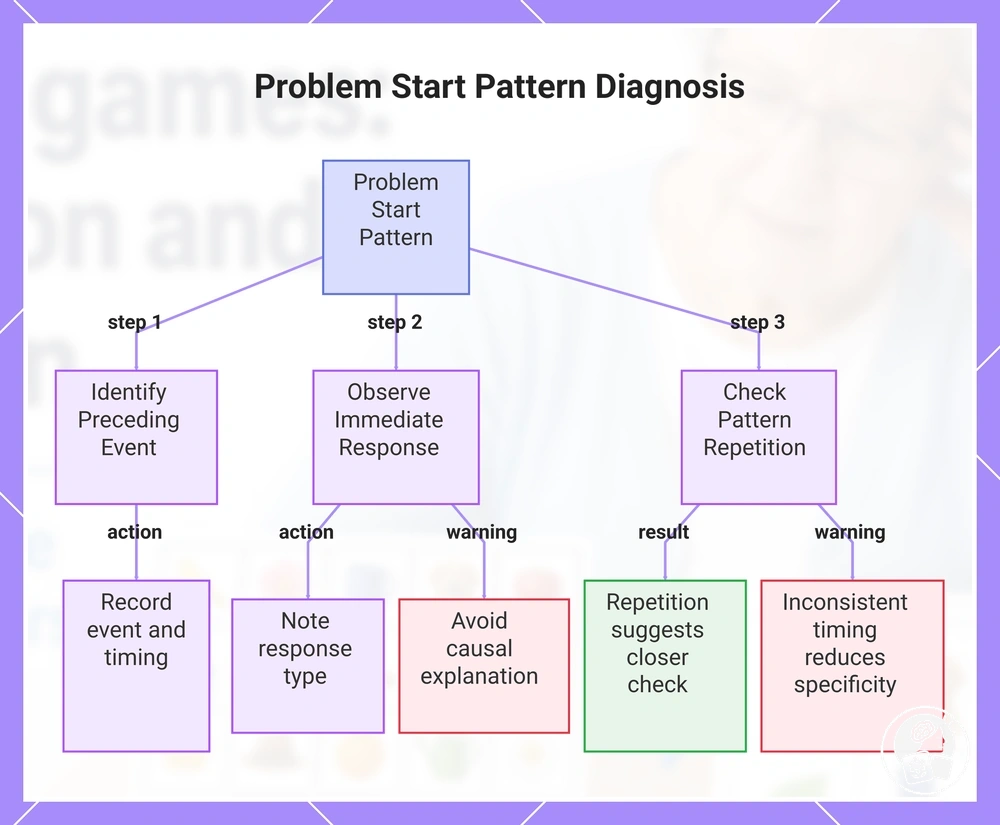
- Identify the preceding event: note the specific instruction, turn, prompt, rule change, error, or interruption immediately before the senior's response changes.
- Observe the immediate response: note whether hesitation, confusion, frustration, or disengagement follows that event without assigning a causal explanation.
- Check the pattern: when the same game event occurs again, observe whether a similar immediate response follows; repetition suggests checking that event more closely, while inconsistent timing makes that explanation less specific.
For example, suppose confusion follows one particular prompt on two separate occurrences but does not appear after other turns; this illustrative two-occurrence pattern makes that prompt a plausible explanation to check in the next observation, not an evidence-based diagnostic threshold.
Temporal proximity and repetition can localise where the problem begins, but they do not establish why it occurs.
This chart outlines a three-step method to identify whether a senior's difficulty in a memory game begins with a particular instruction, turn, or prompt, based on temporal proximity and repetition.
Separate Confusion About What to Do From Difficulty Remembering
Procedural confusion means the senior does not yet understand the instruction, rule, or expected action; difficulty remembering is different because the senior understands and can follow the rule but has trouble recalling information needed for the response.
This distinction separates task understanding from memory demand and identifies which variable should be checked next.
The cue groups below separate procedural cues from recall cues because the next troubleshooting check differs.
Procedural cues:
- The senior asks what the instructions require or what the expected action is.
- The senior starts an action that does not follow the stated rule.
- After rewording, the senior understands or follows the expected action more consistently.
Memory-demand cues:
- The senior can state or correctly follow the rule but later has difficulty remembering information needed for the response.
- Rule understanding and the expected action remain clear, but recall of an item, position, or earlier game information remains difficult.
- Errors continue after the senior has demonstrated understanding of what to do.
Better performance after rewording may support an instruction-related explanation, so instruction clarity is the relevant next check; persistent difficulty after clear rule understanding may instead suggest that task demand needs review.
These observations distinguish what to check within the game, but they do not establish why the difficulty exists beyond the activity. Do not use procedural or recall cues as a diagnostic score or cognitive cut-off; use them only to choose the next in-game check.
Check Whether a Pause or Simpler Prompt Restores Engagement
A single brief pause or simpler prompt can provide a low-pressure check of whether temporary overload is contributing to reduced engagement during a printable memory game.
If engagement improves, the response supports temporary overload as a possible contributor; if engagement does not improve or distress continues, check a different relevant factor rather than repeating the same adjustment.
The response states below organise what is observed after one adjustment and keep the interpretation limited to that response.
Do not apply an arbitrary pause duration, response-time threshold, or score to identify temporary overload. Instead, compare engagement, willingness, and understanding before and after one low-pressure adjustment.
- Engagement improves: if the senior re-engages, responds more willingly, or understands the next prompt more easily after the pause or simpler prompt, the change suggests that temporary overload may have contributed to the earlier difficulty.
- Engagement is unchanged: if hesitation, confusion, or disengagement remains after the adjustment, the response does not rule out temporary overload, but it warrants another check of a different relevant factor rather than repeating the same adjustment.
- Distress persists or increases: if frustration, withdrawal, or unwillingness to engage continues after the low-pressure adjustment, the adjustment has not resolved the immediate difficulty; pause or stop rather than repeating the check and adding pressure.
Improvement after one adjustment is informative because the observed response changed when the activity condition changed, but that pattern alone does not establish the original cause.
No change or continued distress leaves the cause uncertain, so the next action is to keep the interpretation cautious and consider a different relevant factor without treating the response as an assessment of intelligence or cognitive health.
How to Reduce Frustration and Help the Senior Re-engage
When frustration or confusion becomes visible during a printable memory game, the immediate troubleshooting response should reduce pressure, restore clarity, and preserve the senior's choice to continue or stop.
The target is voluntary participation: re-engagement is an acceptable response, and choosing not to continue is also an acceptable response.
Connect the visible symptom to one likely immediate barrier, then make one adjustment and observe the response before changing anything else.
The sequence below moves from calm acknowledgement to one corrective action, one clear next action, and verification of the response so that multiple changes are not stacked together.
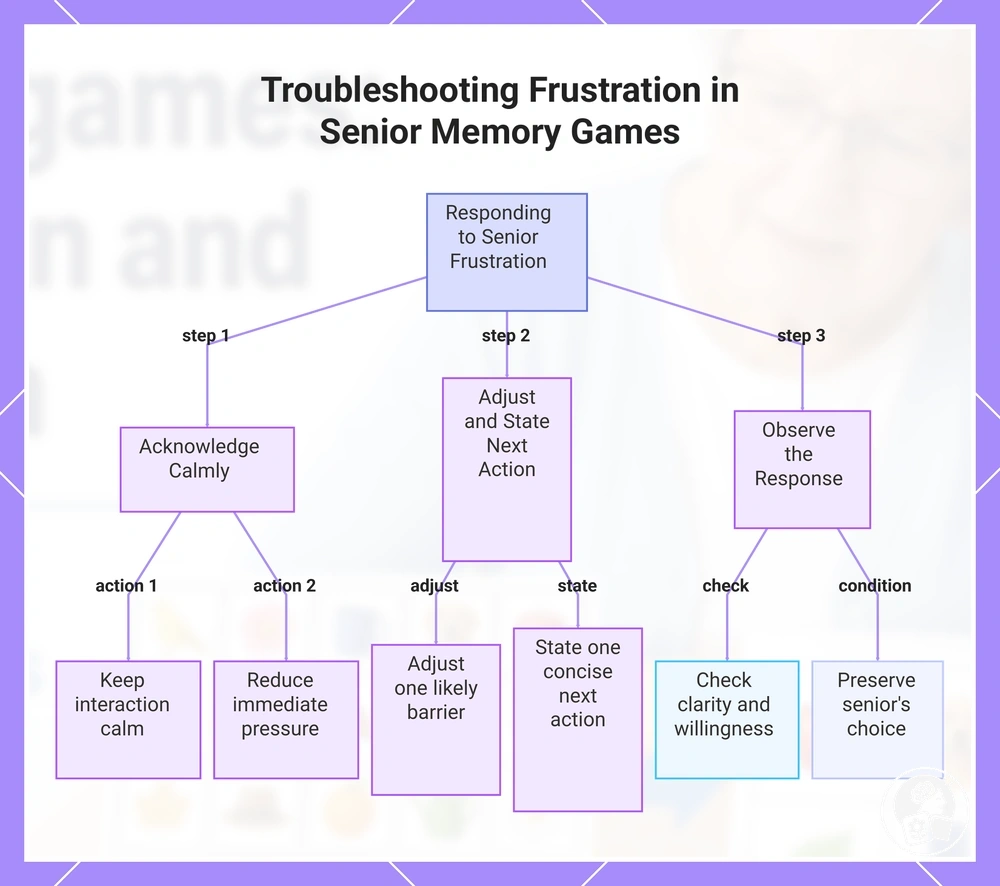
- Acknowledge calmly: acknowledge the frustration or confusion without correcting every error, while keeping the interaction calm and reducing immediate pressure.
- Make one small adjustment: adjust one likely immediate barrier while keeping the other conditions as consistent as practical.
- State the next clear action: state one concise next action and preserve the senior's choice to continue or stop.
- Observe the response: observe whether clarity and willingness improve, remain unchanged, or decline before making another adjustment.
If a small adjustment restores clarity and willingness, continue cautiously while preserving voluntary participation; if distress or confusion persists, do not escalate pressure.
Verify the response before another change, and allow the senior's decision to re-engage or stop to constrain the next action.
This chart shows the step-by-step troubleshooting sequence to reduce frustration and help a senior re-engage, focusing on calm acknowledgement, one adjustment, and observing the response.
Simplify the Immediate Task Without Restarting the Whole Activity
Simplify the immediate task demand by making the smallest reversible reduction to the feature blocking participation while keeping the printable memory game recognisably the same.
Reduce one demand at a time and preserve continuity into the next turn. Use the smallest reversible change that makes the current turn more manageable rather than relying on a universal item count, turn length, or difficulty threshold.
The following adjustments preserve the same activity while reducing one immediate requirement; start with the smallest relevant change and observe the response before changing another variable.
- Reduce choices: remove choices or items from the current turn while keeping its objective and game format the same.
- Shorten the turn: reduce the number of actions required before the senior can complete the next turn.
- Remove one rule: temporarily remove one secondary rule when that rule is adding the immediate task demand.
- Offer one simpler prompt: reduce the prompt to one immediate requirement when prompt complexity is the specific demand being reduced.
For example, suppose a turn presents 8 choices and participation stops when those choices are presented; reducing that same turn to 4 choices is an illustrative before-and-after change that preserves the activity, not an evidence-based threshold or recommendation.
Observe what follows: if participation resumes, the smaller task demand is manageable for that moment; if the response remains unchanged, the adjustment has not clearly resolved the immediate barrier, and neither result establishes the senior's permanent ability.
Clarify One Instruction or Choice at a Time
When instruction load is contributing to confusion during a printable memory game, present one concrete instruction or choice, allow the senior to respond, check understanding from that response, and add the next instruction only if needed.
The practical rule is one immediate action or choice at a time while preserving the senior's independence; add the next instruction only after the current action is understood, rather than relying on a universal word count, response-time limit, or phrasing threshold.
The sequence reduces instruction load without replacing independent participation.
For example, instead of the multi-part instruction “choose a card, turn it over, remember its position, and then choose another,” use the clear prompt “choose one card,” then observe the response before introducing another action.
- State one action or choice: give the current instruction as one concrete action or offer one relevant choice without adding another rule.
- Allow and observe the response: give the senior an opportunity to act independently, then check whether the observed response matches the expected action.
- Add the next instruction only if needed: if the response shows understanding of the current action, introduce the next instruction; if uncertainty remains about what to do, clarify the current instruction before adding another.
A response that matches the expected action supports proceeding to the next instruction, while continued uncertainty supports clarifying the current prompt rather than increasing instruction load.
Treat the observed response as information about the clarity of the current instruction, not as proof of the senior's permanent ability.
Reduce Pressure and Allow More Time to Respond
When pressure appears to be contributing to hesitation or withdrawal during a printable memory game, reduce the specific pressure source—pace, correction style, scoring, or social expectations—and observe whether willingness to participate changes.
Allow response time without treating silence as failure. Use the senior's willingness and ability to respond without visible rushing as the practical pacing condition rather than a fixed number of seconds or a pass/fail time limit.
The adjustments below reduce timing, correction, competitive, or social pressure while preserving the senior's opportunity to respond independently.
- Slow the pace: allow the current response time to continue instead of filling a pause immediately or moving to another prompt.
- Use a neutral correction style: acknowledge an error without repeated correction, then allow the senior to make the next response rather than completing the task for them.
- Reduce scoring pressure: remove score comparisons or competitive emphasis when hesitation appears alongside scoring, while keeping the underlying activity the same.
- Reduce social expectations: avoid requiring an immediate answer because other participants are watching or waiting; in a group, keep response speed from becoming a public comparison.
- Observe participation: after changing one pressure source, note whether willingness to answer or continue increases, remains unchanged, or decreases before altering another interaction condition.
If willingness to participate increases under the lower-pressure condition, the observed change supports pressure as a possible contributor without establishing it as the only cause; if hesitation remains, another explanation may need consideration.
When the pressure is specifically linked to turn-taking, audience attention, or competition between participants, adjust group facilitation for deeper group-specific handling rather than expanding this troubleshooting step into full group management.
When to Pause, Stop or Try the Memory Activity Another Time
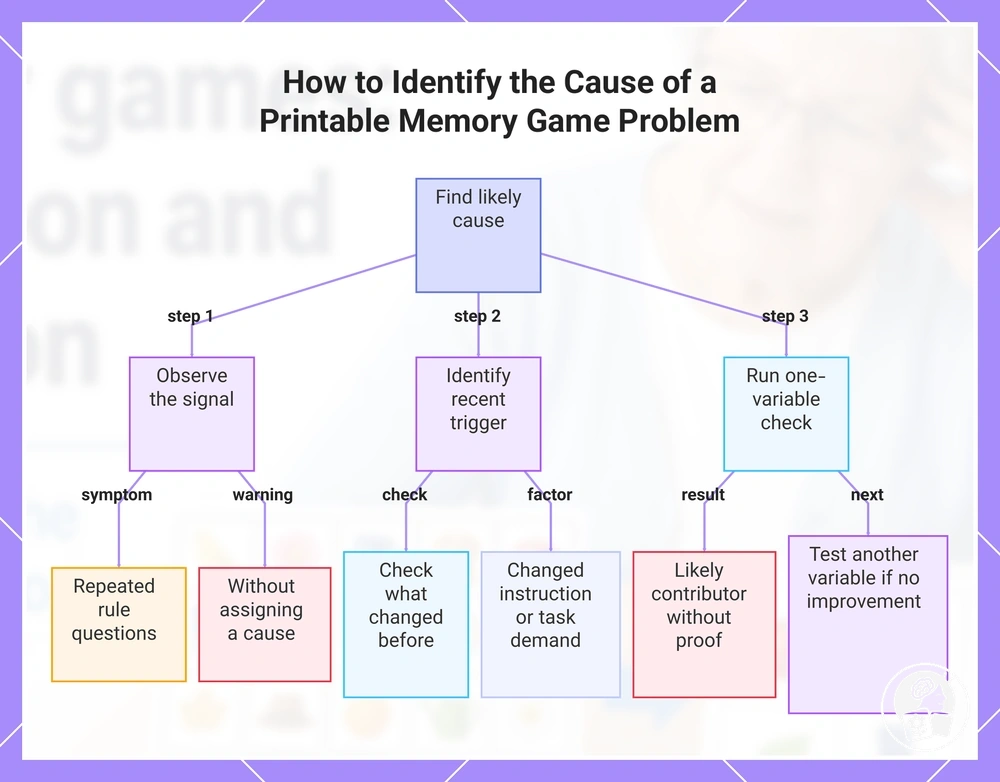
Pause or stop the printable memory activity when the senior chooses to stop, shows sustained distress, or remains confused despite a simple low-pressure adjustment. Consider trying again later only when comfort and willingness support another attempt.
The senior's autonomy and comfort take priority over completing the game, and no fixed duration or performance threshold is required for this decision.
Base the decision on the senior's expressed preference, observable distress or confusion, and response after the low-pressure adjustment.
These criteria distinguish a mild challenge that resolves with support from persistent difficulty that makes continuing the current activity counterproductive.
- End the current session when the senior wants to stop: an expressed participation choice is a reason to stop, regardless of whether the game is complete.
- End the current session when distress persists: sustained distress rather than a brief, resolving challenge is a reason to end the activity and prioritise comfort.
- Pause and reassess persistent confusion: confusion that remains after the simple low-pressure adjustment supports a pause; if confusion persists and willingness does not return, end the current session rather than increasing pressure.
- Continue after a mild challenge only when it resolves: if the senior becomes comfortable with the task and willingly re-engages after the adjustment, continuing remains a participation choice.
- Consider trying again later: a later retry is appropriate only if the senior is willing and the conditions associated with the earlier distress or confusion have settled.
A brief pause fits a challenge that settles while willingness remains, whereas ending the current session fits a wish to stop, sustained distress, or persistent confusion after the adjustment.
Trying again later can be considered when comfort and willingness return; the decision should remain condition-based rather than tied to an arbitrary waiting period, and one difficult session alone does not establish a medical conclusion about the senior's abilities.
This chart shows how expressed preference, distress, and confusion guide whether to stop, pause, continue, or consider a retry of a memory activity for seniors.