
Choosing and Adjusting the Difficulty of Printable Memory Games for Seniors
Choose and adjust printable memory-game difficulty from repeated performance under comparable conditions, not chronological age alone. If repeated attempts remain unmanageable after the rules and print presentation are clear, reduce one principal difficulty dimension; if the task requires effort but remains manageable, maintain it; if completion is consistently effortless, increase one principal difficulty dimension and reassess. Use accuracy, prompting, completion, pace, and effort together rather than treating one score or one round as a universal cutoff.
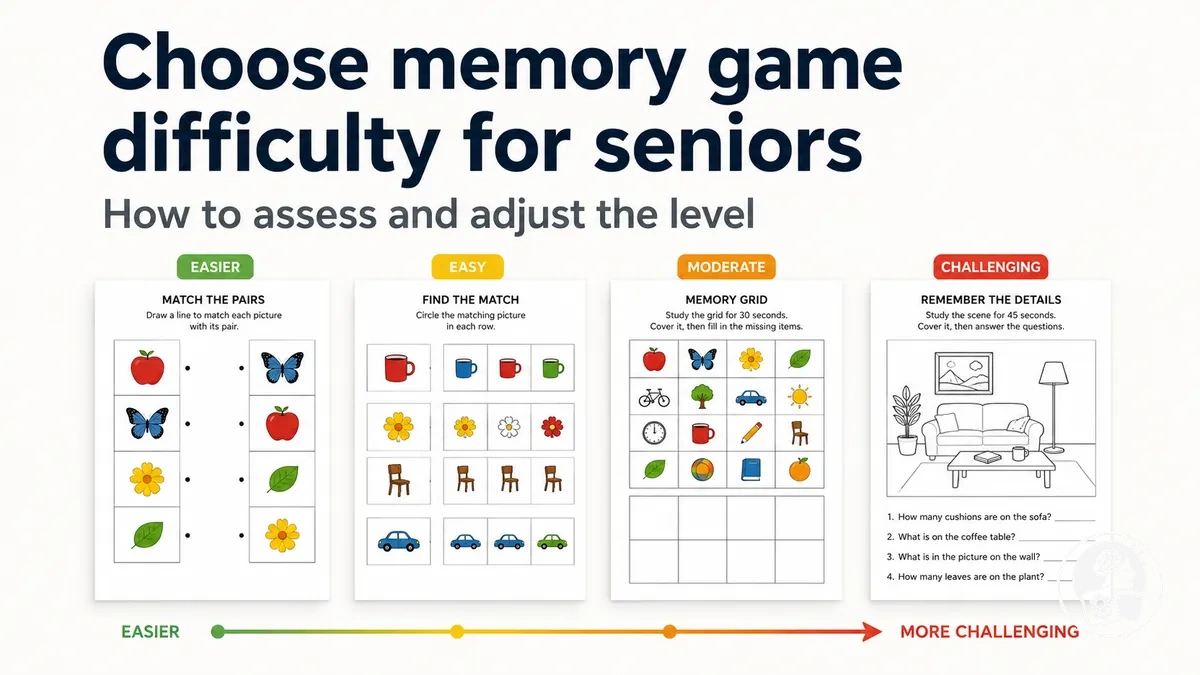
Choose the next difficulty step
Select the repeated performance pattern seen under comparable conditions after the rules are understood and the printed material is clear. The result gives a task-adjustment direction, not a medical judgement.
Next step: Choose a repeated pattern
Difficulty changes should follow a repeated pattern rather than one isolated result.
Adjustment rule: change only one principal difficulty dimension at a time—quantity/load, cue support, item similarity, or rule complexity—then reassess before the next change. In a two-cards-per-pair matching game, pair count, card count, and occupied positions are linked parts of the same quantity/load change.
The challenge level is suitable when the senior understands the task and can respond without the memory demand making the activity consistently unmanageable.
One level can therefore fit one senior but not another, even at the same age.
Observed performance provides the practical basis for judging the current level and making an adjustment.
Accuracy and the amount of prompting needed can show how the senior is responding, but the performance pattern should be interpreted alongside familiarity with the memory game, the clarity of the instructions, and the presentation of the printed material.
A difficult-looking performance does not by itself identify excessive memory demand when one of those conditions is interfering with the task.
This page treats difficulty as an adjustable property of printable memory games, with the adjustment based on task demand and observed performance rather than a medical judgement or an assumed age-based level.
Assessing the current challenge level is therefore the next step before deciding whether the game's difficulty should stay the same, decrease, or increase.
Table of Contents
Assess Whether the Current Challenge Level Fits the Senior
The current challenge level fits the senior when observable performance shows a repeated pattern of manageable accuracy, pace, prompting, and effort rather than one score or difficulty label.
Judge the level from a repeated performance pattern under comparable task conditions; one score, one error count, or one round is not a universal cutoff.
A single error, slow attempt, or emotional reaction does not provide enough information to classify the challenge level.
Repeated failure or heavy prompting suggests that the challenge level needs reassessment, while consistently effortless completion suggests that the task may provide insufficient challenge.
Slow pace, frustration, boredom, or errors may instead reflect familiarity, unclear instructions, or presentation as a non-difficulty barrier.
For example, if one senior completes the same printed game independently while another repeatedly needs prompts across comparable attempts, the contrasting observable performance supports different interpretations without creating an unsupported numerical threshold.
No single signal is conclusive; interpret each sign according to the repeated pattern and check plausible competing explanations before reassessment.

- Likely too difficult: repeated errors across comparable attempts, after the task is understood, suggest that the current challenge level needs reassessment.
- Likely too difficult: repeated prompting needed to continue the task suggests that the present memory demand may be mismatched with independent performance.
- Likely too easy: consistently effortless completion with little observable effort suggests insufficient challenge and indicates a need to reassess the current level.
- Check another barrier first: slow pace alone may reflect limited familiarity or uncertainty about the instructions rather than excessive task difficulty.
- Check another barrier first: frustration, boredom, hesitation, or inconsistent errors may reflect familiarity, instructions, or presentation rather than the challenge level itself.
Assess the current challenge level through repeated observation under comparable conditions, not from a one-off performance response.
If accuracy, pace, prompting, or effort changes after greater familiarity or clearer instructions and presentation, check those competing explanations before changing the task difficulty.
Signs the Memory Game Is Too Difficult
Repeated difficulty with completion, unusually frequent prompting, persistent guessing, or abandoning the memory game can suggest that the current task demand is too difficult, but one occurrence is not enough to establish that interpretation.
The stronger signal is a repeated pattern of support needed or repeated inability to complete the same memory demand under comparable conditions.
Look for the following performance signals across attempts and interpret each one in relation to what the printable memory game requires.
These cues describe task performance rather than a medical condition.

- Repeated difficulty completing the task: leaving the same type of activity unfinished across comparable attempts suggests that the current memory demand may be excessive.
- Frequent prompting: repeatedly needing reminders about what to do next suggests that the current task demand may require more support than is workable independently.
- Persistent guessing: repeatedly choosing without using remembered information suggests that the memory demand may not be manageable at the current level.
- Repeated unresolved matches: leaving multiple pairs unresolved across comparable attempts after the rules are understood suggests that the matching demand may be too difficult.
- Withdrawal from the activity: repeatedly stopping or abandoning the game can indicate excessive challenge, but other explanations should be checked before changing the level.
A genuinely over-demanding game produces repeated difficulty after the rules are understood, whereas apparent difficulty can result from unclear instructions or presentation barriers.
If the senior begins matching successfully after the rules are clarified, the earlier errors support an instruction-related explanation rather than excessive memory demand, so introduce the game clearly before judging the level from performance.
Do not use a fixed failure rate or prompt count as the sole decision boundary; use a repeated pattern across comparable attempts and check plausible competing explanations first.
Signs the Memory Game Is Too Easy
A memory game at the current level may be too easy when effortless completion, high accuracy, little hesitation, and little or no prompting persist across repeated attempts.
Classify under-challenge from a stable pattern of low task demand across comparable attempts, not from one perfect score, fast round, or isolated accuracy result.
Look for multiple observable signs under comparable conditions rather than treating one result as proof.
Familiarity with the same cards can make later rounds easier, so repeated mastery supports an under-challenge interpretation more strongly when the ease persists beyond one familiar game or unusually easy attempt.

- Effortless completion: consistently completing the memory game with little observable effort across repeated attempts suggests under-challenge and may warrant reassessing the challenge level.
- High accuracy with little hesitation: consistently accurate responses made with little hesitation support reassessment when the pattern persists; one perfect score does not establish that the game is too easy.
- Quick completion with minimal prompting: repeatedly completing the task quickly with little or no support can indicate low task demand when accuracy and ease remain stable, but speed alone is insufficient evidence.
- Repeated mastery: rapidly mastering the task and continuing to complete it easily can suggest that challenge may need to increase, while the same pattern with repeatedly used material can reflect familiarity instead.
- Loss of interest after mastery: reduced interest that occurs alongside persistent effortless completion can support an under-challenge interpretation, but boredom alone does not show that the current level is too easy.
Distinguish Memory-Game Difficulty From Readability Barriers
Memory-game difficulty concerns cognitive task demand, including memory demand, recall, and rule complexity, whereas readability concerns how clearly the printed material can be perceived and interpreted.
These are separate dimensions, although a readability barrier can influence observed performance while the intended memory demand remains unchanged.
The distinction is therefore between what the task requires the senior to remember and how clearly the task is presented.

Memory demand changes when the amount to remember, the recall requirement, or rule complexity changes; readability changes when font size, contrast, spacing, or visual clutter changes.
A presentation barrier can make an otherwise suitable memory task harder to perceive without necessarily increasing its cognitive difficulty.
The comparison below keeps these attributes separate so presentation problems are not misclassified as excessive memory demand.
| Dimension | What Changes |
|---|---|
| Memory demand | The amount or complexity of information that must be remembered or recalled changes. |
| Cues/rules | The recall cues or rule complexity change, altering what the senior must remember or apply. |
| Visual presentation | Font size, contrast, spacing, or visual clutter changes how clearly the printed material can be perceived without necessarily changing the intended recall demand. |
For example, suppose the same illustrative matching task contains 12 cards forming 6 pairs before and after a presentation change: enlarging the printed symbols and increasing spacing while retaining the same 12 cards, 6 pairs, matching rule, and recall requirement changes readability rather than the intended memory demand.
These figures are hypothetical, not recommended thresholds; the example shows that the same task can become easier to perceive while still requiring recall of the same 6 pair relationships.
Grade the Main Variables That Control Memory-Game Difficulty
Difficulty variables in printable memory games should be graded by comparing adjustable task conditions rather than by assigning a generic difficulty label.
The criteria split into quantity/load attributes—item count, pair count, and occupied grid positions—and cue/complexity attributes—cues, item similarity, and rule complexity.
An easier condition places fewer items or relationships in play, provides more useful cues, makes items easier to distinguish, or uses fewer rule demands; the corresponding harder condition increases demand or reduces support.
Do not grade every printable memory-game format against one fixed pair count, grid size, cue level, similarity level, or rule threshold; compare the adjustable conditions within the actual game format.
For quantity and memory load, fewer items, fewer pairs, and fewer occupied grid positions create fewer elements or relationships to track, while increasing item count, pair count, or occupied positions increases the information involved in the task.
For example, suppose a matching game changes from 6 pairs to 10 pairs while its other conditions remain constant: the item count rises from 12 cards to 20 cards, adding 8 card locations and 4 pair relationships to distinguish and remember.
Those numbers are illustrative rather than recommended thresholds; the practical implication is that the second version changes the quantity/load dimension without requiring a generic label such as easy or hard.
Cues, item similarity, and rule complexity form the cue/complexity dimension.
More useful cues provide greater recognition or recall support, whereas removing useful cues reduces support; more distinct items reduce the discrimination required between alternatives, whereas more similar items can make the task harder to distinguish; and one stable rule creates fewer rule demands than adding conditions that must also be retained and applied.
These variables can interact, so increasing pair count while reducing cues changes two sources of memory demand at once, while changing one principal difficulty dimension at a time makes the source of the change clearer. In a conventional matching game with two cards per pair, pair count, card count, and occupied grid positions are mechanically linked—for example, 6 pairs require 12 cards and 12 occupied positions—so treat those linked counts as one quantity/load adjustment rather than three independent changes.
| Difficulty Variable | Easier Condition | Harder Condition | Likely Implication |
|---|---|---|---|
| Item count | Fewer items in play | More items in play | More items increase the amount of task information that may need to be distinguished or remembered. |
| Pair count | Fewer pair relationships | More pair relationships | More pairs increase the number of relationships that may need to be tracked and recalled. |
| Occupied grid positions | Fewer occupied positions | More occupied positions | More occupied positions can increase the location information involved in a matching task. |
| Cues | More useful recognition or recall support | Less useful recognition or recall support | Reduced cue support increases reliance on information retained from the task. |
| Item similarity | More distinct items | More similar items | Greater similarity increases the discrimination required between candidate items. |
| Rule complexity | One simple, stable rule | More conditions or rules to retain and apply | Additional rule demands increase the information that must be retained or applied while responding. |
The importance of each difficulty variable varies by format because not every printable memory game exposes the same adjustable controls.
Pair count and occupied grid positions can directly grade the quantity/load of a card-matching task; in a fully occupied two-cards-per-pair grid, those values change together with card count. A different format may change memory demand through another combination of quantity, cues, similarity, or rules; readers can compare different memory-game types to see where those format differences arise.
Grade difficulty relative to the variables actually present in the activity rather than converting one format's easier and harder conditions into fixed thresholds for every game.
Number of Cards, Pairs, or Grid Size
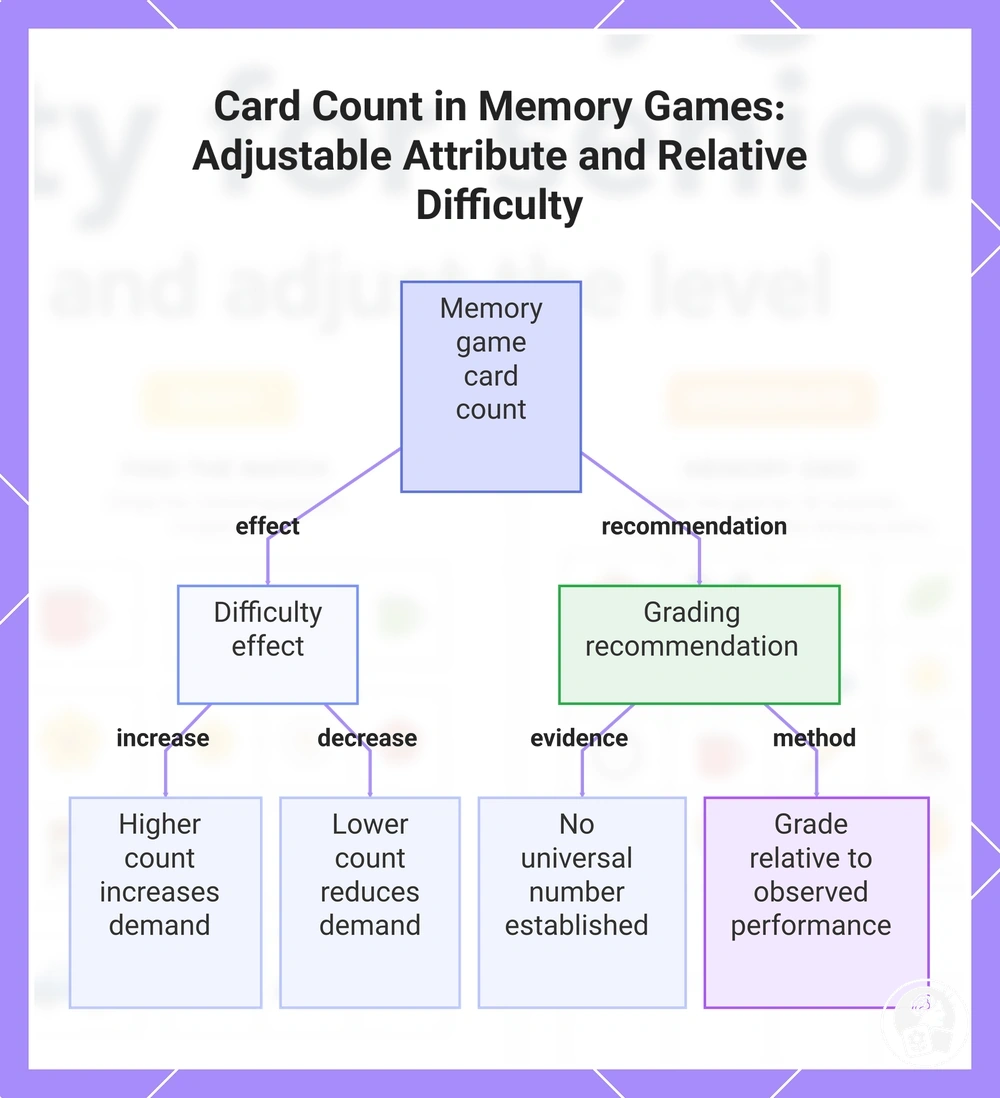
The number of cards, pairs, or occupied grid positions is an adjustable quantity attribute of a printable memory game: all else roughly equal, increasing item count generally increases the information that must be tracked and remembered, while reducing item count generally reduces memory demand and search demand.
Use card count, pair count, and occupied grid positions as relative difficulty controls rather than age-based standards: start from a manageable baseline, then increase or reduce them according to repeated performance.
For example, suppose the same matching task progresses from a 2 × 3 grid with 6 cards and 3 pairs, to a 3 × 4 grid with 12 cards and 6 pairs, and then to a 4 × 4 grid with 16 cards and 8 pairs; these are hypothetical values for relative grading, not recommended settings.
From the first to the last state, the grid contains 10 more card positions and 5 more pair relationships, calculated from the stated dimensions and two cards per pair, so the larger set can raise tracking, search, and memory demand when the remaining task conditions are held roughly constant.
Familiarity can reduce the observed difficulty of the same set over repeated attempts, and other task conditions can also modify performance.
Grade card count, pair count, and occupied grid positions relative to observed performance rather than treating any example count as a universal progression.
This chart shows how the number of cards, pairs, or grid positions in a memory game is an adjustable attribute that affects difficulty, has no universal standard, and should be graded relative to observed performance.
Memory Cues, Similarity, and Rule Complexity
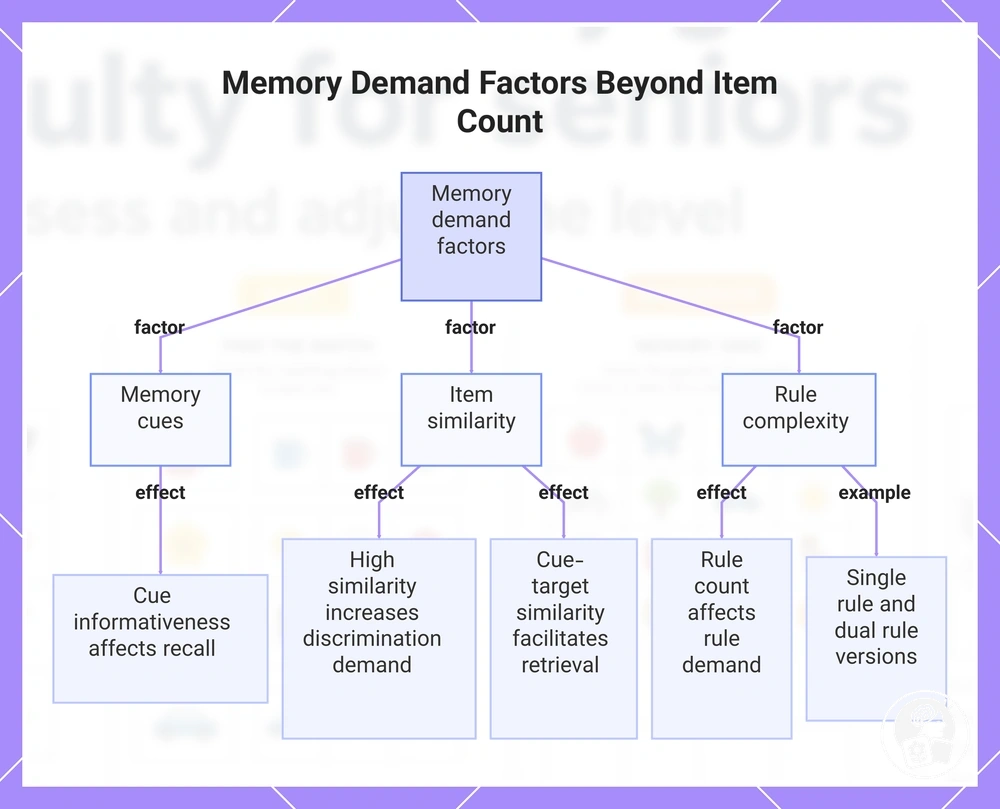
Memory cues, item similarity, and rule complexity can change the memory demand of a printable memory game while item count remains constant.
More informative cues provide greater recall support than weaker cues, clearly distinct items require less discrimination between alternatives than highly similar items, and simple rules impose fewer rule conditions than added rule demands; these are comparative conditions rather than guarantees of how every senior will respond.
Memory cues can support recall by providing information associated with the target, while weaker or less informative cues provide less retrieval support and can increase recall demand.
Item similarity has a different mechanism: highly similar competing items can increase discrimination demand and the opportunity for confusion compared with distinct items, although similarity between a cue and its intended target can facilitate retrieval rather than hinder it.
Do not assume a fixed error-rate effect from cue strength or item similarity alone; the outcome depends on what information is shared, what must be recalled, and the individual response.
Rule complexity can add rule demand when a player must retain and apply more task conditions: one simple matching rule has one stated response condition, whereas adding a second condition requires another rule to be remembered while the item count stays fixed.
For example, suppose two illustrative versions each use 12 cards and 6 pairs: one requires only matching identical pairs, while the other uses the same 12 cards but adds a second rule that must also be followed during matching; the quantity remains 12 cards, but the latter task contains two stated rule conditions instead of one.
Do not assume a fixed error-rate change from that hypothetical rule change; the practical relation is directional: adding a rule can increase recall or application demand without changing item count.
This chart shows how memory cues, item similarity, and rule complexity can change memory demand in printable memory games without altering the number of items.
Choose an Appropriate Starting Difficulty
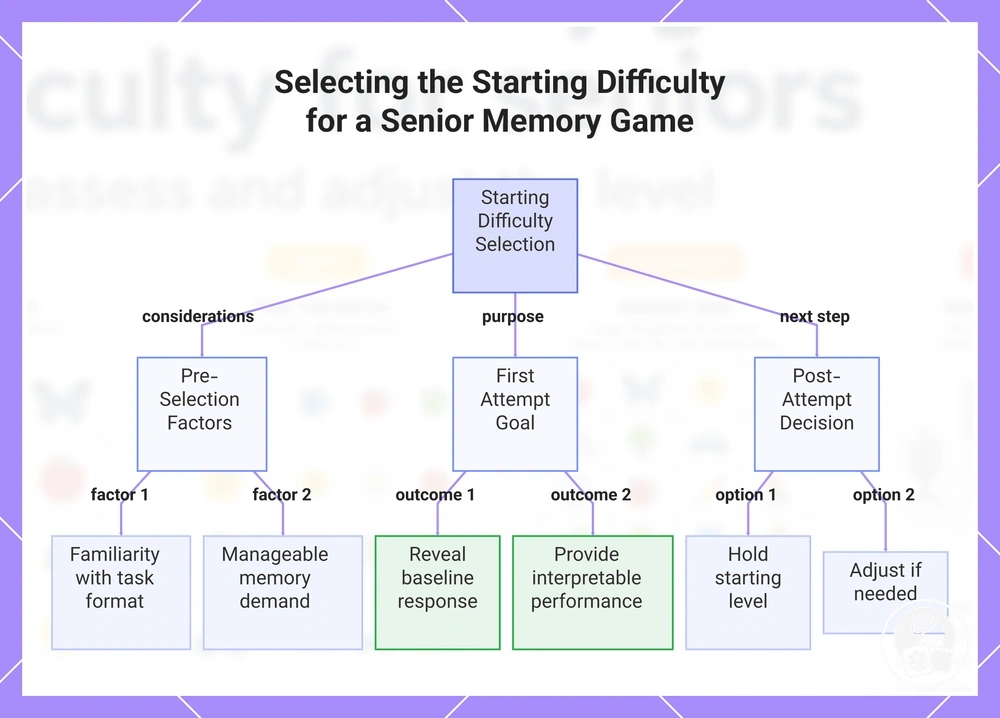
Choose the starting difficulty of a printable memory game as a provisional starting level that provides a usable baseline of the senior's current performance, rather than treating the first choice as a final fit.
Start with a familiar task format and a manageable demand that permits observation of accuracy, prompting, hesitation, and completion under clear instructions.
There is no single card count, pair count, accuracy percentage, or age band that reliably defines the right starting level for every senior. Choose a manageable baseline from current performance, familiarity, and task understanding, then adjust it after observation.
Before selecting the starting level, consider familiarity with the task format, clarity of the instructions, and the specific memory demand being introduced.
Familiarity is a relevant condition because difficulty during an unfamiliar task can reflect learning the rules or format rather than the memory demand alone.
The initial challenge should therefore provide enough demand to reveal a baseline response without requiring the easiest available version; what matters at this planning stage is whether the first attempt produces interpretable performance under clear conditions.
After the first attempt, use the observed baseline to decide whether to hold the starting level or make an adjustment if needed, while leaving the detailed adjustment procedure to the later stage.
For example, suppose two hypothetical matching versions contain 6 pairs and 10 pairs: starting with the 6-pair version creates a conservative quantity condition, and observation of current performance then provides evidence for whether that demand should be retained or changed.
The 6-pair and 10-pair values are illustrative rather than recommended thresholds; choose the starting pair count from the senior's current performance and change it only after observing that baseline.
This chart outlines the key considerations and steps for choosing an appropriate starting difficulty for a printable memory game, based on observed baseline performance.
Base the Starting Level on Current Performance Rather Than Age Alone
Current performance should carry more weight than chronological age alone when selecting the starting level of a printable memory game.
Use accuracy, independence, prompting, pace, and familiarity as task-specific criteria: stable independent performance supports considering a higher starting demand, while repeated failure or frequent prompting after the task is understood supports considering a lower starting demand.
Chronological age alone does not determine a workable starting level. Give more weight to current accuracy, independence, prompting, pace, and familiarity under the actual task conditions.
Interpret the criteria together because pace or errors during an unfamiliar game format can reflect limited familiarity rather than excessive memory demand.
For example, suppose two hypothetical seniors are both 75 years old: one completes the same task accurately and independently without prompting, while the other repeatedly needs prompts and does not complete it after the instructions are understood; despite identical age in this illustration, their different current performance supports considering different starting levels.
The example illustrates the weighting rule rather than a diagnostic threshold: observed task performance informs the starting decision without establishing either person's cognitive ability or medical status.
Aim for a Challenge That Requires Effort Without Repeated Failure or Boredom
A workable challenge range for a printable memory game requires effort while still allowing successful recall, manageable errors, limited prompting, and sustained participation without a repeated pattern of failure or consistently effortless completion.
Treat the workable range as an observable performance pattern rather than a standardized numerical level: successful recall still requires effort, errors remain manageable, prompting is limited, and participation continues.
The middle range suggests a workable challenge when successful recall still requires some effort, errors remain manageable enough for participation to continue, and prompting is limited rather than repeatedly necessary.
Boredom or frustration can add context to that interpretation, but neither provides a precise measurement of difficulty by itself; the current level is better evaluated from the combined pattern of recall, errors, prompting, effort, and sustained participation.
- Too hard: repeated failure with little successful recall or repeatedly necessary prompting suggests that the current demand may be too demanding.
- Workable challenge: successful recall with effort, manageable errors, limited prompting, and sustained participation suggests that the current challenge is workable enough to hold while the pattern remains stable.
- Too easy: consistently effortless completion with little observable effort suggests under-challenge; boredom may accompany that pattern but does not establish the difficulty level on its own.
Adjust the Difficulty Gradually
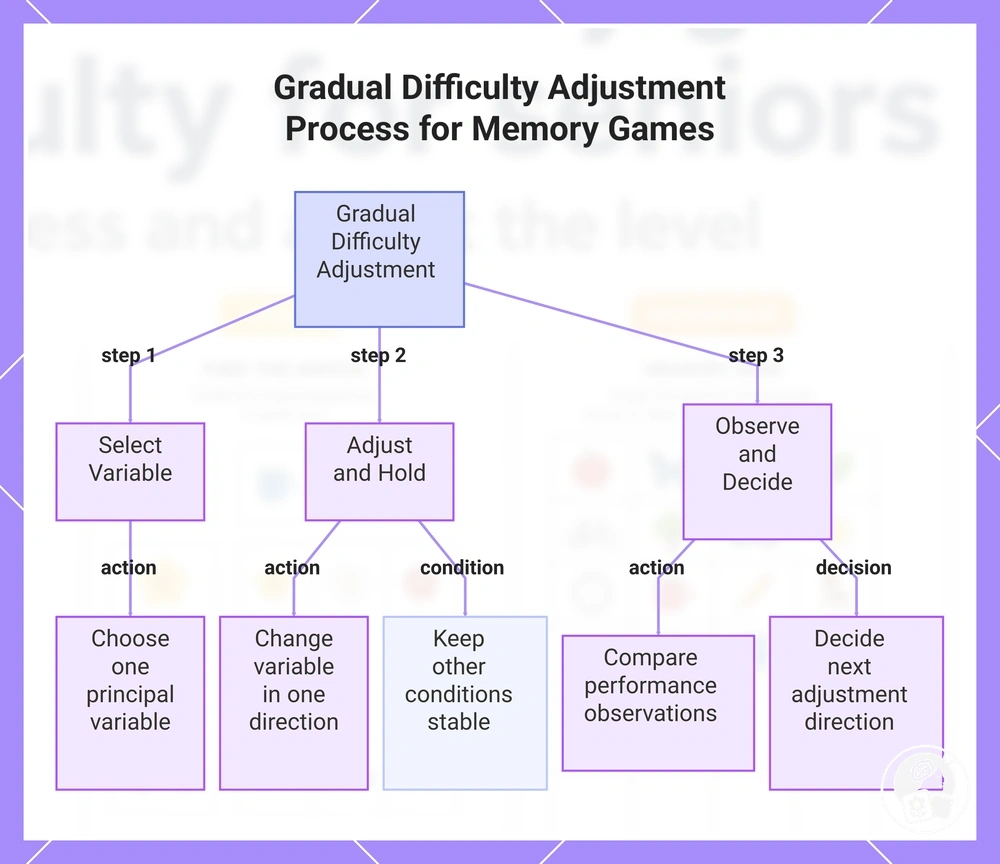
Gradual difficulty adjustment for a printable memory game should change one variable at a time, then observe and compare performance before another variable is adjusted.
Select one principal difficulty dimension—quantity/load, cues, similarity, or rule complexity—and verify the response under reasonably stable conditions before deciding on the next change. For a two-cards-per-pair matching game, changing pair count also changes card count and occupied positions, so treat those linked values as one quantity/load adjustment. The size and timing of the step should follow the game format and observed response rather than a universal increment or progression interval.
Use the sequence below to isolate the principal adjustment from other difficulty variables.
Verification is required before another principal variable is changed.
- Select: choose one principal difficulty dimension: quantity/load, cues, similarity, or rule complexity. Treat mechanically linked pair, card, and occupied-position counts as one quantity/load dimension.
- Change: adjust that variable in one direction while leaving the other principal difficulty variables unchanged as far as practical.
- Hold stable: keep the task procedure and other major conditions reasonably comparable between attempts so the selected adjustment remains the principal planned difference.
- Observe: record performance after the change, including the activity's score when one is used, prompting, errors, and completion, then compare these observations with the preceding attempt.
- Decide: after verification, continue the same adjustment direction, hold the current setting, or reverse the change; do not change another principal variable before this checkpoint.
A one-variable-at-a-time comparison improves interpretation because it limits the planned difference between consecutive attempts.
For example, suppose an illustrative matching game changes from 6 pairs to 8 pairs while cues, similarity, rule complexity, and other major conditions remain reasonably stable: under a two-cards-per-pair format, the change increases the game from 12 to 16 cards, an illustrative increase of 2 pair relationships and 4 cards, so the next performance observation can be compared primarily against the pair-count adjustment rather than several simultaneous changes.
Score tracking should remain one signal within the broader performance comparison rather than the sole progression rule.
Compare the score with prompting, errors, completion, and other observations collected under reasonably comparable conditions; use the direction and consistency of the performance pattern, not a universal score-change threshold, to decide whether to adjust again.
This chart shows the gradual difficulty adjustment process for a printable memory game, with a one-variable-at-a-time approach to ensure clear comparison between attempts.
Make the Game Easier by Reducing Memory Demand or Adding Support
Reduce memory-game difficulty by changing one difficulty-relevant variable at a time: reduce item count, use fewer pairs, use a smaller grid, add stronger cues, use more distinct items, or apply simpler rules.
Keep the same basic game and observe response after each change before making another adjustment. Reduce only one relevant variable at a time; the amount of reduction should match the game format and the senior's repeated response rather than a fixed pair, grid, cue, similarity, or rule threshold.
Each option below changes one source of task demand or support while the other major conditions remain as stable as practical.
- Reduce item count or use fewer pairs: lower the number of items or pair relationships in play while keeping cues, item similarity, grid presentation, and rules constant; then observe response through completion, errors, and prompting before changing another variable.
- Use fewer occupied positions: in a fully occupied matching grid, fewer positions also mean fewer cards, so treat this as a linked quantity/load reduction while keeping cue type, similarity, and rule complexity otherwise comparable; then observe whether tracking and completion become more manageable.
- Add stronger cues: increase retrieval or recognition support while keeping item count, grid size, similarity, and rules constant; then observe whether successful recall increases or prompting decreases before making another change.
- Use more distinct items: increase the difference between competing items while keeping quantity, grid size, cues, and rules constant; then observe whether discrimination errors decrease under the revised condition.
- Use simpler rules: remove one rule demand while preserving the same cards, layout, and basic matching task; then observe performance under the simpler-rule condition before deciding on another adjustment.
Keeping the other major difficulty variables stable makes the effect of the downward adjustment easier to interpret.
For example, suppose the same hypothetical matching game changes from 8 pairs, or 16 cards, to 6 pairs, or 12 cards, while its grid presentation, cues, item similarity, and matching rule remain constant: the illustrative change removes 2 pair relationships and 4 cards, so the next performance observation can be compared primarily with the reduced quantity.
These values illustrate a single-variable reduction and are not recommended difficulty thresholds.
Make the Game Harder by Increasing Memory Demand One Variable at a Time
Increase memory-game difficulty only after stable performance at the current level, and change one legitimate difficulty variable at a time.
The harder condition can add items or more pairs, use a larger grid, reduce selected cues, increase similarity between competing items, or increase rule complexity. Increase only one variable after stable performance, then reassess before progressing again; the size and timing of the increase should follow the game format and observed response rather than a universal progression schedule.
Observe performance after each increase before making the next adjustment.
- Add items or more pairs: increase the number of items or pair relationships while keeping cues, item similarity, grid presentation, and rules as constant as practical; the higher quantity increases the information in play, so observe completion, errors, and prompting before adding more.
- Use more occupied positions: in a fully occupied matching grid, more positions also mean more cards, so treat this as a linked quantity/load increase while keeping cue support, item similarity, and the matching rule comparable; then observe whether stable performance continues before increasing the quantity again.
- Reduce cues: remove one selected source of recognition or retrieval support while keeping quantity, grid size, similarity, and rules constant; the harder condition requires greater reliance on remembered information, so observe recall, errors, and prompting before removing another cue.
- Increase similarity: make competing items less distinct while keeping their quantity, grid arrangement, cues, and rules constant; the change increases discrimination demand, so observe whether matching errors increase before changing another variable.
- Increase rule complexity: add one clearly stated rule condition while preserving the same cards, layout, and basic game; this adds a rule demand without making the instructions ambiguous, so observe whether the added condition is applied consistently before adding another.
Start a new observation period after every single-variable increase and keep the other major difficulty variables stable until performance has been reassessed. Continue long enough to see whether the pattern repeats under comparable conditions; one trial or a fixed number of minutes is not a universal progression rule.
For example, suppose a hypothetical matching game progresses from 6 pairs, or 12 cards, to 8 pairs, or 16 cards, while grid presentation, cues, item similarity, and rules remain unchanged: the illustrative adjustment adds 2 pair relationships and 4 cards, allowing the subsequent observation to be interpreted primarily against the increase in quantity.
These figures illustrate the progression method rather than recommended increments, and another increase should wait until performance under the changed condition has been observed.
Reassess the New Level Before Progressing
Reassess the new level by comparing post-adjustment performance with the prior baseline under reasonably comparable conditions before making another progression decision.
Keep the main task conditions as similar as practical so the difficulty adjustment remains the principal planned difference between observations.
Do not use a single score, accuracy percentage, pace, prompt count, number of trials, or time value as a universal maintain-or-reverse cutoff. Compare the repeated post-adjustment pattern with the prior baseline under comparable conditions.
Compare the same observations used at baseline: accuracy or score, pace, prompting needs, and signs of excessive effort or under-challenge.
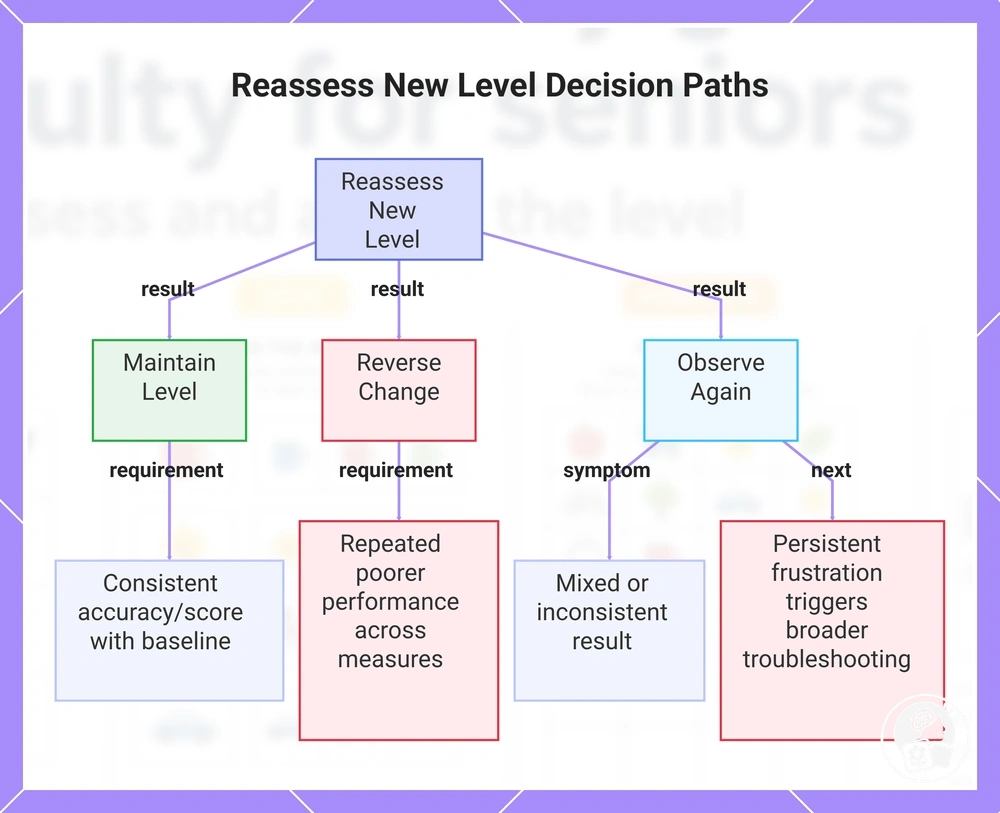
A performance pattern in which accuracy or score remains reasonably consistent with baseline while prompting does not materially increase can support maintaining the new level; a repeated pattern of poorer performance across multiple observations can support reversing it.
Pace, accuracy, score, and prompting should still be interpreted conditionally because unfamiliarity, unclear instructions, or another task barrier can affect the comparison.
Base the next decision on the performance pattern across comparable observations rather than one result.
For example, suppose an illustrative baseline produces 8 correct responses out of 10 with one prompt and the first new-level attempt produces 7 out of 10 with two prompts: the calculated differences are one fewer correct response and one additional prompt, but these hypothetical values are not standardized thresholds, so that single mixed result requires another comparable observation before attributing the difference to the new level.
The decision therefore follows comparison with the prior baseline rather than a universal numerical cutoff.
- Maintain the new level: keep it when the performance pattern remains reasonably consistent with the baseline while the adjusted challenge is still observable.
- Reverse the change: reverse it when comparable observations repeatedly show poorer performance across relevant measures such as accuracy or score and prompting needs.
- Observe again: gather another comparable observation when the result is mixed, inconsistent, or plausibly affected by familiarity, instructions, or another barrier.
Persistent frustration or confusion after comparable reassessment may extend beyond difficulty grading and require broader troubleshooting rather than another immediate progression decision.
In that situation, solve frustration or difficulty problems before interpreting the next observation as support for maintaining or reversing the new level.
This chart shows the three decision outcomes when reassessing a new difficulty level in a memory game, based on comparing post-adjustment performance to baseline under similar conditions.
Use Scores and Signs of Strain to Judge the New Level
Performance indicators for a printable memory game should be interpreted together: score or accuracy gains meaning when compared with pace, prompts, self-corrections, guessing, visible effort, and recent performance under comparable conditions.
Score should not dominate the decision because the same score can require very different levels of prompting, time, self-correction, guessing, and effort. Interpret those indicators together under comparable conditions.
A score gains meaning when compared with similar task conditions, such as the same item count, grid, cues, rules, and a person's recent attempts.
Under those comparable conditions, a similar score accompanied by more prompts, slower pace, fewer self-corrections, repeated guessing, or visibly greater effort can suggest that the new level requires more support; a score achieved with less support can support a different interpretation.
Fatigue, frustration, or slow pace can be recorded as observations within the performance pattern, but they should not be interpreted here as medical indicators.
For example, suppose two hypothetical attempts under comparable conditions each produce 8 correct responses out of 10: the first requires 1 prompt, while the second requires 5 prompts and includes repeated guessing.
Accuracy is equal at 80%, but the second attempt requires 4 additional prompts, so the equal scores support different interpretations of the support needed at the new level.
The values are illustrative rather than standardized thresholds; score, accuracy, pace, prompts, self-corrections, guessing, and effort should be interpreted as a coordinated performance pattern.
Maintain, Reduce, or Increase the Challenge Based on Performance
The challenge adjustment decision for a printable memory game has three possible values: maintain, reduce, or increase the challenge, and the decision should follow repeated performance under comparable conditions rather than a single round.
The current performance pattern determines the direction: maintain a workable challenge, reduce persistent excessive demand, or increase consistently effortless demand. No single score, number of rounds, schedule, or age rule replaces that comparison.
Use the repeated performance pattern to choose one decision, and measure the current state again after any justified change.
- Maintain: maintain when challenge and successful performance remain balanced across comparable attempts; measure again at the same level to confirm that the current state remains suitable.
- Reduce: reduce when excessive demand persists across comparable attempts; change one principal variable downward, measure the response, and reassess before another adjustment.
- Increase: increase when performance is consistently effortless with little memory demand across comparable attempts; change one principal variable upward, measure the response, and reassess before another adjustment.
After a reduction or increase, keep the other principal difficulty variables as stable as practical and reassess the changed condition before making another decision.
The controlled sequence is current state → adjustment of one variable → measurement → interpretation, with maintaining the level remaining a valid outcome when the existing challenge fits the repeated performance pattern.