
Printable Memory Games for Seniors
Printable memory games for seniors are printed matching, recall, sequencing, word, number, picture, or trivia activities used for structured play or practice. Choose one by matching task difficulty and rule complexity, readability, and available support to the individual; performance in the game is not a diagnosis or proof of cognitive improvement.
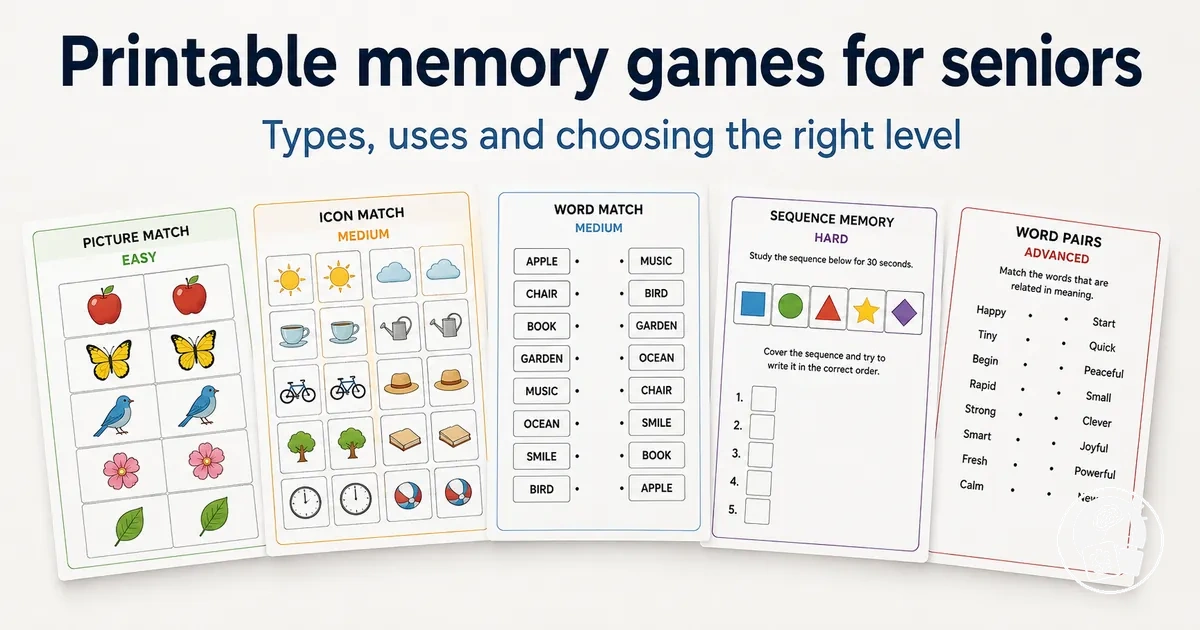
Selection aid
Quick fit check for a printable memory game
Use observations from the current activity to decide whether to keep the setup, change the presentation, adjust the challenge, or change the support. The result is an activity-fit guide, not a cognitive assessment.
Important: This tool evaluates how well the activity fits the current use conditions. It does not diagnose memory problems, dementia, or cognitive decline.
The sections below explain how game format, difficulty, readability, setting, and support change suitability and when repeated signs indicate that the activity should be adjusted.
Table of Contents
The Role of Printable Memory Games in Senior Activities
Printable memory games in senior activities provide a structured way to support engagement, task practice, enjoyment, and participation during the activity itself.
For seniors, their practical role is to create a defined cognitive activity in which attention or recall is used as part of completing a task.
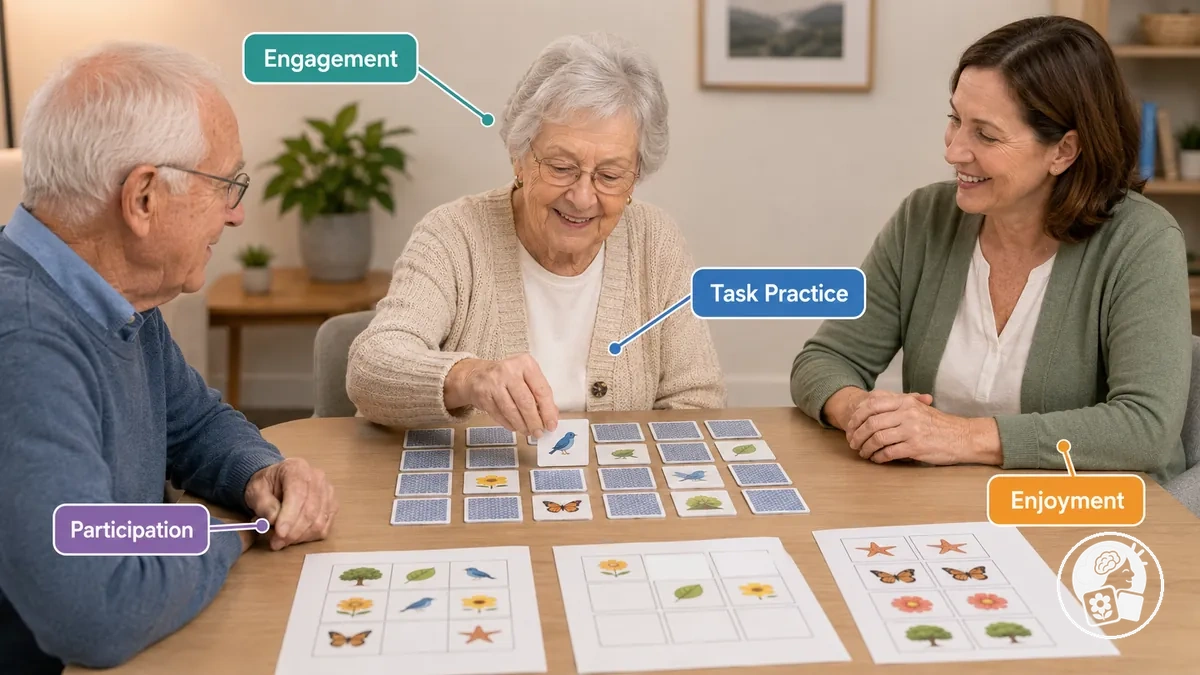
During use, printable memory games can give seniors a task to focus on, an opportunity to practise the abilities required by that task, and an activity that can be completed alone or with another person.
Shared use can also make social participation part of the activity, while enjoyment depends on whether the task feels manageable and engaging for the individual.
These immediate functions describe participation and task practice rather than a measured change in long-term cognitive health.
Broader cognitive outcomes require separate evidence, so participation or better game performance should not by itself be interpreted as evidence of cognitive improvement.
What These Games Ask Seniors to Do
Printable memory games ask seniors to perform different task demands according to the format: recognition, recall, matching, sequencing, attention, and processing of words, numbers, pictures, or cards.
A matching format asks the participant to compare items and identify corresponding pairs, a recall format asks for remembered items after the original cue is absent or reduced, and a sequencing format asks the participant to place information in a required order.
The format therefore changes what the participant must process and how they participate in the activity.
A game centred on pictures emphasises visual information, while one centred on words or numbers also requires the participant to process that material as part of the memory task; different printable games consequently emphasise different combinations of demands.
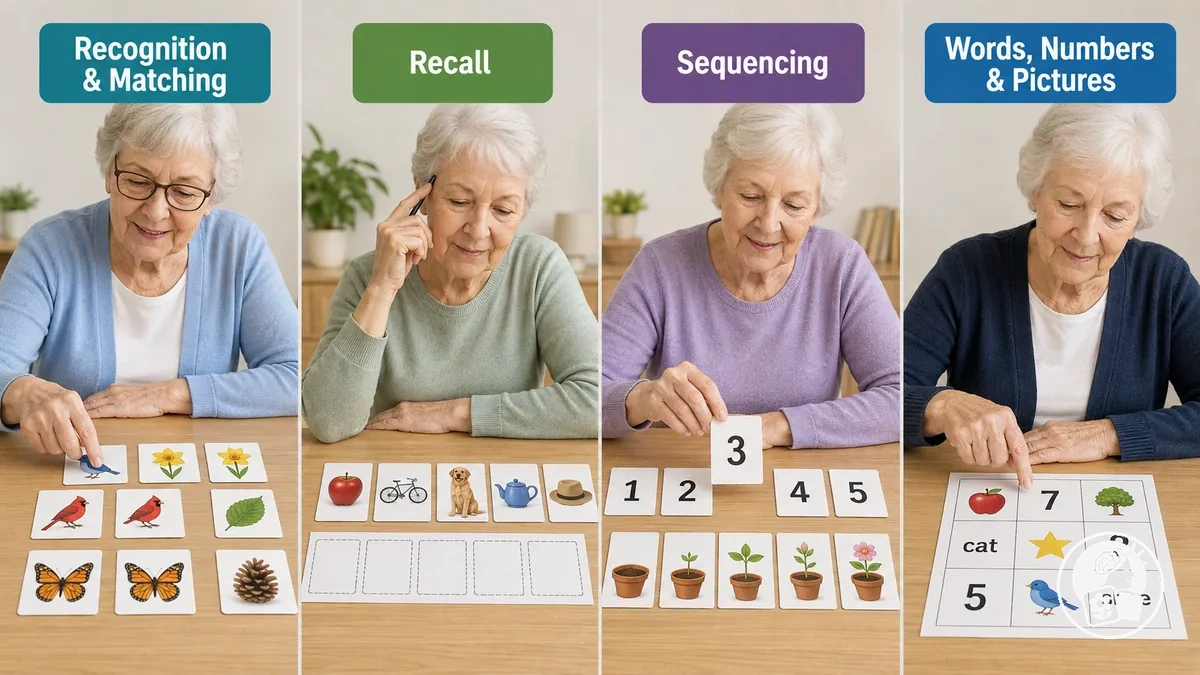
- Recognition and matching: Picture cards presented as pairs ask the participant to compare visible items, recognise corresponding pictures, and make the required matches.
- Recall: A picture or word activity in which previously presented items are no longer shown in the same way asks the participant to retrieve remembered items rather than rely on direct side-by-side matching.
- Sequencing: Numbers or pictured events presented out of order ask the participant to attend to the items and arrange them according to the sequence required by the activity.
- Word, number, and picture processing: Printed words, numerals, or pictures must first be interpreted as the relevant type of information and then used to complete the game's matching, recall, or sequencing task.
What These Activities Can and Cannot Support
Printable memory activities can support structured practice, engagement, participation, and enjoyment during the activity, while broader cognitive benefits are variable and evidence-dependent.
Evidence from formal cognitive training cannot establish the same outcomes for an ordinary printable game because effects depend on the activity being tested, participant characteristics, and how the activity is used.
The distinction concerns evidence and claim strength: completing a matching or recall game provides practice in the task presented, but good game performance does not by itself establish improved memory beyond that task or a long-term cognitive effect.
The National Institute on Aging reports that cognitive-training interventions are studied under defined conditions and populations, including cognitively healthy older adults and people with mild cognitive impairment, so findings from those interventions should not automatically be generalised to printable memory activities.

Printable memory activities cannot by themselves diagnose cognitive status or establish prevention, reversal, or treatment of dementia or cognitive decline.
The World Health Organization's 2026 second-edition dementia risk-reduction guidelines include cognitive training and cognitive stimulation among a broader set of evidence-based risk-reduction interventions while also identifying areas where evidence remains insufficient; that is a different evidentiary standard from treating performance on a printable game as a clinical outcome.
This distinction defines what memory games can realistically support.
Memory Games Are Activities, Not Memory Tests
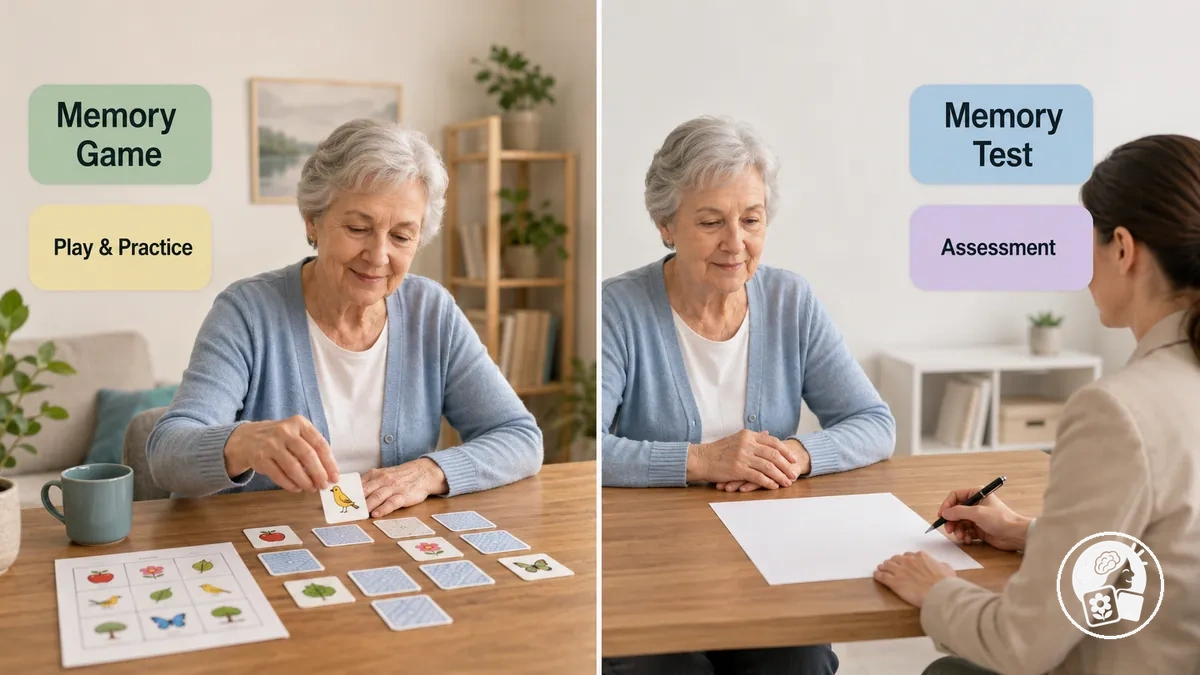
A printable memory game is an activity for play or practice, not a formal memory test used for assessment.
A memory game is administered as an activity, whereas a memory test has an assessment purpose and its result requires interpretation within that assessment context.
Game performance therefore belongs to the activity context and should not be interpreted as a diagnosis.
The visual below distinguishes these purposes without depicting a testing procedure.
What Makes a Printable Memory Game Suitable for a Senior
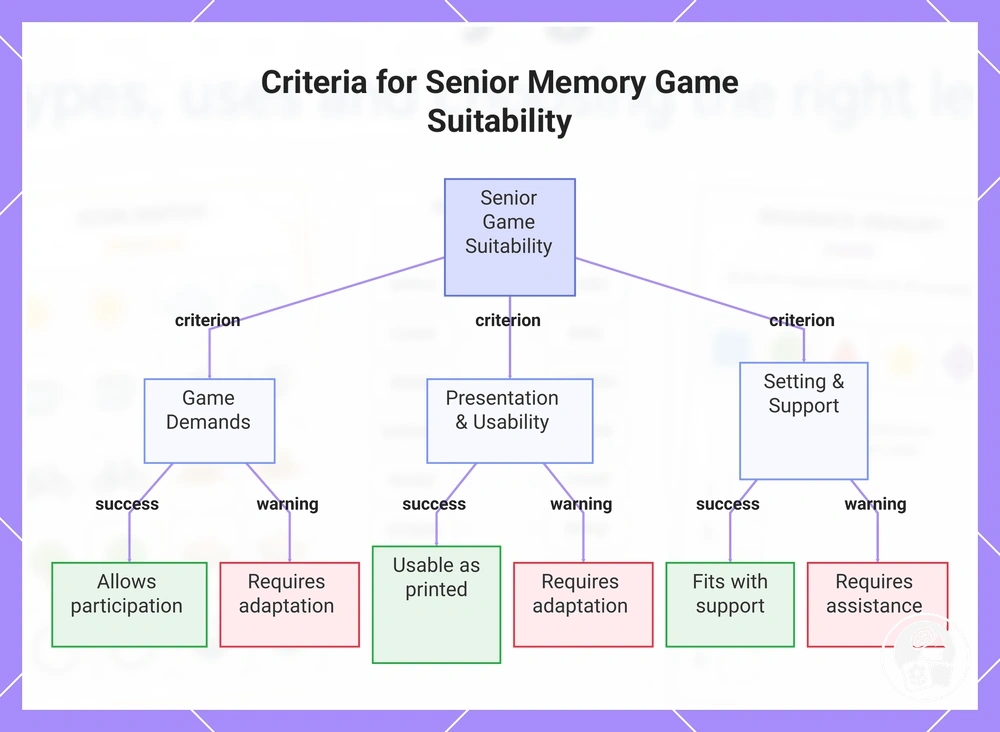
The suitability of a printable memory game for a senior depends on a match across three condition groups: game demands, presentation and usability, and setting and support.
A game fits an individual when its task type, difficulty, and rule complexity are manageable, its readability allows the printed material to be used comfortably, and the available support and setting allow participation; chronological age alone does not establish that fit.
These criteria determine practical fit for a particular individual and context rather than rank games universally.
The task-demand criterion fits when the individual can understand the task and rules at the presented difficulty; presentation and usability fit when print size, layout, and other readability features allow the material to be perceived and handled; setting and support fit when the activity can be completed with the assistance available in that environment.
A single age cut-off, difficulty score, print-size threshold, or fixed support level is not a reliable universal selection rule for every senior. Choose the level from the person’s current ability to see the material, understand the rules, participate comfortably, and use the support that is available.
- Task demand: If the task type is understandable and the difficulty is manageable for the individual, the game allows participation; if the rule complexity prevents the person from following what to do, the game requires adaptation or a different task demand.
- Presentation and usability: If the print size and layout provide adequate readability for the individual, the printed game is usable in that condition; if the material cannot be comfortably perceived or handled, the presentation requires adaptation.
- Setting and support: If the setting provides the support the individual requires, the game can fit that use context; if independent use is not workable but assistance enables participation, suitability is conditional on that assistance being available.
For example, the same matching game can fit one individual who can read its cards, understand its rules, and complete the task independently, while another individual may require clearer presentation, reduced rule complexity, or support in the same setting.
The relevant selection rule is therefore to match the activity's demands and usability conditions to the person and context rather than infer suitability from age alone.
This chart shows the three condition groups that determine whether a printable memory game fits a senior, and the outcomes when each condition is met or not.
Game Format and Memory Task
Game format determines the primary task demand in a printable memory game for seniors.
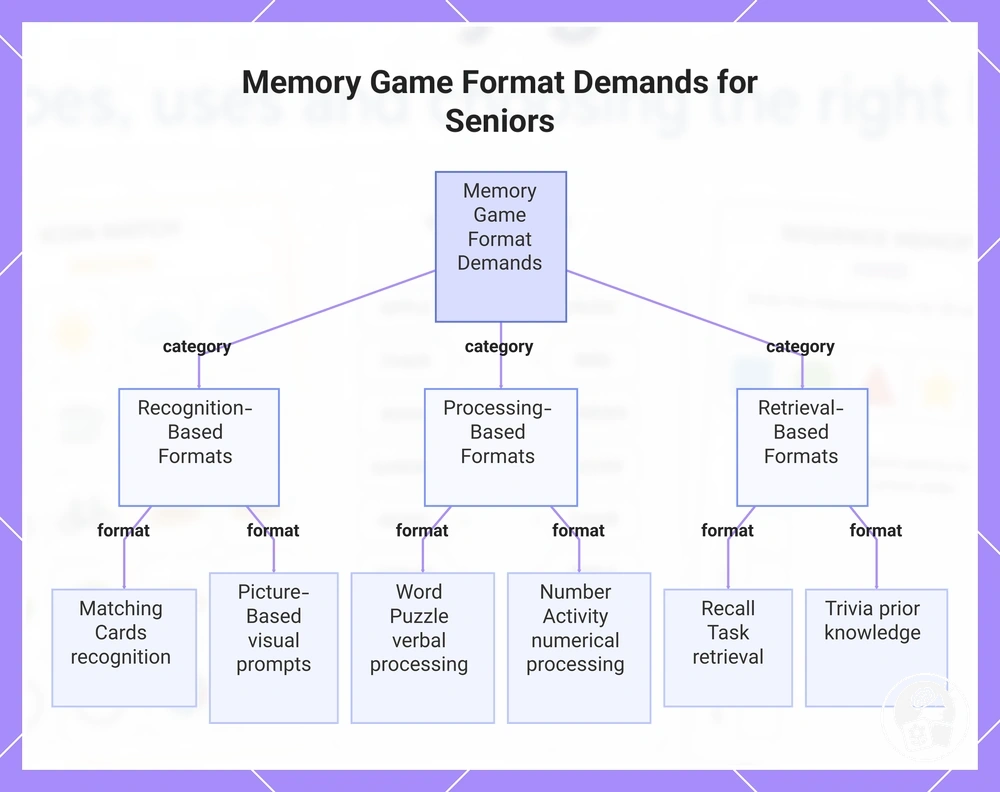
Matching cards emphasise comparison and recognition of pairs; picture-based activities emphasise processing visual prompts; a word puzzle or number activity adds verbal or numerical processing; a recall task requires retrieval of previously presented information; and trivia relies on retrieving previously acquired knowledge from a question or clue.
The selection relevance is the difference between those demands, not a universal ranking of formats.
A format is suitable in this context when its distinguishing demand matches the kind of task the participant is intended to perform; the representative comparison below shows that distinction, while a broader classification is covered under types of printable memory games.
- Matching cards: Matching pairs requires comparison and recognition and can involve visual memory; the distinction matters when the activity is intended to provide visible items that can be compared directly.
- Picture-based activities: Recognising, matching, or recalling pictured items requires processing visual prompts; the distinction matters when pictures, rather than written words or numerals, are the information used for the task.
- Word puzzle: Working with printed words requires verbal processing alongside the puzzle's memory demand; the distinction matters when reading and manipulating word-based information are intended parts of the activity.
- Number activity: Remembering, matching, or sequencing numerals requires numerical processing alongside the specified memory demand; the distinction matters when numbers are the information the participant is expected to process.
- Recall task: Producing or identifying previously presented information after the original material is removed or reduced requires retrieval rather than continuous comparison with the full original cue; the distinction matters when remembering without that full cue is the intended demand.
- Trivia: Answering a question or clue requires retrieval of previously acquired knowledge; the distinction matters when the activity calls for an answer from prior knowledge rather than recognition of a presented matching pair.
This chart categorises printable memory game formats by their primary cognitive demand, emphasising that selection relevance lies in the difference between demands, not a universal ranking.
Difficulty, Rule Complexity, and Support Needs
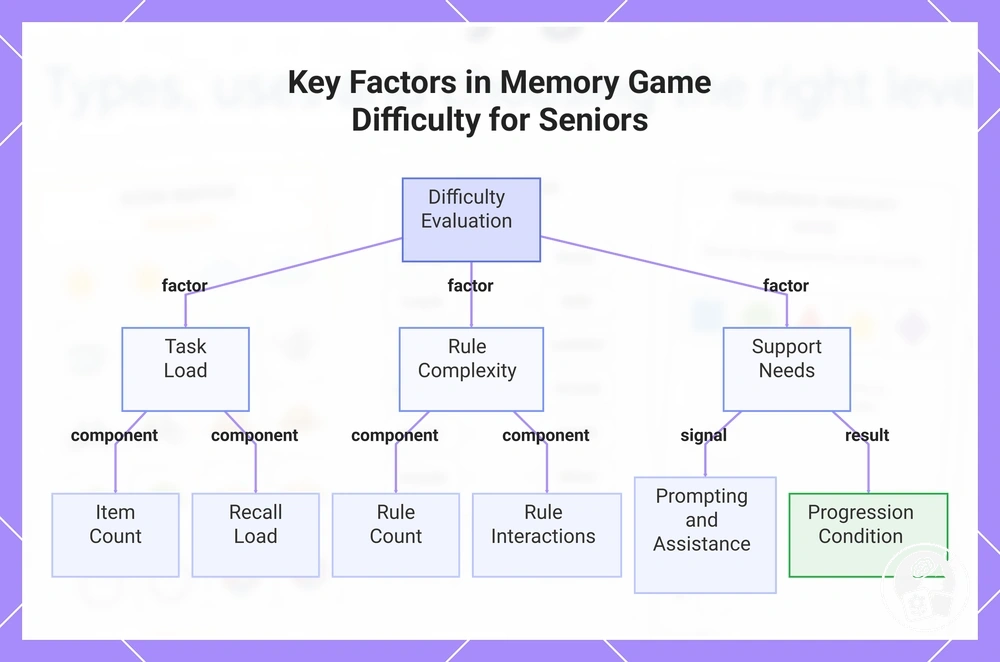
The difficulty of printable memory games depends on three conditions: task load, rule complexity, and the support required to complete the activity, rather than an “easy” or “hard” label alone.
Task load includes the number of items and recall load, while external support includes prompting or assistance needed to understand and continue the task.
A fixed item-count cut-off, prompting threshold, or progression rate is not a reliable universal rule for every senior. Set difficulty from repeated performance, comprehension, comfort, and the amount of support required.
Difficulty should therefore be evaluated by separating the challenge built into the activity from the support used to complete it.
Item count and recall load affect how much information the task requires the participant to process or retrieve, while the number and complexity of rules add demands on comprehension and rule handling.
Repeated prompting under the same task conditions may suggest that the current challenge requires more support, whereas one mistake or a slow response is insufficient to establish excessive difficulty or cognitive impairment.
Progression to a more demanding version is conditional on observable performance, comprehension, comfort, and support requirements rather than a universal numerical schedule.
- Number of items: Increasing the item count increases the amount of material presented within the task. Use fewer items when the current load repeatedly prevents workable participation, and increase the count only when the current level is consistently manageable.
- Recall load: Requiring more information to be retained or retrieved increases the memory-related task demand; fit is conditional on whether the participant can engage with that load with workable comprehension and comfort.
- Rule complexity: Increasing the number of rules, required steps, or interactions between rules adds challenge beyond remembering the game material; difficulty may therefore arise from rule comprehension as well as recall.
- Prompting: A repeated need for cues or explanations indicates that more external assistance is required under the current task conditions; it is a support indicator, not a diagnostic result.
- Support: Independent completion and completion with assistance are different support conditions, so performance should be interpreted together with the amount of help provided.
- Progression: Moving to a more demanding version can increase item count, recall load, or rule complexity, or reduce available support. Progress only when the current level is consistently manageable for the participant, and step back if the change repeatedly prevents comfortable participation.
These criteria assess challenge without assuming that greater difficulty produces greater benefit.
Detailed choosing the right difficulty decisions can then consider how these task and support conditions apply to the individual activity.
This chart shows the three main conditions—task load, rule complexity, and support needs—that determine difficulty, along with specific indicators and the conditional progression rule.
Print Size, Contrast, and Layout Clarity
Visual presentation affects the usability of printable memory games independently of the underlying memory demand.
Print size and instruction legibility affect whether text can be read comfortably, contrast and image clarity affect whether visual elements can be distinguished, and spacing, visual clutter, and layout affect whether the page can be navigated and followed.
A readable presentation can therefore improve access to the activity without making its recall rules or memory task cognitively easier.
Text legibility improves when print is sufficiently clear for the person and printing conditions; Vision Australia uses 18-point Arial for its large-print documents, but that production specification is a large-print reference rather than a universal font-size threshold for printable memory games.
Visual distinction improves when contrast and image clarity make relevant items easier to separate from their backgrounds or from one another, while page organisation improves when spacing separates related elements and visual clutter does not compete with instructions or game content.
For printed memory games, use clear visual contrast, distinct images, and enough spacing for the individual to separate instructions and game elements. A single contrast ratio or spacing measurement should not be treated as a universal suitability rule for every senior.
- Print size and instruction legibility: Clearer or larger text can improve legibility when the participant can read the game content and instructions more comfortably; Vision Australia's 18-point Arial large-print specification provides a documented large-print reference, not a guarantee of suitability for every participant.
- Contrast: Greater visual distinction between relevant content and its background can improve visibility; Vision Australia gives black on white and black on yellow as examples of strong contrast while advising that contrast should meet the individual's needs.
- Image clarity: Pictures and symbols should be distinct enough for the participant to identify the intended item; unclear or overly similar images can introduce a visual-recognition obstacle separate from the memory demand.
- Spacing: Separation between instructions, cards, answer areas, or other elements can make their relationships easier to follow. Increase spacing when neighbouring elements are difficult to distinguish, while keeping related items visually grouped.
- Visual clutter: Unnecessary competing elements can make relevant information harder to locate, whereas a simpler presentation can make the game content easier to identify and follow.
- Layout: Page organisation should keep instructions and game elements distinguishable and navigable; a clear layout can improve usability while the underlying memory task remains difficult.
These attributes evaluate printable presentation rather than eyesight or cognitive status, and difficulty reading a worksheet does not by itself establish either condition.
More detailed guidance on making printable games easier to read belongs to the separate readability and accessibility context.
Factors That Change How a Printable Memory Game Is Used
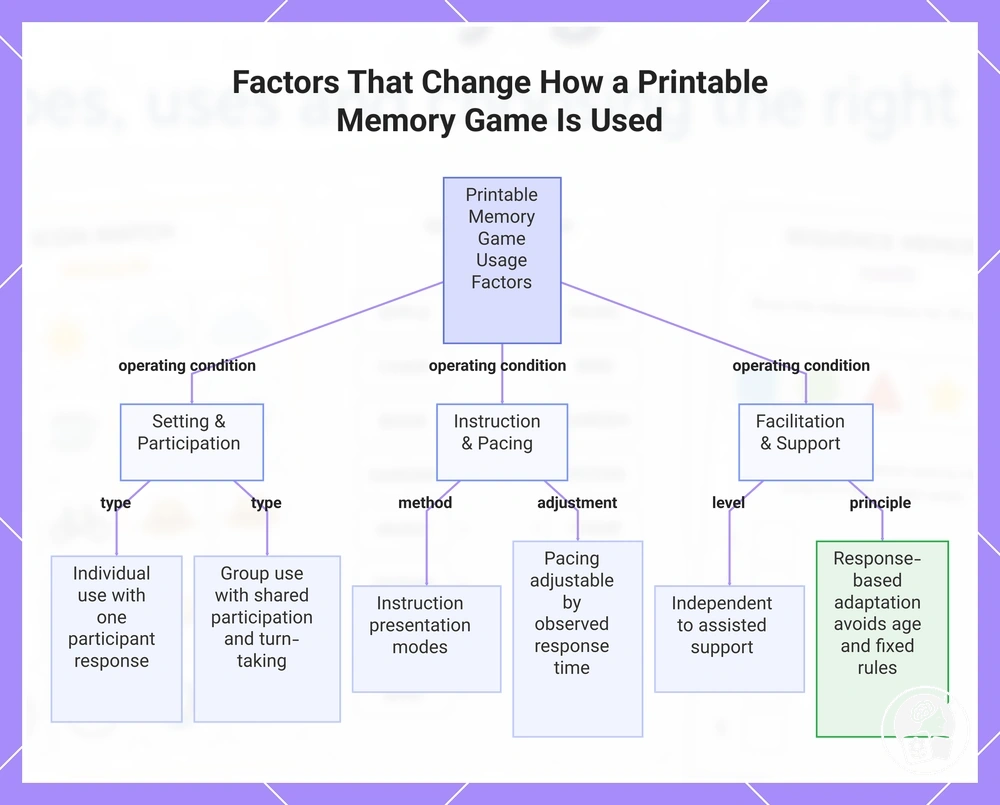
The same selected printable memory game may be used differently according to its setting, facilitation, pacing, instructions, turn-taking, and support.
Individual use allows facilitation to follow one participant response, while group use adds shared participation and, when the game format calls for it, turn-taking; these are operating conditions after game selection rather than reasons to assume a different game is required.
Instructions may be presented verbally, demonstrated with the printed materials, or combined, and pacing may provide more or less response time according to what is observed during play.
Facilitation also changes the opportunities for prompting: a participant may complete the activity independently, receive an occasional cue or clarification, or receive continuing assistance with the task.
No fixed response-time, prompting-frequency, or support setting should be used as a universal rule for every participant. Allow more time or support when the person cannot proceed under the current conditions, and reduce assistance when it is no longer needed.
Adaptation should follow the participant response under the actual use conditions rather than chronological age alone.
If the participant follows the instructions and participates comfortably, the current setting, pacing, and support can remain in place; if the observed response shows that clarification, more response time, or prompting is needed, facilitation can be adjusted to that condition without treating the response itself as a diagnosis.
This chart shows the operating conditions that affect how a printable memory game is used, emphasising adaptation based on participant response rather than universal rules.
Individual and Group Settings
An individual setting allows the pace, prompting, and facilitator attention for a printable memory game to follow one participant, while a group setting requires those conditions to be shared across participants.
In one-to-one use, facilitator attention can remain with the same participant and prompting can respond directly to that person’s progress. Keep the pace flexible rather than imposing the same response time or prompting schedule on every participant.
A group setting introduces turn-taking and social interaction and may add cooperation or competition when the selected game uses those forms of participation.
Mixed challenge levels also change facilitation because facilitator attention and prompting must be distributed: for example, one participant may need a cue while another is ready to take a turn, so the pace can differ between participants even though they share the activity.
Group size, turn length, prompting, and support should be set so participants can take part and facilitator attention can be shared. Do not treat one group size, turn duration, or support level as a universal target for all seniors.
Detailed decisions about turn-taking, mixed challenge levels, and shared facilitation belong to using memory games with a group.
Instructions, Pacing, and Support
Clear preparation, instructions, demonstration, suitable pacing, observation, and proportionate support help an already-selected printable memory game function as intended by reducing avoidable confusion during the activity.
Response time and prompting should remain condition-specific: allow time for a response before adding help, then adjust support according to observable comprehension and participation rather than a fixed schedule.
- Prepare: Arrange the printed materials and required game pieces before the activity so the setup matches the instructions and the participant can identify what will be used.
- Explain and show: Give the instructions for the selected game and use a demonstration or example turn when explanation alone does not make the rule clear. Check the participant's observable response before adding another explanation or prompt.
- Allow response time: After giving the instruction or presenting a turn, allow time for a response before prompting. Use the participant’s observable processing and participation rather than a fixed number of seconds as the practical guide.
- Observe: Use observation of comprehension and participation as the verification point: continuing with the task indicates that the current explanation and support are sufficient for that moment, while difficulty proceeding indicates that clarification or assistance may be needed.
- Adjust support: Increase prompting or assistance when the participant cannot proceed under the current conditions, and reduce support when the participant can continue without it. Support is a condition of participation, not a score.
This sequence covers immediate facilitation of the selected activity; how to introduce and use the games addresses the broader implementation context.
Signs a Printable Memory Game Needs Adjustment
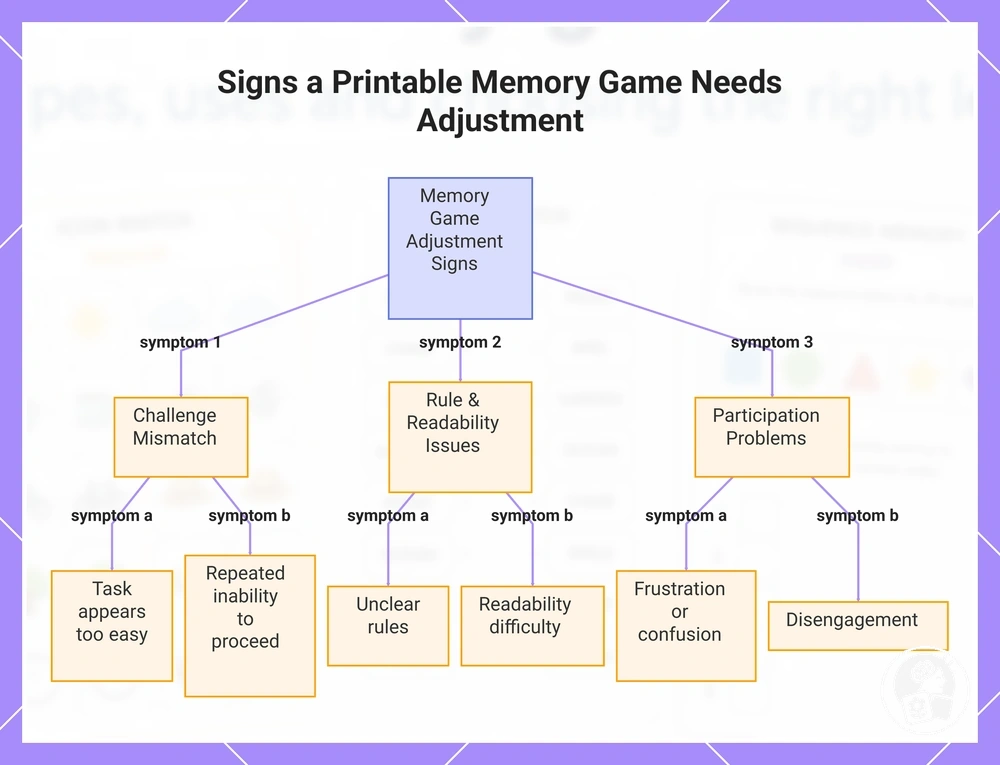
A printable memory game needs review when observable signs repeatedly point to poor fit in the game, printed presentation, or facilitation, including challenge mismatch, unclear rules or readability difficulty, and participation problems such as frustration, confusion, or disengagement.
These signs suggest checking challenge, presentation, pace, or support. A single occurrence does not identify the cause; use a repeated pattern across attempts to decide what to review.
The signs are useful for triage because each directs attention to a different area rather than identifying a proven cause.
A repeated pattern across attempts strengthens the practical reason to check activity fit, whereas a single occurrence does not establish why the difficulty happened.
- Challenge mismatch: Repeated performance that makes the task appear too easy or leaves the participant repeatedly unable to proceed suggests checking whether the current challenge is insufficient or excessive.
- Unclear rules: Repeated uncertainty about what to do next suggests checking the instructions, rule complexity, pace of explanation, or available support.
- Readability difficulty: Repeated difficulty identifying printed words, pictures, cards, instructions, or layout elements suggests checking readability and whether visual difficulty in the presentation is interfering with the activity.
- Frustration or confusion: A recurring pattern of frustration or confusion during play suggests checking challenge mismatch, unclear rules, presentation, pace, or support as possible contributors.
- Disengagement: Repeatedly withdrawing from turns or stopping participation suggests checking task fit and facilitation conditions; disengagement alone does not identify which possible contributor is responsible.
These observable signs point to areas to check, not proven causes or clinical findings. Use them to review activity fit, not to diagnose cognitive status.
Once the relevant problem class has been identified, troubleshooting common problems can address the next checks without turning an activity-fit observation into a medical interpretation.
This chart groups observable signs that a printable memory game needs adjustment, pointing to areas to check rather than proven causes.
The Activity Is Too Easy or Too Difficult
A challenge-level mismatch in a printable memory game can appear in two contrasting patterns: effortless completion or boredom may suggest the activity is too easy, while repeated guessing, rule breakdown, inability to progress, or heavy prompting may suggest it is too difficult.
Do not classify the challenge level from one completion time, error count, item count, or prompting episode. Use the repeated pattern of completion, errors, rule handling, prompting, and comfort to judge whether the current level needs review.
Effortless completion combined with recurring boredom suggests insufficient challenge and may warrant reviewing whether the challenge level should increase; effortless completion by itself is less conclusive.
Repeated guessing or rule breakdown, particularly when the participant cannot progress without heavy prompting, may reflect excessive demand and may warrant reviewing whether the challenge level should decrease.
A pattern across play provides a stronger basis for this tentative interpretation than an isolated result, without assigning a clinical meaning to the observed performance.
The next decision is therefore whether the current challenge level should be reviewed.
The Print or Layout Is Hard to Read or Follow
Difficulty with a printable memory game may stem from its presentation rather than the memory task when the participant has trouble perceiving or following information on the page.
The diagnostic value is conditional: problems involving legibility, item separation, visual clutter, image distinction, or instruction clarity support checking the layout, while one failed item is insufficient to establish presentation as the cause.
Difficulty reading the instructions suggests checking legibility; difficulty separating neighbouring items suggests checking item separation and spacing; and repeatedly losing the relevant item among competing elements suggests checking visual clutter and layout organisation.
Difficulty telling pictures apart suggests checking image distinction and contrast, while uncertainty about the action required by otherwise readable content suggests checking instruction clarity.
Do not use one font size, spacing measurement, contrast ratio, or error count as a universal cause threshold. Check whether difficulty with legibility, item separation, image distinction, or layout recurs under the actual printed presentation.
If these checks plausibly account for the observed difficulty while the memory task can otherwise be followed, the next decision is to review whether the presentation needs adjustment.
Frustration, Confusion, or Disengagement
Frustration, confusion, and disengagement during a printable memory activity are observable participation states with multiple possible contributors rather than one confirmed cause.
Their interpretation is conditional: challenge, unclear rules, pace, support, visual difficulty, and setting are distinct activity conditions to check. No single observation assigns one of these conditions as the cause, so compare the pattern across repeated attempts before changing the activity.
Frustration may relate to excessive challenge, an unsuitable pace, or insufficient support, while confusion can arise when unclear rules, instructions, or prompting make the expected action difficult to follow.
Disengagement may relate to the setting or social context, but challenge, support, or visual difficulty can also contribute to the same observable response.
Because frustration, confusion, and disengagement do not have a one-to-one relationship with these conditions, the relevant activity conditions should be checked together before assigning a cause.