
Running Printable Memory Games With a Group of Seniors
To run printable memory games with a group of seniors, choose the group format before the round, make turn ownership and response rules explicit, give waiting participants a defined way to stay involved, and adapt the participation structure when a recurring imbalance appears. Treat the group size as workable when participants receive regular, recognisable response opportunities and the facilitator can still track the sequence.
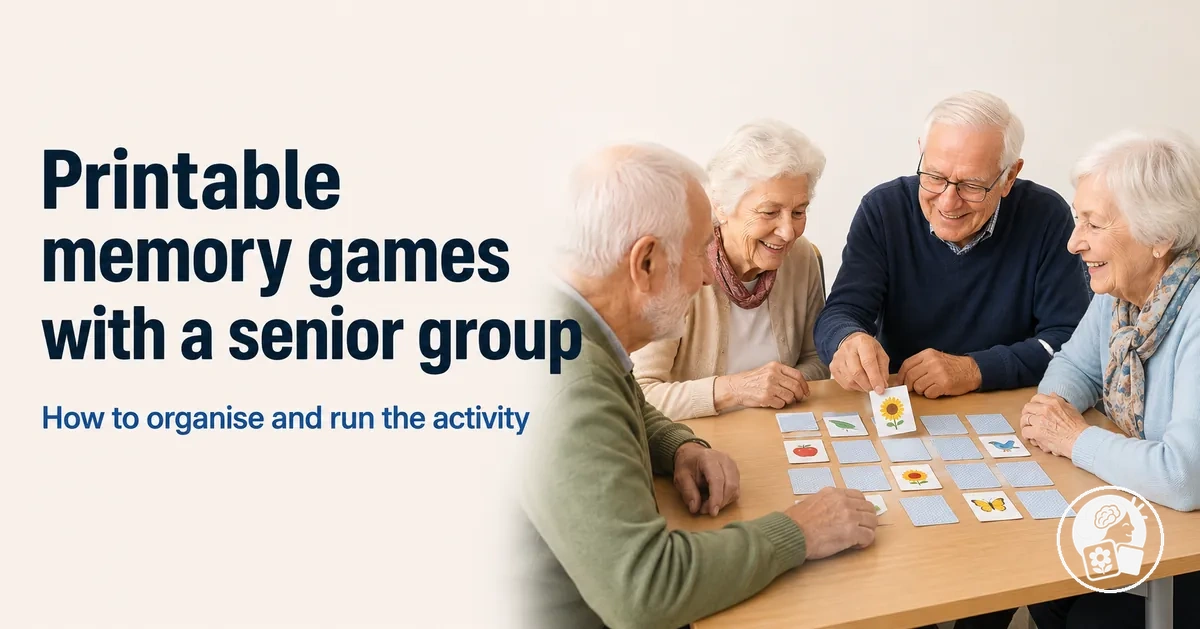
Group memory-game facilitation guide
Use these four controls to plan, run, adapt and review the same printable game. The key question is not a fixed participant number; it is whether each person can identify a response opportunity and the facilitator can maintain a clear turn sequence.
- Plan the formatChoose individual, paired or shared responding so each participant has a recognisable way to contribute.
- Run clear turnsName the current turn, state the response rule and mark the end before handing play to the next participant.
- Adapt participationUse pairs, shared responses or flexible roles when the current structure repeatedly limits a participant's opportunity to contribute.
- Check the patternLook across several turns or rounds for repeated waiting, confusion, interruptions or concentrated participation.
Adjust from the recurring signal
- Long waits
- First check group size and turn frequency; if the sequence is too long, split the group, pair participants or change the turn arrangement.
- Turn confusion
- Clarify who owns the turn, the start cue and the response boundary before changing the game itself.
- Uneven responses
- Protect identifiable response opportunities with clearer turn ownership, shared responses or role rotation.
- Handling limits participation
- Separate the choice from material handling so one person can communicate the response while another handles the printed pieces.
- Scoring changes interaction
- Compare cooperative shared-goal play with competitive individual or team scoring according to how the group responds.
Decision rule: change one format variable at a time, observe the same participation signal across several turns or rounds, then keep or revise the change according to the resulting pattern. A single quiet, slow or interrupted turn is not enough to identify the cause.
Group play requires clear participation rules, manageable waiting time, and visible turn ownership so each participant can recognise when to respond and when to wait.
The facilitator should therefore make the turn-taking pattern and response rules explicit rather than relying on the printable memory game alone to organise the group.
Printable memory games used with a group of seniors run differently according to group size, group format, pace, and participant differences.
More participants or longer responses increase the interval before a participant's next turn, while pairing participants or assigning roles changes how often each person participates. Use group size and pace as adjustable variables: retain them only while participants still receive recognisable response opportunities and the facilitator can track the sequence.
The facilitator should therefore use the observable condition—whether participants can follow the turn order, recognise the response rule, and remain included in the activity—to decide whether the current pace and format are workable.
This page covers group-specific facilitation after a printable memory game has already been selected; game selection, cognitive outcomes, and detailed troubleshooting are separate topics.
The next planning decision is to choose a group format that makes turn ownership clear, keeps response rules consistent, and allows the facilitator to adjust the pace when the group's participation pattern shows that an adjustment is needed.
Table of Contents
Plan the Group Format Before the First Round
Choose the group format for the printable memory game before play starts by checking participant count, response format, turn structure and facilitator capacity.
The workable condition is that each participant has a recognisable way to respond, the turn structure makes the next response clear, and the facilitator can follow participation across the group.
These group-specific decisions are separate from the broader selection and use of printable memory games for seniors.
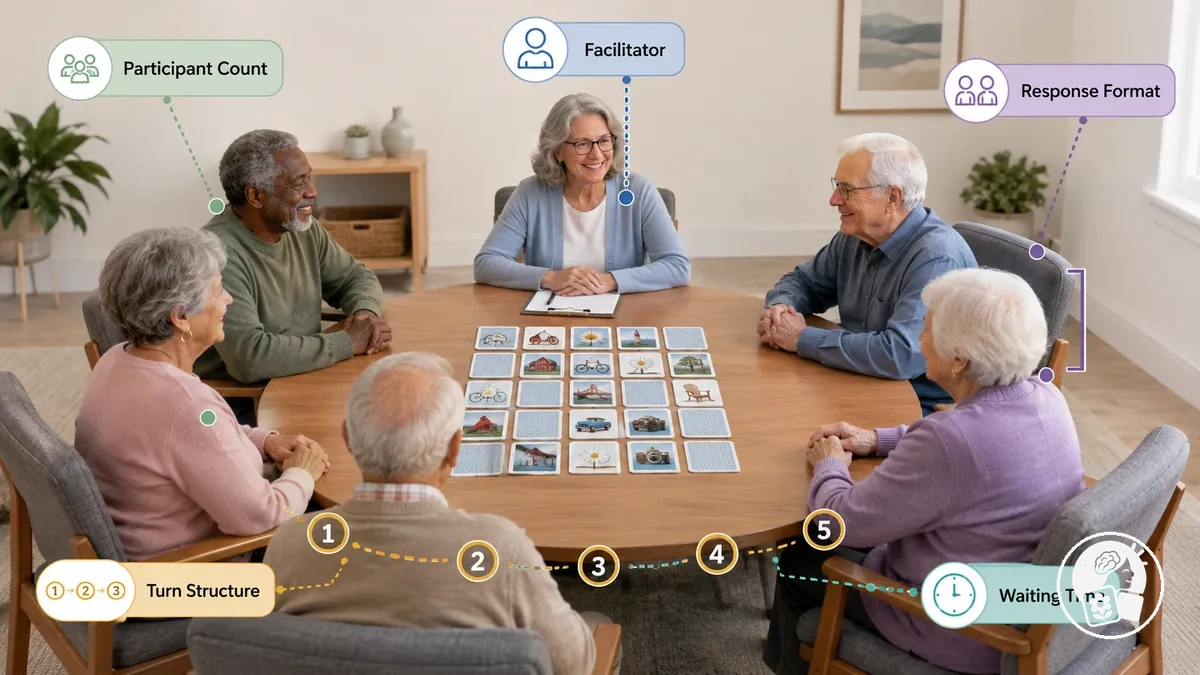
Before the round, observe participant count, expected response pattern, turn structure, facilitator attention, and likely waiting time, then use those conditions to choose the play format.
With a fixed one-person-at-a-time sequence, adding participants increases the number of other turns between one participant's turns; paired or shared responses reduce the number of separate response units and therefore change turn frequency.
Do not treat a fixed participant count, facilitator-to-participant ratio, or waiting-time limit as a universal rule for this activity. The pre-round criterion is whether the chosen arrangement gives participants a clear response opportunity and allows the facilitator to track the turn sequence.
- Participant count: Check whether every participant can be assigned a recognisable response opportunity; if individual turns become difficult to track, consider pairs or another shared-response arrangement.
- Response pattern: Choose an individual, paired, or shared response format according to how participants will signal an answer and how clearly the facilitator can identify the active response.
- Turn structure: Use an explicit sequence for individual responses; cooperative play may use a shared goal and shared responses, while competitive play may require a defined active turn and scoring rule.
- Facilitator oversight: Choose an arrangement that allows the facilitator to observe the active response, cue the next turn, and identify a participant who has not received a clear opportunity to respond.
- Waiting time: Check how many other turns or response units occur before the same participant responds again; if that interval leaves participants without a clear role for multiple turns, change the grouping or response format before starting.
For example, suppose eight seniors use a fixed individual turn structure: after one participant responds, seven other individual turns occur before that participant's next turn; if the same eight participants are arranged as four pairs, three other pair turns occur before that pair responds again.
These are illustrative calculations from the stated hypothetical group arrangements, not evidence-based recommendations for participant count or waiting time.
Before the first round, the facilitator should check that each participant can identify how to respond and when the next turn occurs, and use the chosen group format only when those conditions are workable for this group.
Choose a Group Size That Allows Frequent Participation
Group size is workable when the participant count allows regular turn opportunities, manageable waiting time, enough facilitator attention to follow participation, and a response pace that fits the response demands of the printable memory game.
Do not apply a single group-size number automatically to every session. Evaluate group size by observable participation conditions—regular response opportunities, manageable waiting, clear turn tracking and sufficient facilitator attention—rather than by a fixed participant count.

As participant count increases in a one-at-a-time format, the number of intervening turns increases, which increases waiting time and reduces turn frequency unless the response structure changes.
For example, suppose a group has eight participants taking one turn each in a fixed sequence: seven other turns occur before the first participant responds again; splitting the same eight participants into two illustrative groups of four reduces that interval to three other turns within each group, assuming the same one-turn-per-person sequence.
These figures are calculated examples of the turn-order relationship, not recommended group sizes or evidence-based thresholds.
A split may be useful when repeated waiting leaves participants without regular response opportunities or when facilitator attention is insufficient to follow who is participating; one quiet turn alone does not establish that the group is too large.
Choose Between Cooperative and Competitive Group Play
Cooperative play organises the printable memory game around a shared goal and shared or coordinated responses, while competitive play uses individual or team scoring with explicit turn ownership.
Compare the two formats on the same facilitation dimensions: goal structure, turn ownership, interaction, pressure, and participation pattern.
Suitability is conditional on how the group responds to shared versus separately owned responses, rather than on one format being universally preferable.

| Format | Goal structure | Participation implication | Suitable group condition |
|---|---|---|---|
| Cooperative | Shared goal | Interaction can include shared or coordinated responses, so participation does not require each response to produce a separate individual score. | May suit a mixed ability group when participants can contribute toward the shared goal despite differences in individual response levels. |
| Competitive | Individual or team scoring | Turn ownership is explicit because each scoreable response belongs to an individual or team; pressure can increase or reduce depending on how participants respond to competition. | May suit a group when participants can follow separate individual or team turns and are comfortable having responses attached to individual or team scoring. |
The practical trade-off is how the same printable memory game distributes participation: cooperative play emphasises contribution toward a shared goal, whereas competitive play emphasises separately owned turns and individual or team scoring.
For example, suppose four seniors of mixed ability complete eight turns and one participant supplies five responses while the other three supply one response each; changing those same eight responses from separately scored turns to contributions toward one shared goal changes the goal and scoring structure, but it does not by itself prove that participation will become balanced.
The facilitator can use the observed distribution of responses and participants' reactions to scoring to judge which format fits the group's participation pattern without inferring a memory or cognitive outcome from the play format.
Run Each Round With Clear Turn-Taking
Run each group round with explicit turn-taking: establish who owns the current turn, state the expected response, and mark when that turn is complete before passing play to the next participant.
The operational sequence is clear turn ownership → clear response boundary → orderly turn transition.
Use a consistent facilitator cue for each handoff so participants can identify when to respond and when to wait.
The suitable pace is the pace at which this group can follow the sequence and complete responses without unnecessary waiting. Do not impose a fixed seconds-per-turn target unless the specific setting or program provides one.
Use the sequence below to organise turn ownership, cueing, and transitions during the round; it assumes the general memory-game setup and instructions are already understood.

- Establish the turn sequence: identify the first participant and the order in which turns will pass, so current and next-turn ownership are explicit.
- State the response rule: tell the group what response belongs to the active turn and what marks the turn end.
- Cue the start: use the facilitator cue to show that the named participant now has the response opportunity.
- Pass the turn: when the response boundary is reached, mark the turn as complete and cue the next participant. For example, after Maria completes her response, the facilitator can mark her turn as finished and cue David to begin his turn.
- Maintain the pace: continue the same turn sequence while observing waiting time and participation, slowing the handoff when participants need more response time and shortening avoidable pauses when the group is ready to continue.
- Verify clarity: check that participants can identify the active turn, expected response, and next turn before continuing the sequence.
Verify turn-taking by observing whether participants respond to the facilitator cue and follow each turn transition without repeated uncertainty about turn ownership or the response boundary.
If the group repeatedly loses the sequence, make the handoff more explicit or adjust the pace; if participants follow it but spend unnecessary time waiting between completed responses, shorten those pauses.
Use observable participation and clarity conditions rather than an invented timing target: repeated uncertainty calls for a clearer handoff or pace adjustment, while unnecessary pauses after completed responses call for a tighter transition.
Set a Turn Order and Clear Response Rules
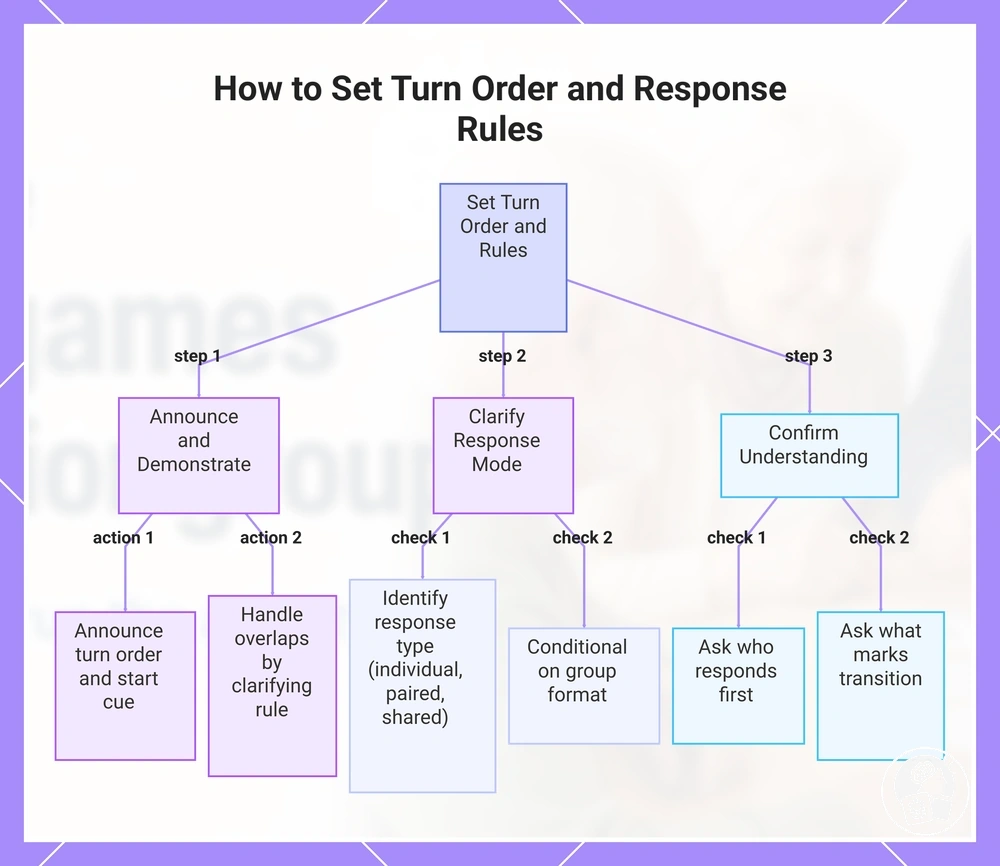
Set the turn order and response rule before play develops momentum so participants know who may respond, what facilitator cue marks the turn start, and what response boundary marks the turn end.
Make turn ownership observable by announcing the turn order and demonstrating the start cue and end condition before play begins.
Clarify whether the local rule uses an individual response, paired response, or shared response; the appropriate mode is conditional on the group's chosen format rather than one universal response pattern.
For example, the facilitator can announce the order as Maria, David, then June, demonstrate that naming Maria is the facilitator cue for her turn start, and state that her completed answer marks the turn end before David is cued.
If David or June answers during Maria's turn, the facilitator can clarify that the current response rule assigns this answer to Maria without treating the overlap itself as a behavioural problem.
The facilitator then confirms understanding by asking the participants to identify who responds first and what marks the transition to the next participant, beginning once those two rule boundaries are clear.
This chart shows the steps to establish clear turn order and response rules before group play begins, including announcement, demonstration, clarification of response mode, and confirmation of understanding.
Keep Everyone Involved Between Turns
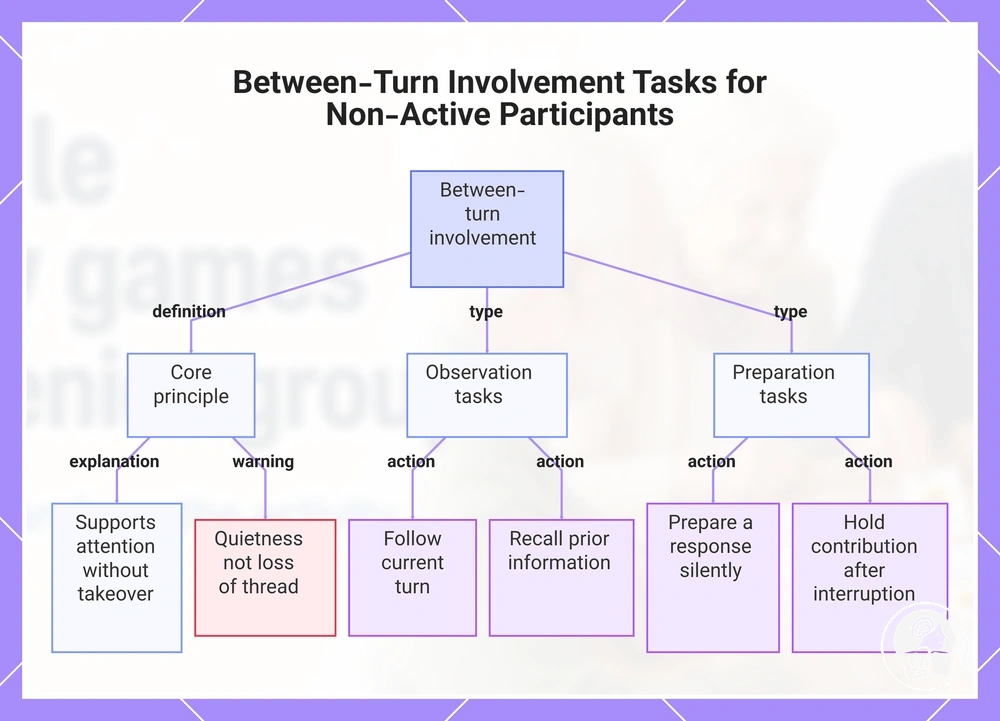
Non-active participants can remain involved between turns when the facilitator gives them a defined participation task while one participant retains ownership of the current turn.
Suitable tasks are to follow the active move, prepare a response for a later turn, recall information already revealed, or support a shared goal when the chosen format allows shared participation.
Waiting time may reduce active involvement when other players have no meaningful task, but quietness alone does not show that a participant has lost the thread.
Constructive between-turn involvement therefore supports attention to the game without taking over the active participant's turn.
Use a between-turn task that fits the observable situation:
- Follow the current turn: when non-active participants are waiting, ask them to follow the active move or information being revealed while leaving the response to the participant who owns the turn.
- Prepare a response: when the game permits advance preparation, other players can prepare a response silently for their own later opportunity rather than calling it out during the current turn.
- Recall prior information: when a later response depends on previously revealed cards, positions, words, or pictures, non-active participants can keep that information in mind while the active participant responds.
- Support a shared goal: when the format uses a shared goal, non-active participants can follow progress or prepare a contribution while preserving the active participant's immediate response opportunity.
- Hold a contribution after repeated interruption: when a dominant responder repeatedly answers during another participant's turn, the facilitator can acknowledge the contribution and ask the responder to hold it for the appropriate opportunity; a single interruption does not by itself establish a participation problem.
For example, suppose four participants are following a card-matching turn and one participant owns the current response: the other three can track the cards being revealed and prepare what they might choose later without announcing an answer.
The four-person scenario is illustrative, not a recommended group-size threshold, and its purpose is to distinguish one active response opportunity from three between-turn participation roles.
The facilitator can vary the task according to what the game requires, but each task should preserve the active player's turn.
This chart shows the core principle and specific tasks facilitators can use to keep non-active participants engaged between turns without disrupting the active player's turn.
Adapt Participation for Mixed-Ability Groups
Mixed-ability group participation may require a different participation structure when meaningful differences in pace, confidence, recall performance, communication, or physical participation change how the same printable memory game functions for the group.
The adaptation criterion is observable: change the group format when the current participation structure repeatedly limits a workable response opportunity, whether through turn burden, response mode or role allocation.
For example, a participant who consistently needs more response time may require a different turn arrangement without requiring a different game.
The adaptation target is participation structure rather than an assumed explanation for the difference.
Use the relation observed participation condition → group effect → facilitation adjustment to decide whether pairing, response mode, turn burden, or role allocation needs to change.
A slower pace can lengthen a turn sequence, lower confidence with individual responding can limit observable participation, differences in recall performance can allow one participant to answer before others contribute, and differences in communication or physical participation can make one response method or material-handling role unsuitable.
Use a condition-based rule rather than a fixed number: retain the existing format while participants have workable opportunities to contribute, and adjust the relevant participation element when the observed condition repeatedly limits those opportunities.
| Observed participation condition | Group effect | Facilitation adjustment |
|---|---|---|
| One participant consistently needs more time to complete a response. | The existing sequence increases that participant's turn burden or extends waiting for the group. | Change the turn arrangement or pairing so different paces can be accommodated without requiring every participant to use the same response pace. |
| A participant contributes with another person but rarely responds when an answer must be given alone. | The individual response mode limits that participant's observable contribution. | Use pairing or a shared response mode when it allows the participant to contribute while preserving opportunities for other participants. |
| Differences in recall performance result in one participant repeatedly answering before others have an opportunity to contribute. | Response opportunities become concentrated rather than distributed across the mixed-ability group. | Change response mode or role allocation so the participant can remain involved while other participants retain identifiable opportunities to respond. |
| A participant can communicate a choice but cannot readily handle the printed materials. | A material-handling role limits physical participation even though a response remains possible. | Allocate material handling to another participant while retaining a meaningful response role for the participant making the choice. |
These adjustments respond to observable participation conditions and do not diagnose why differences in pace, confidence, recall performance, communication, or physical participation occur.
If a participant can communicate a choice but handling the cards is the limiting condition, changing role allocation addresses the group-format issue without making that participant's needs define the entire group's method.
Questions that require difficulty modification, detailed accessibility measures, or clinical interpretation fall outside this participation-focused section.
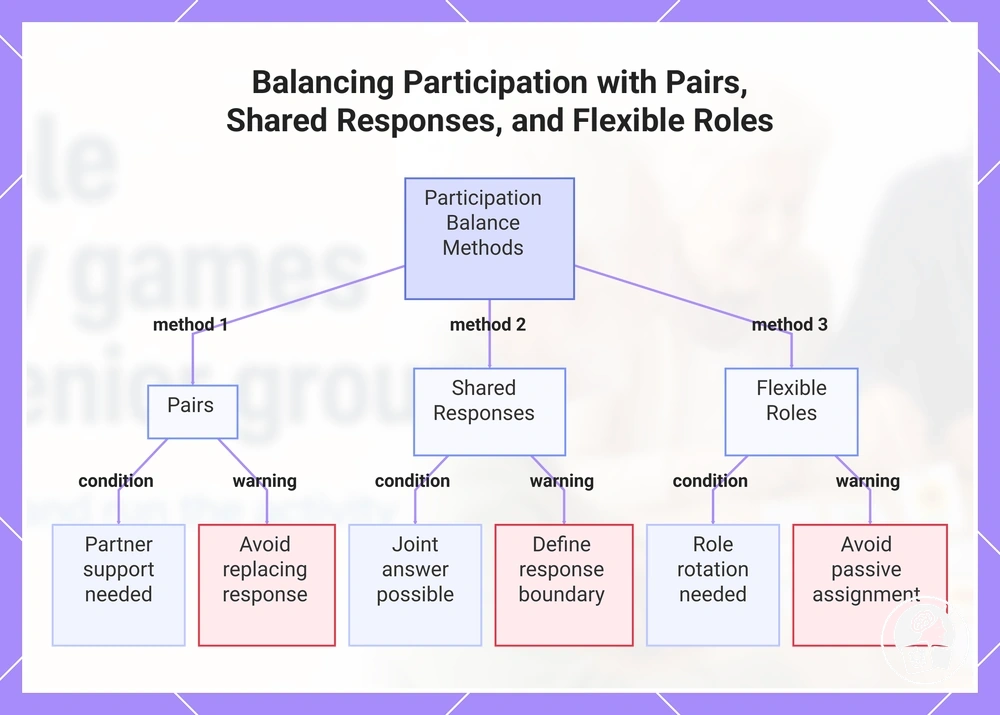
Use Pairs, Shared Responses or Flexible Roles to Balance Participation
Pairs, shared responses, and flexible roles redistribute turn burden in different ways when individual turns produce a persistent participation imbalance.
Pairs divide participation between two partners, shared responses make response ownership joint for a defined answer, and flexible roles rotate response or material-handling functions among participants.
The facilitator should choose among these three methods according to the participation condition being addressed rather than treating one method as universally preferable.
Participation balance remains the outcome being managed while the underlying printable memory task can remain the same.
The three methods below compare participation methods, not fixed ability labels.
- Pairs: Pairs redistribute turn burden between two partners and may fit when a participant can contribute more readily with partner support than through an individual-only turn. The partner can support the response, but consistently supplying the other participant's answer replaces rather than redistributes that participant's response opportunity.
- Shared responses: Shared responses change response ownership from an individual answer to a joint response and may fit when participants can contribute to the same answer without requiring separate turns. The facilitator should define the joint-response boundary because excessive prompting or one participant repeatedly answering first can concentrate participation despite the shared format.
- Flexible roles: Flexible roles redistribute participation through role rotation, such as separating the person who communicates a choice from the person who handles the printed materials, and may fit when one fixed role restricts a participant's contribution. Role rotation becomes ineffective for participation balance if the same participant is repeatedly assigned a passive function rather than a meaningful response role.
For example, suppose two partners perform the same card-matching task: on one turn, Partner A communicates the two card selections while Partner B turns those cards, and on a later turn the two roles are reversed.
This illustrative two-person example changes two participation functions—response ownership and material handling—without changing the underlying task of selecting and matching cards.
If the partner or facilitator instead prompts until the selection is effectively supplied for the participant, the role structure should be adjusted because the intended response opportunity has been replaced rather than redistributed.
This chart compares three methods for redistributing turn burden to address participation imbalance, including when each method fits and key cautions.
Check Whether the Group Format Is Working
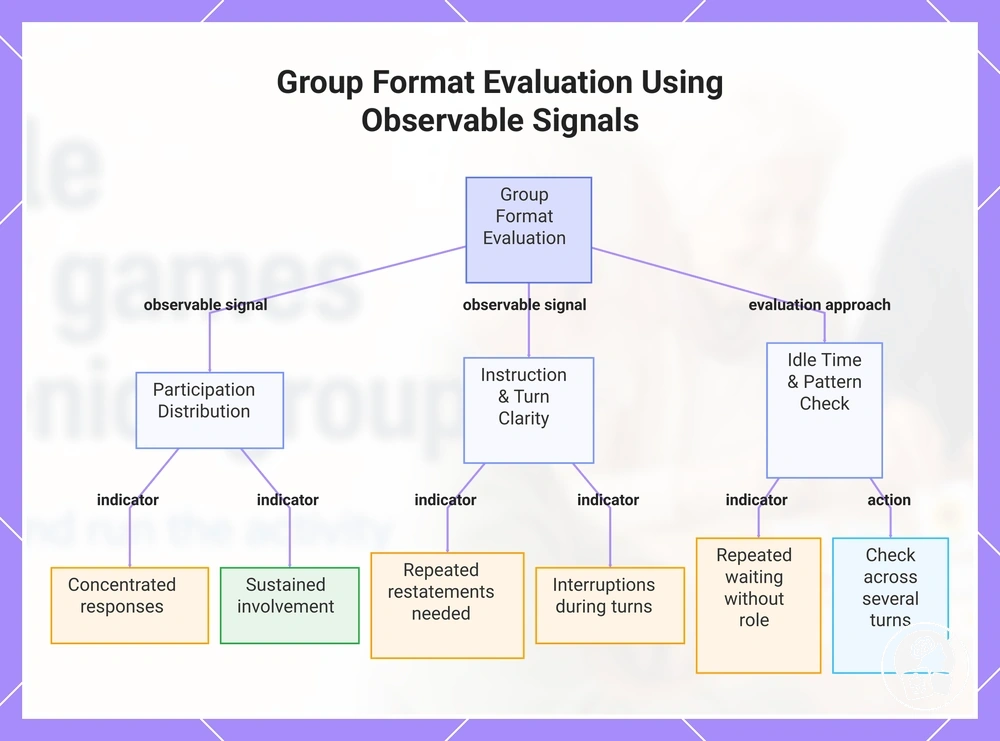
The current group format remains workable when observable participation distribution is reasonably spread across participants, instruction clarity is maintained, and idle time does not repeatedly leave participants without a defined role.
Evaluate group-format performance through observable behaviour such as turn frequency, understanding of the response rule, waiting time, and sustained involvement rather than assumptions about an individual's behaviour.
Do not use a single count of turns, rounds, interruptions, skipped participants or minutes of idle time as a universal pass/fail rule. Judge the format from a recurring participation pattern across several turns or rounds.
Use the following criteria to separate each observable signal from its possible implication for the group format:
- Participation distribution: When turn frequency repeatedly concentrates responses among the same participants or produces skipped participants, the pattern suggests that the current participation structure may warrant adjustment.
- Instruction clarity: When participants repeatedly need the facilitator to restate whose turn it is or what the response rule requires, the observable behaviour indicates a need to check whether the current turn cues and instructions remain clear.
- Interruptions: When responses repeatedly occur during another participant's turn, the pattern suggests checking turn ownership or the response rule; one interruption does not establish why it occurred.
- Idle time: When participants repeatedly wait without a defined role after other turns are completed, the pattern may warrant adjustment to the current group format; treat repeated undefined waiting as the signal to adjust rather than waiting for a fixed time limit.
- Sustained involvement: When participants continue following the activity and receive identifiable opportunities to contribute, the observable participation pattern supports retaining the current format; one quiet turn, one incorrect answer, or one slow response does not establish a contrary pattern.
Check the same observable signals across several turns or several rounds before changing the group format, because the relevant value is a recurring participation pattern rather than a single event.
Cornell University's Center for Teaching Innovation advises assessing group processes as well as outcomes and observing how members participate, supporting repeated observation without assigning a certain cause to one behaviour.
When the same participation-distribution, instruction-clarity, or idle-time issue recurs across the observation period, make a measured adjustment to the relevant format variable and evaluate the subsequent pattern rather than assigning a simple success-or-failure verdict.
This chart shows how to evaluate whether a group format is working by observing participation distribution, instruction clarity, idle time, and sustained involvement, and by checking patterns across multiple turns rather than single events.
Look for Long Waits and Uneven Participation
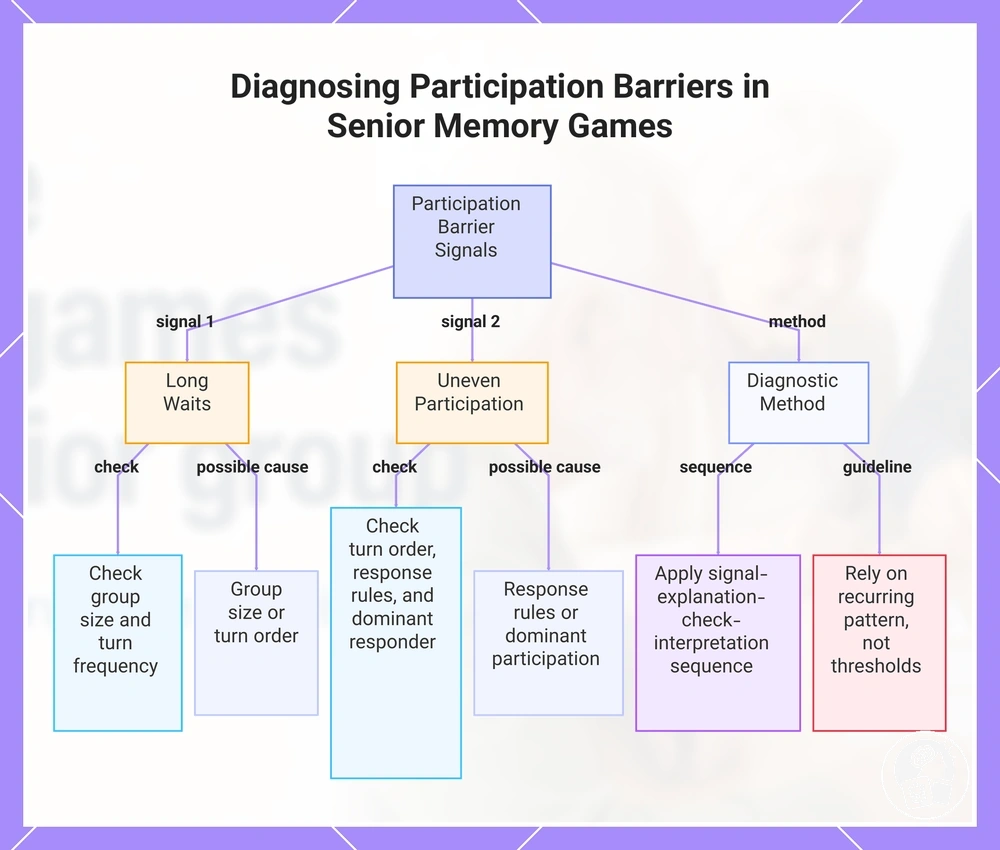
Long waits and uneven participation are signals that the group format may be creating a participation barrier, but neither observable pattern establishes its cause.
Long waits may reflect group size or turn order, while uneven participation may reflect response rules or dominant participation by one responder.
The differentiating check is whether the pattern changes when the relevant format variable is changed while the memory game itself remains the same.
Interpret long waits or uneven participation from a recurring observable pattern rather than an invented numerical cutoff.
Apply the sequence signal → possible format explanation → check → interpretation: long waits suggest checking group size and turn frequency, while uneven participation suggests checking turn order, response rules, and whether a dominant responder is taking opportunities assigned to others.
For example, suppose an illustrative six-person group uses one turn per participant: five other turns occur before the first participant responds again, so the same visible waiting could reflect the group size, a slow turn order, or unclear response rules if other participants repeatedly respond out of turn; six participants and five intervening turns are calculated features of this hypothetical sequence, not recommended thresholds.
If clearer turn ownership changes the pattern, the response rules or turn order become the more plausible format-related interpretation; if it does not, changing group size or the turn arrangement is the next format check.
Persistent frustration or confusion is a contextual boundary rather than proof of a format cause and should be addressed separately when deciding how to handle frustration or disengagement.
This chart shows how to interpret long waits and uneven participation as signals of format barriers, with actionable checks and a diagnostic method for printable memory games.
Refine the Group Size, Turn Order or Play Format for the Next Round
Refine the next-round adjustment by changing the one variable most plausibly connected to the current participation pattern: consider group size when waiting dominates, turn order when response opportunities are uneven, or play format when interaction or pressure is the main issue.
Change one format variable at a time and keep the other two unchanged for the next round so the comparison isolates the selected adjustment.
Observe the same participation signal before and after the change, then interpret whether its direction changes.
Use the resulting participation pattern—not a preset percentage, waiting-time target or required amount of change—as the comparison criterion for the next round.
Apply the current state → one adjustment → next-round observation → comparison → interpretation cycle to the selected variable:
- Group size: When waiting dominates the current state, change the participant grouping while retaining the same turn order and play format, then compare waiting and response opportunities in the next round. For example, suppose six participants taking sequential individual turns are divided into two groups of three: the calculated number of other participant turns between one person's opportunities changes from five to two, illustrating the structural comparison rather than a recommended group-size threshold.
- Turn order: When response opportunities are uneven, change the turn sequence while retaining group size and play format, then observe and compare whether response opportunities are distributed differently in the next round. Interpret a changed participation pattern as evidence about the adjustment, not proof of the original cause.
- Play format: When interaction or pressure is the main issue, change the response or scoring format while retaining group size and turn order, then compare the relevant interaction or participation signal in the next round. Interpret the comparison according to whether the observed pattern changes in the expected operational direction, without treating that observation as certainty that the selected format caused the original pattern.